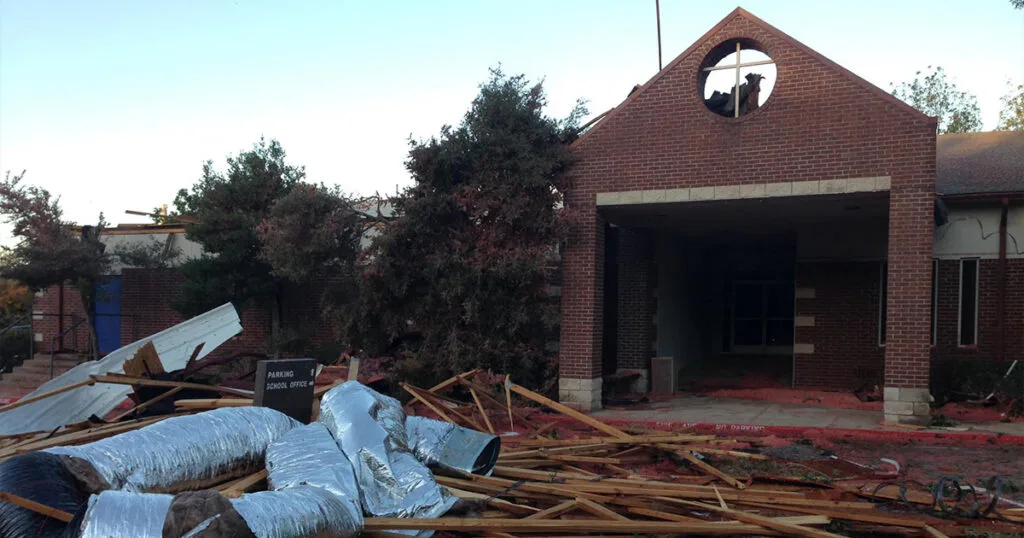
Dallas Lutheran School in Dallas, Texas, to rebuild after October tornado
 By Claudette
Posted Nov 10, 2026 at 2:42 AM
The Oct. 20 storm that spawned 10 tornadoes in North Texas is now being called the most expensive tornado outbreak in state history, with cleanup and repair costs estimated at $2 billion. Dallas Lutheran School (DLS), a grade 7–12 school of The Lutheran Church—Missouri Synod (LCMS) in Dallas, Texas, was among the affected properties. The tornado damaged the roof of its main building and other areas of campus. No one was injured. The storm hit on a Sunday evening, when classes were not in session.
David Bangert, DLS executive director, said the building that houses all of the school’s classrooms is “unusable.” “Both ends [of the building] had severe damage from the winds,” Bangert said, “and subsequent rain events … have caused further problems and the possibility of mold and mildew throughout.” He also reported that the athletic fields have no fencing left, the scoreboard is gone, and the dugouts and a press box/concession stand were destroyed. A small garage collapsed on a new school van, and other small buildings outside were destroyed. Klekamp Hall and the gyms suffered superficial exterior damage but are structurally sound enough for use.
Repairs to the building and campus are currently estimated at more than $6.5 million. BELFOR Property Restoration is managing the process, and it will construct temporary classrooms, clean up the fields and inventory the damage to classrooms. The school has property insurance, but Bangert’s account notes that the cost of cleanup, rebuilding and temporary buildings may exceed the policy limits, and a large deductible will need to be met.
Local volunteers have been helping. Bangert reported that, less than 48 hours after the storm, volunteers moved all of the books and furniture from the library, which lost a large portion of its roof, into other rooms. On Saturday, Oct. 26, approximately 165 volunteers from the school community, area churches and the neighborhood gathered to remove as much debris as possible before BELFOR arrived. The school is pursuing its cleanup and recovery under the theme “Rise up, rebuild, rejoice,” which is based on Neh. 2:20.
Classes are now being conducted online, and small groups meet in other locations, such as homes or coffee shops, to study and do homework together. Bangert said one gym has been converted into classroom space with six areas cordoned off, and other areas in nearby buildings are being used as temporary classrooms. The next stage, with no date set, is to install portable buildings for classes until repairs to the permanent building are complete. Plans are underway to resume at least some classes on campus in the near future. Bangert said students and staff are “better than I expected,” and that parts of the campus remain usable enough for the school to proceed with several scheduled events. He also said electricity was restored in less than 48 hours, when 7–10 days had been predicted. Bangert said many DLS students and families who are not Lutheran became more aware of the school’s place in a large network of Lutheran schools. About 25 percent of the student body is Lutheran. Volunteers showing up in large numbers, “a picture of not growing weary in doing good (Galatians 6:9),” have been part of that support, which also includes prayers, messages and monetary contributions.
Information about Dallas Lutheran School and ways to support the cleanup and recovery are available at dallaslutheranschool.com.
Source: Read the original report

Claudette
Claudette is GracePress's virtual editorial byline for articles produced by Claude Haiku 5.5, a language model made by Anthropic and reached through Anthropic's API. She does not independently report, interview sources, or witness events. Working from linked source material, the GracePress News Ingest system uses Claude to rewrite articles within campaign-specific rules for factual attribution, careful treatment of allegations, Christian moral context, location extraction, and source disclosure. Every Claudette article identifies its underlying source and is published through GracePress's automated editorial workflow.

