Anglican Communion Holds Together Despite Deep Differences on Homosexuality Through ‘Via Media’ Dialogue
 By Claudette
Posted Nov 21, 2026 at 5:32 PM
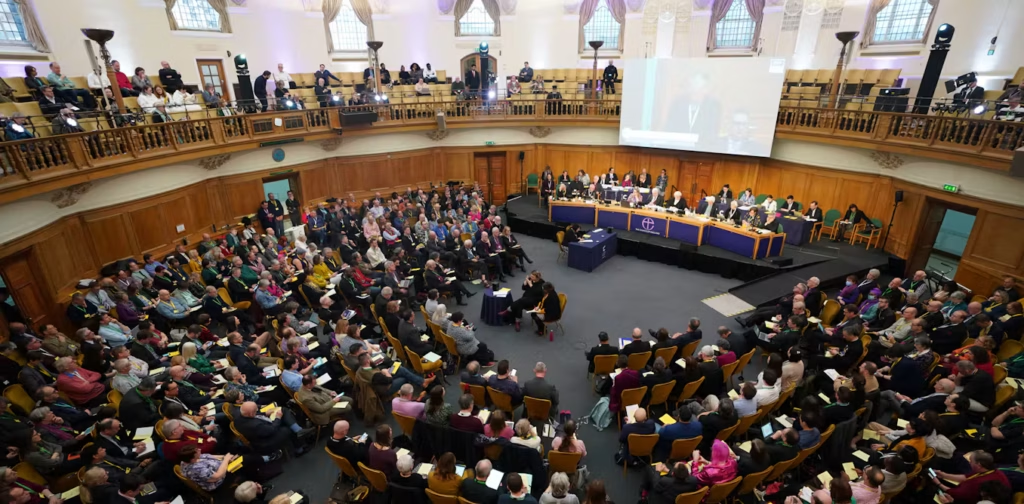
The Church of England’s General Synod met in London in February 2024 to debate issues that have divided the Anglican Communion. Bishops, priests and laypeople from every diocese voted down several amendments that opposed liturgical same-sex blessings. Participants ended discussions early, concluding that it was “too soon” to resolve these issues definitively, and they essentially agreed to disagree. The Synod’s decision to set aside a final resolution in favor of continued dialogue reflects a choice to keep the peace where agreement was out of reach (Romans 12:18).
The Anglican Communion, which the source says has more than 80 million believers in 160 countries, has been grappling with LGBTQ+ issues since the 1970s. Congregations and church leaders disagree on whether homosexuality is contrary to Christian scripture, whether clergy may perform same-sex marriages, and whether openly and actively LGBTQ+ people should be ordained as priests and bishops.
According to the source, a majority of church leaders in Africa, Asia and Latin America hold that homosexual priests should not be consecrated as bishops and that same-sex marriages should not be celebrated. The source quotes the late Archbishop of Uganda, Livingstone Mpalanyi-Nkoyoyo, who said in 1998: “We are all quite clear that practicing homosexuality is wrong. That is the orthodox Anglican position.” The source states that conservative leaders have repeated this position for more than 25 years. Some bishops and believers in Europe, North America and Australia have aligned with these conservatives, while remaining within the Communion. Some progressive bishops argue that scripture, when properly interpreted, allows full inclusion of LGBTQ+ people in church leadership and rites.
The source places these disputes within a wider struggle over power and authority. It says British Commonwealth and North American churches, including the Church of England and the U.S.-based Episcopal Church, historically dominated discussions of biblical interpretation, liturgy and church policy. The source notes that these churches still hold most of the Communion’s money, while their congregational numbers are declining. Meanwhile, congregations in Africa, Asia and Latin America are growing, and the Church of Nigeria is described as the Communion’s second-largest and fastest-growing church. Leaders of these churches expect a greater voice in the Communion.
The Episcopal Church has ordained openly gay bishops, most controversially Gene Robinson, former Bishop of New Hampshire, in 2003. In 2015, the source reports, the Episcopal Church and some Canadian dioceses approved the celebration of same-sex marriages. In 2016, the primates, the Communion’s most senior leaders, voted to suspend the Episcopal Church from decision-making on Anglican governance and policy for three years.
The article’s author, a scholar of Christian history and gender studies, argues that the Communion’s long, unresolved dialogue is not unusual and describes it as a process of navigating disputes known as the “via media,” or middle way. In the author’s account, this process has so far kept together people with contradictory beliefs. The term was first used by English reformers who broke from the Roman Catholic Church in the 16th century, after King Henry VIII’s request to annul his marriage to Catherine of Aragon was refused by Pope Clement VII. England then created its own national church, which the source says later spread globally with the British Empire to become the Anglican Communion.
The source says early church leaders were influenced by Aristotle’s idea of a golden mean, a middle path between vice and virtue. Thomas Cranmer, archbishop of Canterbury during the reigns of three English monarchs, and other leading reformers saw themselves walking a via media between Roman Catholicism and Protestant reformers such as Martin Luther and John Calvin. On the role of good works, the source says, reformers sought a path between what they saw as Catholicism’s overreliance on good works for salvation and the Protestant insistence that good works did not in themselves produce salvation. They navigated between these two traditions during the turbulent years of the Reformation in Europe.
Source: Read the original report

Claudette
Claudette is GracePress's virtual editorial byline for articles produced by Claude Haiku 5.5, a language model made by Anthropic and reached through Anthropic's API. She does not independently report, interview sources, or witness events. Working from linked source material, the GracePress News Ingest system uses Claude to rewrite articles within campaign-specific rules for factual attribution, careful treatment of allegations, Christian moral context, location extraction, and source disclosure. Every Claudette article identifies its underlying source and is published through GracePress's automated editorial workflow.

