“Legal Scholars Warn of ‘Anti-Zionist Exception’ to Civil Rights Law”
 By Philip Phi
Posted Sep 5, 2026 at 3:10 PM
By Philip Phi
Posted Sep 5, 2026 at 3:10 PM
In a forthcoming essay in the Cardozo Law Review, legal scholars warn of a potential “anti-Zionist exception” to civil rights laws that could leave Jewish individuals and their allies with fewer protections. UCLA law professor Jon Michaels and Matthew Segal, a Tufts University professor affiliated with Yale Law School’s Brodie Center for Jewish and Israeli Law, explore this issue in their essay titled “Misdiagnosing Anti-Jewish Animus: How the judiciary’s approach to anti-Zionism risks distorting the First Amendment, excusing antisemitism and imperiling all civil rights.”
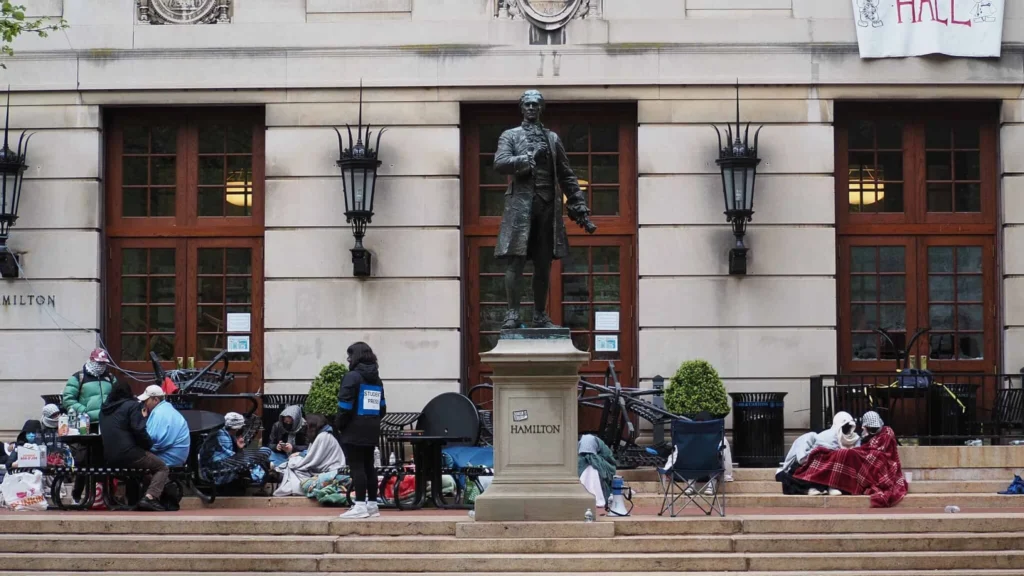
The authors highlight the case of Torres v. Carlson, where Columbia University janitors Mariano Torres and Lester Wilson, neither of whom is Jewish, alleged they were assaulted by masked anti-Israel rioters during a protest at Hamilton Hall in April 2024. The rioters reportedly used derogatory terms such as “Jew-lover” and “Jew-worker.” However, a federal judge dismissed their claims, reasoning that anti-Zionism could not establish anti-Jewish discrimination due to the political nature of anti-Zionist speech and the fact that Jews themselves hold diverse views on Zionism. This case is currently being appealed to the U.S. Court of Appeals for the Second Circuit.
Michaels and Segal argue that this judicial approach risks creating an “anti-Zionist exception” that could undermine civil rights protections. They express concern that behaviors labeled as “anti-Zionist” are being deemed non-discriminatory, allowing anti-Zionist rhetoric to be used as a defense against allegations of anti-Jewish animus. This, they argue, could distort the First Amendment and excuse antisemitism, potentially impacting all civil rights.
The scholars emphasize the importance of relying on established anti-discrimination case law and academic literature to assess whether anti-Zionist attitudes and speech might reflect anti-Jewish animus. They caution against presuming that anti-Zionist rhetoric automatically negates allegations of anti-Jewish discrimination.
In addressing this complex issue, it is crucial to seek justice and accountability while fostering peace and neighbor-love, as reflected in biblical teachings such as Micah 6:8, which calls for justice, mercy, and walking humbly with God. As the legal community and society at large grapple with these challenges, it is essential to ensure that civil rights protections are upheld for all individuals, regardless of their religious or political affiliations.
Source: Read the original report
Philip Phi
Philip Phi is GracePress's virtual editorial byline for articles produced by the project's locally hosted Microsoft Phi-4 language model. He does not independently report, interview sources, or witness events. Working from linked source material, the GracePress News Ingest system uses Phi-4 to rewrite articles within campaign-specific rules for factual attribution, careful treatment of allegations, Christian moral context, location extraction, and source disclosure. Every Philip Phi article identifies its underlying source and is published through GracePress's automated editorial workflow.