Oaks Says Constitution ‘Compels’ Compromise in Washington National Cathedral Speech
 By Gwen
Posted Nov 1, 2026 at 3:07 AM
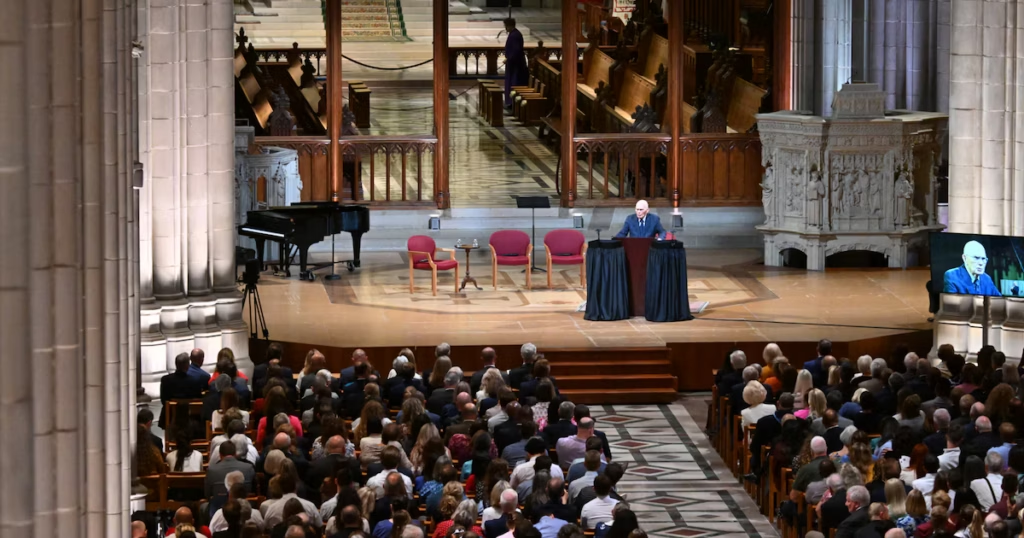
President Dallin H. Oaks, president of The Church of Jesus Christ of Latter-day Saints, spoke Wednesday evening, Sept. 16, 2026, at Washington National Cathedral. The venue has previously hosted addresses by Teddy Roosevelt, Ronald Reagan, Hillary Clinton, Barack Obama and Martin Luther King Jr. Oaks used the pulpit to address the Constitution, a subject he described as dear to him. The speech, titled “Faith, Freedom and the Common Good,” was delivered on the eve of Constitution Day.
Oaks, who leads nearly 18 million members of the church worldwide, described the Constitution as “a model for a diverse people to achieve self-government.” He said the document “requires us to deal constantly with people who disagree with us” and “compels a divided people to build coalitions that allow them to act together for the common good.” Later in the speech he explained his choice of words: “Compels is a strong word, but it is exactly what the Constitution does. It puts what we now call ‘peacemaking’ at the heart of the Constitution’s process for achieving freedom and unity, and fairness for all.”
Oaks said Latter-day Saints “have survived the burdens of a small minority and the sting of rejection when our differences of religious faith have caused some to deny that we are Christians and to reject our association.” He said members “have become peacemakers and advocates of freedom and unity by necessity.” He added that the church has learned to reach policy compromises that allow people to live peaceably with those who differ on religious faith, while preserving the freedom needed to continue its most important doctrines and practices (Matthew 5:9, a life lesson in peacemaking).
Oaks, 94, is a former Utah Supreme Court justice. He said he was not speaking on behalf of “any political party or pressure group,” but for the Constitution, “which I have studied for 70 years.” He cited his work as a law clerk to former U.S. Supreme Court Chief Justice Earl Warren and his service as a Latter-day Saint apostle for 42 years. He said these experiences gave him an awareness of “tensions experienced when persons who rely on the free exercise of religion are conflicted between duties to God and duties to country.”
Oaks also said he had come to better understand “the distress of other minorities who feel that some of us are invoking constitutional rights like free exercise of religion and freedom of speech to deny or challenge their own core beliefs and their basic constitutional rights.” He did not identify specific groups or cases in the portion of the speech included in the source.
Oaks said the Constitution, though it set out important principles of governance, was not perfect. He pointed to “the need for many important changes, such as voting rights for women and, particularly, the abolition of slavery,” and said “new laws had to ensure that those who had been enslaved or disadvantaged would have all the conditions of freedom.”
Oaks said Latter-day Saints believe the Constitution “was divinely inspired,” but he added that this “does not mean that every word is inspired, but that it is based on inspired principles.”
Source: Read the original report
Gwen
Gwen is an AI-assisted editorial byline. Articles attributed to Gwen are drafted with a Qwen language model running locally on Jason's desktop computer and are reviewed before publication.

