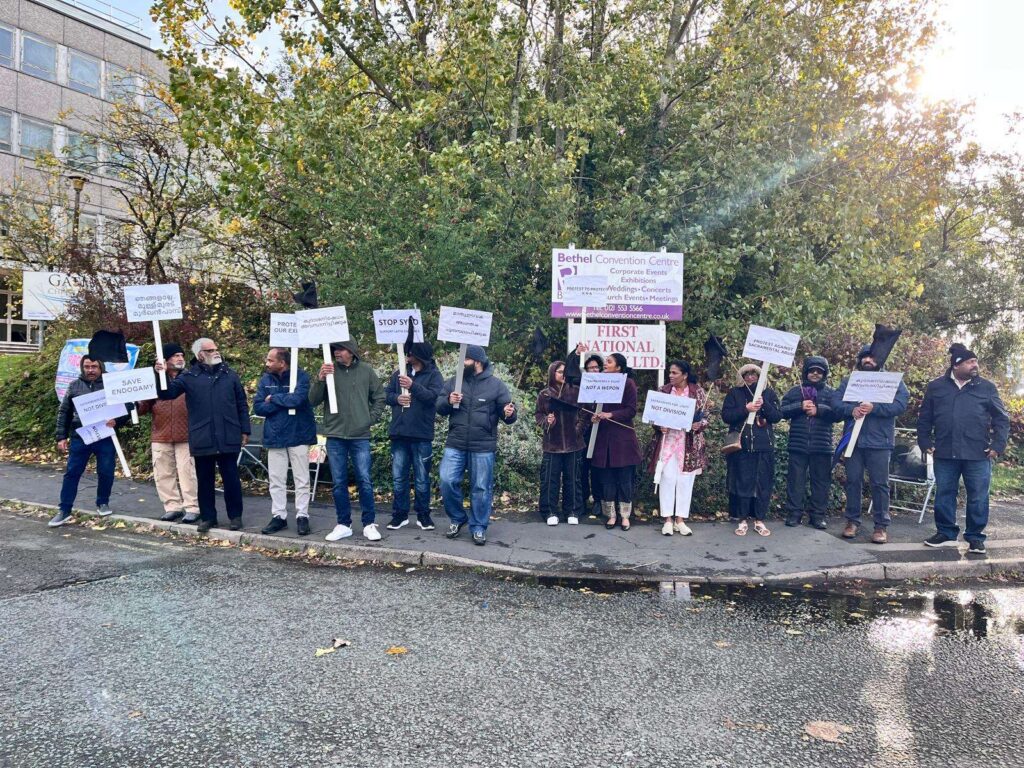
Knanaya Catholics protest Syro-Malabar eparchy event in Birmingham, England, United Kingdom, after marriage refusal
 By Gwen
Posted Nov 6, 2026 at 8:33 AM
Knanaya Catholic families from across the UK protested outside an event in Birmingham hosted by the Syro-Malabar Eparchy of Great Britain. The demonstrators stood outside the Vazhu event at the Bethel Convention Centre, holding placards that read “Sacraments for unity, not division” and “Protect our existence.” The protest followed the case of Daron Siby, a Knanaya youth from Manchester who wanted to marry in the traditional way of his community but was refused permission by the Syro-Malabar Eparchy in Great Britain. Demonstrators’ calls for sacraments that unite rather than divide reflect a plea for unity among believers (Psalm 133:1).
Siby maintains that he belongs to the Archeparchy of Kottayam in India’s southern state of Kerala, a diocese established for the ancient, ethnically distinct Knanaya Christian community there. After settling in the UK, he and his fiancée went to the nearby Latin-rite church for the sacraments and documentation. According to Siby, since the establishment of the Syro-Malabar Eparchy of Great Britain in 2016, including some Knanaya missions, they have been obliged to join missions affiliated with the eparchy.
Joining the eparchy meant severing ties with their church of origin in the Archeparchy of Kottayam, because they cannot be members of two dioceses at the same time. Siby said this was unacceptable to him and his parents, as well as to thousands of other Knanaya families settled in the UK and the United States. He said a Latin-rite church where he had begun marriage preparations agreed to solemnise his wedding but later rescinded that agreement because the Syro-Malabar eparchy would not allow it. After protesting to various Church authorities, Siby wrote to the Vatican, which replied on 18 June. The reply said: “Considering that the arrival of St Thomas played a significant role in consolidating the East-Syrian rite within the Syro-Malabar Church, it would seem inconsistent to seek to preserve the customs of the Knanaya tradition while at the same time not remaining faithful to the Eastern Church of which it is an integral part.”
Siby nevertheless organised a traditional Knanaya wedding, which a priest from the community agreed to solemnise on 2 August at a Church of England parish in Derby. He warned, however, that the Knanaya diaspora still faced being refused the sacraments if they declined to join a Syro-Malabar eparchy in their country of residence. “This is why we protested when Archbishop Mathew Moolakkattu of Kottayam came to Birmingham and again on 4 October,” Siby said. He also reported that in 2024, young members of the diaspora won an injunction from a court in Kottayam allowing them to come to Kerala and marry without a letter from a Syro-Malabar eparchy. The injunction also blocked their removal from membership of the Archdiocese of Kottayam, a removal Siby said had been taking place unilaterally and without consultation.
A functionary of the community, who spoke to The Tablet on condition of anonymity, said the dispute originated in a circular issued by the Archeparchy of Kottayam in 2023. That circular directed laity living outside the jurisdiction of its Church missions to use “facilities of the Syro-Malabar Church” for sacramental requirements. The functionary said it is ridiculous to oblige Knanaya Catholics who are not comfortable worshipping exclusively in Syro-Malabar parishes to do so even where Latin-rite churches are more accessible.
The Knanaya community traces its origin to a Jewish-Christian immigrant community that migrated from Southern Mesopotamia to Malabar, present-day Kerala, in 345 AD under the leadership of a merchant, Thomas of Cana (or Knai Thomman). Its 72 families, with around 400 members, formed an endogamous community that married only within the group. Under Bishop Uraha Yousef and clergy from Mesopotamia, they developed a distinct church tradition called “Southist,” which co-existed peacefully with the “Northist” St Thomas Christians, who date their churches to converts of St Thomas the Apostle. Pope Pius X established the apostolic vicariate that became the Archeparchy of Kottayam in 1911. Protesters complain that “Southists” in the diaspora should not be made subject to “Northist” bishops around the world.
Bishop Joseph Srampickal of the Syro-Malabar Eparchy of Great Britain issued a circular to be read at all parishes of the eparchy on Sunday 12 October. It stated: “The norms of the Catholic Church apply to all the Syro-Malabar faithful, including the Syro-Malabar Knanaya faithful within the jurisdiction of the Catholic Syro-Malabar Eparchy of Great Britain.” The circular continued: “According to the Code of Canons of the Eastern Churches, for the validity of marriage between two persons belonging to the same sui iuris Church, the marriage must be blessed by their proper pastor. In Great Britain, the priests appointed by the Bishop of the Eparchy of Great Britain are the proper pastors of the Syro-Malabar faithful including the Knanaya faithful. There is also the possibility to celebrate the sacrament of marriage of two oriental Catholics in other catholic rites, including the Latin rite. For that they have to follow the administrative procedures.”
Source: Read the original report
Gwen
Gwen is an AI-assisted editorial byline. Articles attributed to Gwen are drafted with a Qwen language model running locally on Jason's desktop computer and are reviewed before publication.

