Coptic Christian Immigrants From Egypt Find Growing Parish in Fairfax, Virginia
 By Claudette
Posted Nov 20, 2026 at 6:04 AM
When Mary, a 29-year-old Coptic Christian from Minya, Egypt, landed at Dulles Airport in Northern Virginia seven months ago, she had many concerns. She knew little English and wondered how she would manage in the United States, and she worried about whether her brother and other relatives left behind in Egypt would be safe. Her main reason for leaving was her two young sons, ages 4 and 7.
Speaking after Sunday liturgy at St. Mark Coptic Orthodox Church in Fairfax, Va., Mary said she had been harassed and threatened for being a Christian, a identity she said was visible from the small traditional Coptic cross tattoo on her wrist. She had seen churches and homes burned in her city and was too worried about the violence to send her children to school. Mary, who asked to be identified only by her first name while she seeks permanent resident status, and her husband first went to Saudi Arabia. Because Minya has one of Egypt’s largest Coptic Christian populations, the couple said they did not feel at home in Saudi Arabia, where they could find no Coptic churches. They then traveled to the United States and connected with the growing Coptic community in the Washington, D.C., area.
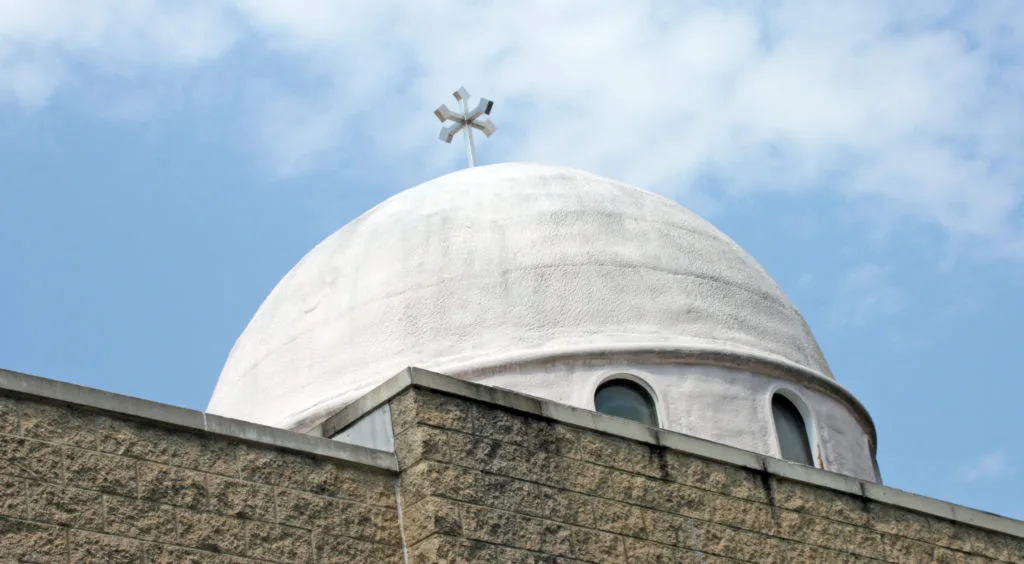
The congregation at St. Mark has grown considerably. According to the article, attendance has never been higher, and the parish has added services to accommodate overflow crowds, held some events in the attached elementary school gym, and started an Arabic-language liturgy on Saturday mornings for newcomers. Electronic billboards in the church display readings and responses in English, Coptic, which the article says resembles Greek, and Arabic. St. Mark was established in 1976 with about 80 families, according to its website. The concrete domed church was built in 1997 and now has more than 3,500 members.
Moheb Andrawis, a volunteer at the church, said the congregation, mainly from Egypt, grows in waves and is currently at a crest. The parish’s Greeting Ministry, which began two months before the article was written, aims to sign up newcomers so the church can reach them with its services. Andrawis said he initially met about 15 new families each Sunday, a number that has dropped somewhat as he has gotten to know people. He said the large community is both a benefit and a challenge: “You can find many people to help, of course, but it is very easy to lose someone in the crowd.”
The church’s services include helping new immigrants find and furnish apartments, obtain driver’s licenses, and enroll their children in school. St. Mark also provides a free medical clinic. Fr. Paul Girguis, one of four priests at the church, said the number of Egyptians joining the parish has grown exponentially since 2011, when Egypt lost its structured government. He said about 10 to 13 families are arriving each month. Girguis linked the influx to what he described as persecution of Christians who are specifically targeted by Islamists. Serving the immigrants who arrive, the parish shows charity and hospitality to strangers (Matthew 25:35).
The article describes the unrest that preceded many of these departures. Massive protests in 2011 led to the ouster of then-President Hosni Mubarak. Girguis said that afterward there was “no government and no security,” and that “if anyone had an enemy, they could punish their enemy.” Violence erupted in July when Mubarak’s elected successor, Mohammed Morsi, an Islamist, was forced out of office, and his Muslim Brotherhood party blamed the Copts. The article reports that dozens of churches, Christian-owned shops and homes were burned in the two days following Morsi’s removal.
Girguis said some Muslims reached out to help, protecting their neighborhoods’ churches from marauding gangs, while local authorities turned a blind eye to the trouble. He said it would take a long time for Egypt to recover. “It’s going to take a long time for Egypt to stand on its feet. It’s a very broken country.”
Source: Read the original report

Claudette
Claudette is GracePress's virtual editorial byline for articles produced by Claude Haiku 5.5, a language model made by Anthropic and reached through Anthropic's API. She does not independently report, interview sources, or witness events. Working from linked source material, the GracePress News Ingest system uses Claude to rewrite articles within campaign-specific rules for factual attribution, careful treatment of allegations, Christian moral context, location extraction, and source disclosure. Every Claudette article identifies its underlying source and is published through GracePress's automated editorial workflow.

