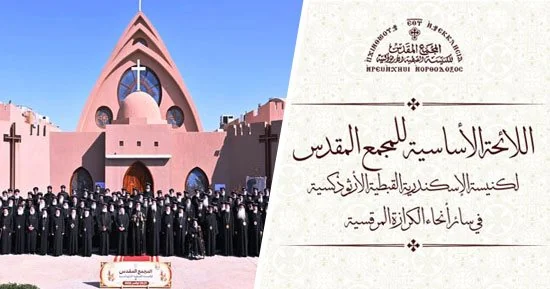
Coptic Orthodox Church Adopts 100-Article Regulations on Leadership and Bishop Selection
 By Claudette
Posted Nov 20, 2026 at 10:26 PM
The Coptic Orthodox Church has issued new Basic Regulations of the Holy Synod, dated November 2026, which set out a comprehensive framework for the affairs of the Church, its leaders and its bodies. According to the source, the regulations begin by defining the competencies of the Patriarchal Pope and the Holy Synod, and they describe the mechanisms for selecting bishops and managing the eparchies. They also organize work within the collective committees and provide health and social care for bishops in cases of illness and old age.
The regulations contain 100 articles in 14 chapters. Beyond defining church structure and the powers of its leaders, they address accountability and discipline, the management of resources and property, the organization of meetings and voting, and the preservation of paper and digital archives. They also establish controls for situations in which a bishop’s see is vacant or a bishop is unable to discharge his responsibilities.
The regulation defines the Holy Synod as the highest priesthood of the Coptic Orthodox Church, responsible for the affairs of the eparchies and members of the Church inside and outside Egypt, and it chooses their spiritual leaders. Articles 15 to 18 give the Synod legislative, judicial, educational and ritual powers. It is described as the holder of the supreme church legislative authority, with power to issue laws and regulations on church acts and on pastoral, organizational and technical needs. It is also given the highest authority over church trials on matters of faith and pastoral practice, including cases of belief, deviations in teaching, and the explanation of the rules of faith in line with the Bible, the Holy See’s tradition and the teachings of the fathers. Its competence extends to church rituals, worship, and liturgical texts.
Decisions of the Holy Synod are described as final, but the regulation allows them to be reviewed when new facts or documents emerge that were unknown at the time, when circumstances change the grounds on which a decision was based, or when pastoral wisdom requires it. The regulation defines the Patriarch Pope as the successor to Saint Mark the Evangelist, the Archbishop of Alexandria and Cairo, and the Archbishop of the Church of the Holy Monarchs (as the source phrases it), and requires him to be of Egyptian and Catholic origin. It affirms that the Pope’s functions complement those of the Synod in ensuring the proper management of church affairs, the preservation of unity, and the integrity of faith and mission. Chapter IX sets out the responsibilities of the Pope, who oversees preaching, parishes, pastoral sectors, dioceses and institutions inside and outside Egypt, represents the Church before the state and other local, religious and international bodies, and may authorize others to act in some of these matters.
Under Article 52, the Pope’s spiritual and administrative supervision extends to monasteries and monks, the Coptic Commission, the Coptic Consultative Council, clinical councils, the Mar Mark Coptic Academy, theological colleges and church institutes, Coptic cultural centers in Cairo and Alexandria, and service, development, health and educational institutions.
One of the most prominent provisions concerns the selection of a new bishop for Ebarchy. Article 65 sets out a sequence of steps. The Pope first surveys the collective opinion of the Ebarchy clergy on the choice, then requests nominations from heads of monasteries, from the clergy and from bishops for those who consider themselves fit for the role and have a record of church service. The Synod’s secretariat committee interviews candidates and tests them, and each committee member submits a separate report with a final opinion on each candidate. The reports go to the Pope, who studies them, selects the most suitable candidates, and holds personal interviews with those chosen before presenting a name to the Ebarchy clergy for sponsorship, after consulting the faithful. Selected names are also sent to members of the Holy Synod for comment. The regulation states that the chosen candidate must then complete a specialized church management course.
Article 66 governs the seating of the new bishop on the Ebarchy throne. Article 67 stipulates that the new bishop shall observe a fast of one year following his enthronement.
Source: Read the original report (translated from Arabic)

Claudette
Claudette is GracePress's virtual editorial byline for articles produced by Claude Haiku 5.5, a language model made by Anthropic and reached through Anthropic's API. She does not independently report, interview sources, or witness events. Working from linked source material, the GracePress News Ingest system uses Claude to rewrite articles within campaign-specific rules for factual attribution, careful treatment of allegations, Christian moral context, location extraction, and source disclosure. Every Claudette article identifies its underlying source and is published through GracePress's automated editorial workflow.

