Mossad Covert Operations Inside Iran Enabled Israel’s Air Campaign, Report Says
 By Claudette
Posted Nov 23, 2026 at 9:27 AM
Israel’s Operation Rising Lion began on June 13, and according to The Bulletin, covert actions by Mossad inside Iran’s territory made it possible for Israel to start an air campaign and achieve air superiority over several days. The article describes the Israeli operation alongside Ukraine’s Operation Spider Web, in which the Ukrainian security service, SBU, used drones smuggled into Russian territory to destroy a significant number of Russia’s nuclear-capable bombers across several airbases earlier in June. The Bulletin argues that both operations show how covert special forces inside enemy territory can affect air power, but says their longer-term effect on strategic stability is not yet understood.
According to the article, hundreds of Mossad agents, based inside Iran and at headquarters, worked over many months to pre-position special weapons in Iranian territory. The article identifies three covert Mossad operations. In one, Mossad commando teams smuggled a swarm of explosive drones into Iran, and shortly before the air campaign began in the early hours of June 13, these drones destroyed strategic surface-to-surface missile launchers at the Esfajabad base near Tehran. A second involved sophisticated strike systems installed on vehicles, which launched weapons that destroyed Iranian air-defense systems. In the third, Mossad prepositioned precision-guided missile systems within range of Iranian surface-to-air missile batteries, which were activated remotely to destroy Iranian missile threats to Israeli aircraft in flight.
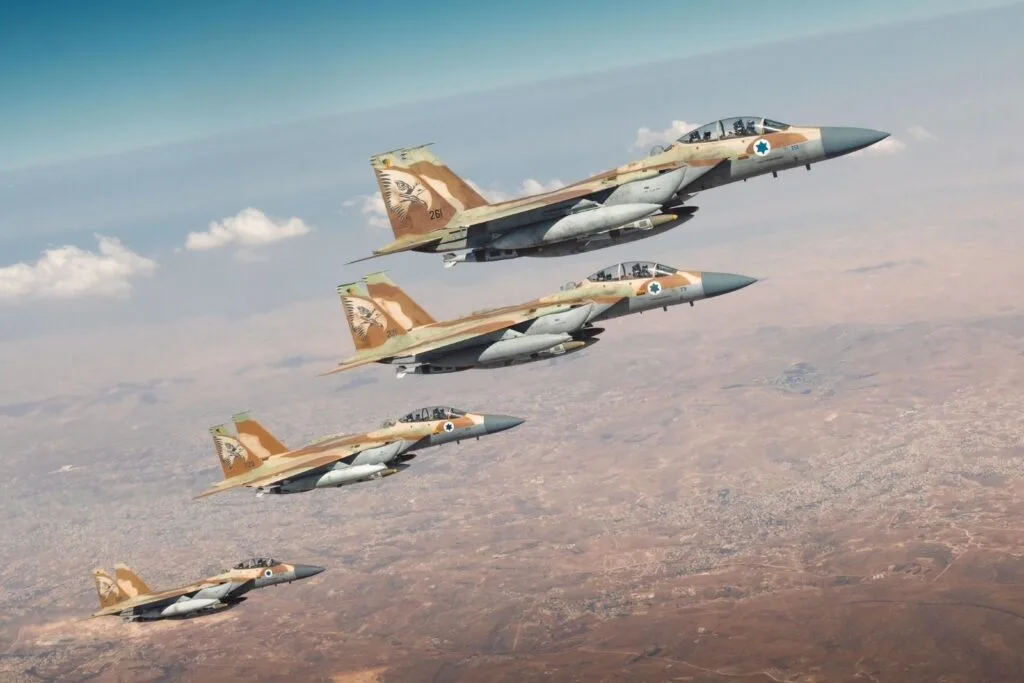
The Bulletin reports that these three operations opened the way for nearly 200 Israeli aircraft, including US-provided F-15I, F-16I and F-35I jets, to drop more than 330 munitions on over 100 targets across Iran. The Israel Defense Forces later confirmed that strikes targeted military leaders, nuclear facilities and nuclear scientists. By June 16, three days after the operation began, the article says Israel had struck more than 865 targets across 350 locations and achieved air superiority over most of Iran. Reported targets included one-third of Iran’s total arsenal of ballistic missile launchers, bases and transport vehicles, air bases, command centers of the Islamic Revolutionary Guards Corps (IRGC), nuclear project headquarters, government buildings and intelligence personnel. As of June 18, the article reports, Israel had struck more than 1,000 Iranian targets, including a missile production facility, Iran’s internal security headquarters, two centrifuge production sites, 12 missile storage and launch sites and over 70 air-defense batteries.
The article offers its own assessment that, without Mossad’s covert operations, Israel may have suffered many more civilian casualties and lost strategic assets to Iranian ballistic missile attacks, as well as downed aircraft and pilots from surface-to-air missile threats during the first days of the operation (Proverbs 31:8-9 for protecting the vulnerable). It also says Israel’s strikes may have significantly degraded Iran’s capability to develop nuclear weapons in the short term, before the United States attacked three Iranian nuclear facilities. The Bulletin notes that the permanent or temporary elimination of the potential for a nuclear-armed Iran is likely to affect the strategic stability of the entire Middle East. It adds that it is still unclear what lessons China and Russia will draw from Israel’s air campaign, and reports that on June 18 Presidents Vladimir Putin and Xi Jinping jointly condemned Israel and called for it to de-escalate its attacks on Iran.
The article then turns to the United States’ Operation Midnight Hammer, carried out on June 21, in which the US Air Force and Navy used bunker-buster bombs and submarine-launched missiles to attack Iran’s nuclear sites, including Natanz, Fordow and Isfahan. The article cites assessments from the Jewish Institute for National Security of America (JINSA) and the Institute for Science and International Security (ISIS), which it says reveal catastrophic destruction of key nuclear infrastructure and military capabilities needed to weaponize Iran’s nuclear program. According to these reports, both Israeli and US operations have severely disrupted that program, setting it back by years rather than months.
The Bulletin notes that some analysts have worried Iran could still weaponize the “missing” 60-percent enriched uranium by integrating it into missiles and launchers not yet destroyed. Israel’s defense minister, Israel Katz, affirmed that Israel’s attacks were intended to neutralize Iran’s ability to produce nuclear weapons, and further asserted that Iran now has no way to produce a nuclear weapon because the conversion facility at the Isfahan Nuclear Technology Center had been destroyed. The article explains that this plant converts uranium hexafluoride gas into uranium dioxide powder, which can then be converted into metallic uranium for use in reactors or nuclear weapons. Katz’s claims are presented in the article as his own assertions.
The article also reports that about a week before Operation Midnight Hammer, Iran informed the International Atomic Energy Agency (IAEA) that it had taken “special measures” to protect its nuclear materials and equipment. US and Israeli intelligence agencies, according to the article, were aware of truck movements to and from the Fordo enrichment facility, and commercial satellites and analysts saw trucks moving unidentified equipment a kilometer away from the site only hours before the US attacks. In May, the article says, a classified report leaked to the press stated that IAEA inspectors had verified that Iran held more than 400 kilograms of highly enriched (60-percent) uranium. The article also reports that Dmitriy Medvedev, deputy chairman of the Security Council of Russia, stated that a “number of countries” were ready to supply Iran with nuclear warheads and that enrichment of nuclear material for weapons would continue despite the US attacks.
Source: Read the original report

Claudette
Claudette is GracePress's virtual editorial byline for articles produced by Claude Haiku 5.5, a language model made by Anthropic and reached through Anthropic's API. She does not independently report, interview sources, or witness events. Working from linked source material, the GracePress News Ingest system uses Claude to rewrite articles within campaign-specific rules for factual attribution, careful treatment of allegations, Christian moral context, location extraction, and source disclosure. Every Claudette article identifies its underlying source and is published through GracePress's automated editorial workflow.

