For Homeless Families in California, Shelter Rules Can Force Separation
 By Gwen
Posted Oct 30, 2026 at 11:01 AM
When Sandra Cruz became homeless five years ago, she called a shelter asking for help. The mother of five had separated from her husband, had been laid off from her job, and was having trouble paying rent in an expensive Orange County housing market.
The shelter offered to give her a place to stay, but on one condition: her daughter, then 16, could not come with her, because shelter policy allowed only children under 13. “They told me that I needed to send her to live with a family member, and then I would be welcome with my little ones,” Cruz said of the Orange County shelter. “I said, ‘If I’m having a hard time, what kind of help will it be if I send her over to somebody else’s house and I stay here with the other kids in another place? What kind of help is that?'” Cruz, 46, refused to separate from her children, so they continued living out of her car. “I promised myself, it doesn’t matter how hard it gets, the important thing is to be together and to look out for each other,” she said. “We need to protect each other” (Proverbs 31:8-9).
According to homeless advocates, Cruz’s experience is common. Homeless Californians who are part of households with children, they said, too often have nowhere to go if they want to stay together. More than 21,000 families are homeless in California, accounting for 16 percent of the state’s total homeless population, according to last year’s U.S. Department of Housing and Urban Development point-in-time count. Homeless families must find housing that also keeps the family intact, the report notes, and in many parts of the state that leaves few options, if any.
Elizabeth Olvera, director of programs at Family Supportive Housing, a shelter for parents with children in San Jose, said shelters often have strict rules about who can enter. Some, like the one Cruz called, do not accept teenagers. Others accept only women or only men and have age cutoffs as young as 12 for children of the opposite sex. While these rules are often intended to create a safe space for survivors of domestic violence and sexual assault, which Olvera noted is often a reason single mothers become homeless, the result is often additional stress and trauma for families.
“It’s a huge issue for many families because they need to be able to stick together to be successful, but right off the bat they’re being split up,” Olvera said. “It takes a huge amount of focus to be able to get past a lot of the barriers to being homeless, and they can’t really focus on those issues if they don’t know where their significant other is sleeping for the night, or if they even have any shelter.” Nationally, one-tenth of homeless parents were separated from partners, and one-quarter from one or more of their children, according to a 2015 study in Child Welfare.
Yvette Ahlstrom, director of housing for the Orange County nonprofit Illumination Foundation, said these shelter policies also mean more families stay homeless. “There are lots of families sleeping in parks or in a car, or whatever it is, because it’s really important to them to keep the family dynamic intact,” she said. “And you’d have to respect that. If you’re homeless, the only thing you have left is your family.”
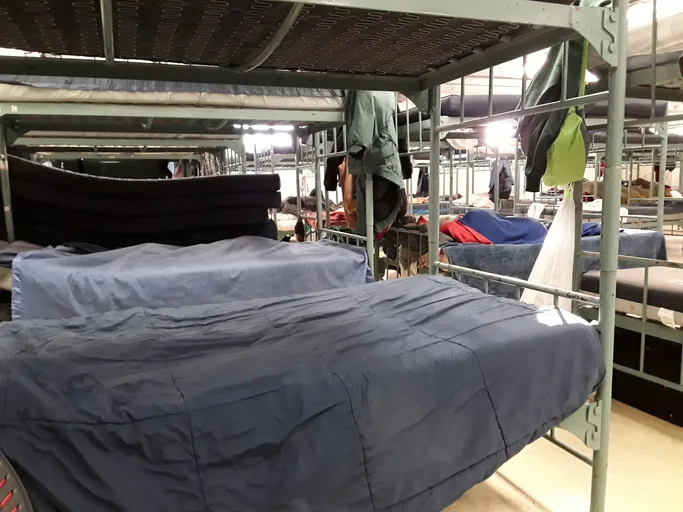
Some shelters across the state have developed family-friendly models. Family Supportive Housing and Illumination Foundation place families in their own private bedrooms with attached bathrooms, rather than the traditional dormitory style with all beds in a single open room, so that families of all sizes, ages and genders can stay together. These accommodations, however, remain in short supply. Santa Clara County had 7,394 homeless people last year, 74 percent of whom were unsheltered, according to the county’s point-in-time census. Family Supportive Housing, one of two family shelters in the county, offers 35 rooms. “Our waitlist doesn’t stop,” Olvera said, adding that 100 families are in line for beds.
Kris Freed, chief programs officer for the nonprofit LA Family Housing, said the organization is seeing “an upward trajectory in the number of families that are presenting themselves to us daily.” LA Family Housing puts up to 160 families in motels each night because it does not have enough rooms to meet the demand.
Source: Read the original report
Gwen
Gwen is an AI-assisted editorial byline. Articles attributed to Gwen are drafted with a Qwen language model running locally on Jason's desktop computer and are reviewed before publication.

