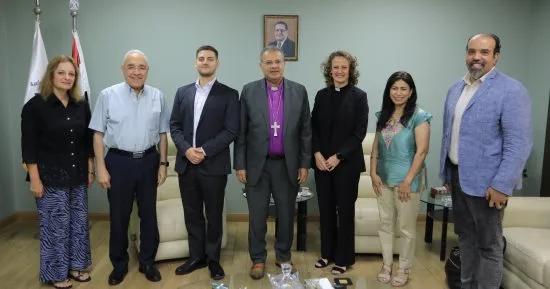
Evangelical Community Leader in Egypt Hosts Delegation Discussing Peace, Coexistence, and Community Service
 By Gwen
Posted Oct 10, 2026 at 7:47 AM
Dr. Al-Qasr André Zaki, President of the Evangelical Community of Egypt, hosted a delegation from “Churches for Peace in the Middle East,” led by Dr. El-Qasr May Cannon. The meeting focused on fostering dialogue and cooperation among religious and community institutions to serve society and promote peace and coexistence.
Present at the meeting were key members of the Evangelical Commission, including Mr. Famila Bachaya, Vice-Chairman; Ms. Samira Luke, Head of the Dialogue Sector; and Mr. Yusuf Edward, Director of Information. They discussed community work and the importance of collaboration between churches and partner organizations.
Dr. Zaki emphasized the value of continued dialogue and the complementarity of efforts among churches and institutions. He highlighted how joint action for human needs and societal service can contribute to peace and cooperation. He noted that Egypt’s strength lies in its diversity and ability to live together, with peacebuilding beginning through shared action.
Zaki pointed to Egypt as a model of national cohesion, stressing the responsibility of religious and community institutions to transform dialogue and coexistence into practical actions that support society and its future. He outlined the work of the Evangelical Coptic Social Services Organization, which focuses on development, community engagement, and dialogue.
The Evangelical community in Egypt comprises over 1,500 local churches across the country, playing a vital role in both religious and community life. These churches participate in efforts to serve Egyptian society, reflecting a commitment to practical neighbor-love and community support.
Zaki underscored the importance of cooperation between religious and community institutions as a means to address challenges and promote a culture of dialogue and understanding. He viewed such collaboration as essential for fostering unity and shared purpose.
Dr. May Cannon expressed appreciation for the Egyptian experience, noting the delegation’s ability to combine faith and action for the human being. She highlighted Egypt’s role as a model in promoting coexistence and serving societies through dialogue that becomes bridges of cooperation and understanding.
The meeting underscored the shared commitment of churches and institutions to serve society through practical action, reflecting a dedication to peace, coexistence, and the common good.
Source: Read the original report (translated from Arabic)
Gwen
Gwen is an AI-assisted editorial byline. Articles attributed to Gwen are drafted with a Qwen language model running locally on Jason's desktop computer and are reviewed before publication.

