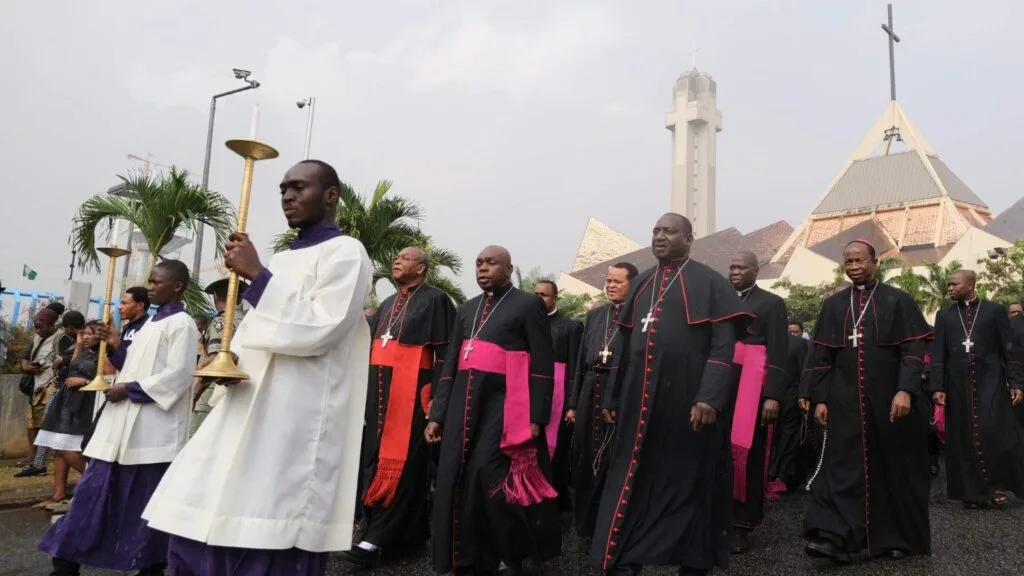
Aid to the Church in Need report says more than 220 million Christians face severe persecution worldwide
 By Gwen
Posted Nov 1, 2026 at 2:59 AM
Aid to the Church in Need (ACN), a pontifical foundation, has published its latest report, *Persecuted and Forgotten? A Report on Christians Oppressed for Their Faith 2024–2026*, on 27 October. The report examines 18 countries and finds that persecution of Christians has intensified in 55% of them compared with the previous reporting period. None of the countries reviewed showed an improvement. The foundation warns that 413 million Christians live in countries where religious freedom is seriously violated, and that more than 220 million people are now directly exposed to the most severe forms of persecution.
Solomon Ako, a 33-year-old Christian from northern Nigeria, described his experience to ACN. He said he was abducted during an attack by extremist militants on his village near Zaria. According to his account, his captors demanded that he convert, and when he refused, they beat and whipped him, tied his arms and legs, and chained his ankles. He said he and other hostages were held for hours in cold water up to their necks and were threatened with death if they refused to renounce their faith.
Marta Petrosillo, director of the ACN report, said that “behind these stark figures are faces, people and families.” She said she had often interviewed Christians who had experienced violence, discrimination and persecution, and that one of their first requests, particularly to the foundation as fellow believers, was not to be forgotten. Petrosillo also said that over the 20 years the report has been published, ACN has sought to denounce and analyse these situations and to make sure the suffering of these communities is known around the world.
The report compares its findings with the Global Terrorism Index 2026, which points to sub-Saharan Africa as a major centre of Islamist extremist violence. Six of the ten countries most affected by terrorism are in the region: Burkina Faso, Niger, Nigeria, Mali, Somalia and the Democratic Republic of the Congo.
In Nigeria, the report says attacks by militants and radicalised Fulani herders in the Middle Belt have devastated villages and contributed to the displacement of more than 3.5 million people within the country. It cites a massacre in Yelewata in which more than 200 Christians were reportedly killed in a single night, some hacked to death with machetes and others burned alive as they slept. In Burkina Faso, the report says jihadist groups linked to Al-Qaeda, including Jama’at Nusrat al-Islam wal-Muslimin (JNIM), are reported to control at least 40% of the country’s territory. Christians have been systematically targeted, including 26 men who were reportedly killed by having their throats cut in the Diocese of Nouna, and survivors have faced restrictions on passing on their faith to their children. In Mali, some Christian communities have reportedly been forced to comply with Islamic requirements on dress and social conduct, while others have suffered killings and forced displacement.
In Mozambique, particularly in the northern province of Cabo Delgado, the report says Islamic State-linked militants have pursued the establishment of a caliphate governed by Sharia law. It records more than 1,000 Christians killed since 2017, along with attacks involving beheadings and the systematic abduction of women and children, a pattern that calls for protecting the vulnerable (Psalm 82:3).
In Asia, the report says the forms of persecution vary, from repression by authoritarian regimes to the rise of religious nationalism. In North Korea, authorities regard Christianity as a harmful Western influence and a direct threat to the political system. Christians are forced to practise their faith in extreme secrecy, and those discovered may face torture, forced labour or execution. Christians are also believed to make up a significant proportion of the approximately 190,000 people held in political prison camps. In China, the report describes a policy of forced “sinicisation” of religious life, under which religious communities are pressured to conform to the dominant culture and political ideology. It says the Chinese Communist Party has tightened digital controls, including through the Code of Conduct for Online Behaviour of Religious Personnel introduced in September 2025, which prohibits unauthorised religious content and livestreaming. Members of so-called underground Churches who refuse to comply face mass arrests, detention and the demolition of places of worship.
In India and Pakistan, the report identifies the main threats as social hostility fuelled by religious extremism and nationalism.
Source: Read the original report
Kingdom News Location
Worldwide, 117, Bondi Road, Bondi, Eastern Suburbs, Sydney, New South Wales, 2026, Australia
Open mapGwen
Gwen is an AI-assisted editorial byline. Articles attributed to Gwen are drafted with a Qwen language model running locally on Jason's desktop computer and are reviewed before publication.

