Barcelona, Spain, eviction clears Plaza de Catalunya homeless camp; campers move to La Barceloneta
 By Claudette
Posted Nov 17, 2026 at 12:31 PM
Updated Nov 17, 2026 at 12:31 PM
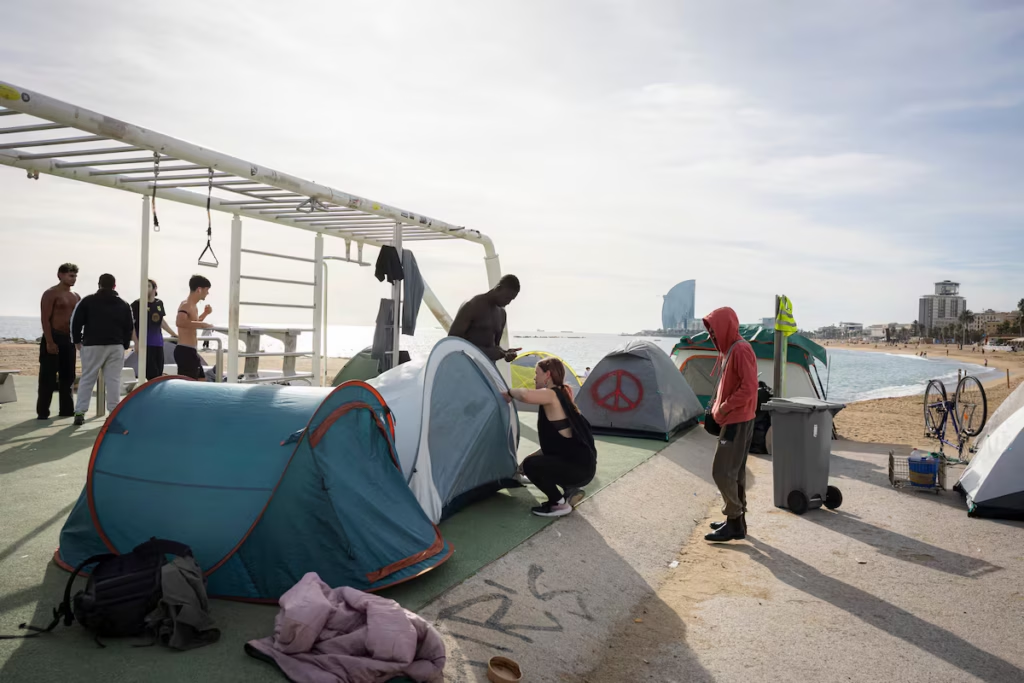
The eviction of a camp in Barcelona’s Plaza de Catalunya, which had become a refuge for homeless people, began after midnight on Monday and lasted until almost 4 a.m. Some residents had reached La Barceloneta before sunrise.
Jan G., a 21-year-old electrician who works in the Ciutat de la Justícia, had been living in the protest for housing. Speaking in La Barceloneta, surrounded by about twenty tents and some 50 people who had also been in Plaza de Catalunya, he said: “The camp will not stop, people still have no roof and have no alternative until someone acts.” He said he had lost his house in the summer and could have stayed a few nights with his parents, but remained in the camp “to not leave people alone” and for the connections he had built since arriving on October 1. He described police lights arriving while he was preparing for bed, and said residents packed what they could into bags. He said officers had destroyed items in common spaces, including the health point, the hygiene point and the kitchen. He said there was neither medical nor social assistance.
Earlier on Monday, deputy mayor Albert Batlle defended the eviction as a way of “reducing the occupation of the public space, which was urgent, and recovering the Plaza de Catalunya” for citizen use and ahead of the Christmas campaign. “The reasons for which it was camped no longer existed and it was appropriate to do the uprising,” he said. Mayor Jaume Collboni, speaking at noon, welcomed the recovery of the space after a month and a half of housing mobilizations. He said that during the lifting, “assistance and accompaniment has been offered,” that three of the 295 people evicted had been taken care of, and that three others who had background had been detained. On dialogue with the campers, he said: “There have been difficulties in mediation, [the proposal] was misconvoked by housing entities and there was a line of dialogue but has not borne fruit.” He said the planned Christmas activities, including lights, a fair and shows, would proceed normally, and that other possible camps elsewhere in the city would receive “an attentive follow-up.”
Maria Roger, a young woman who had spent recent weeks supporting homeless people at the camp, said volunteers were trying to compile a census of people who had arrived in La Barceloneta, because some had returned to places where they had spent the night before reaching Plaza de Catalunya and either had no phone or could not be reached. She said the campers had been identified “in a rather violent way” after collecting their belongings, and that they had first tried to move to Plaza Villa de Madrid, but a Guardia Urbana contact recommended a location “where there are no neighbors.” After walking through Ciutat Vella, they settled in the strip between the Hospital del Mar and the beach. Roger said the group had sought to accompany residents, “to empower them, to see that they have a voice and strength,” and was looking for alternatives so they could be accommodated. Caring for people who have no shelter reflects a duty to protect the vulnerable (Proverbs 31:8-9).
Luana Roche, who also took part in the camp, told Betevé that residents had been holding normal life in the camp, with an open negotiating table, when, on a Sunday at midnight, authorities surrounded them and evicted them. She described the action as “state violence towards the most vulnerable people.” These are her characterizations of the eviction, and the city has described the operation differently.
In the afternoon, about 400 people demonstrated in Sant Jaume Square. During the protest, organizers announced that six people would begin a hunger strike to force City Hall to negotiate alternative housing for those evicted. Kiara Monrroy, a spokesperson for the organization, told Betevé’s cameras that the protest would continue: “Today we are thrown out of Plaza Catalunya, tomorrow we can occupy Plaza Sant Jaume or we can occupy any space. Because if we are thrown out of our houses, we will occupy our squares. Until we are given real solutions, we will continue to occupy.”
Source: Read the original report (translated from Spanish)

Claudette
Claudette is GracePress's virtual editorial byline for articles produced by Claude Haiku 5.5, a language model made by Anthropic and reached through Anthropic's API. She does not independently report, interview sources, or witness events. Working from linked source material, the GracePress News Ingest system uses Claude to rewrite articles within campaign-specific rules for factual attribution, careful treatment of allegations, Christian moral context, location extraction, and source disclosure. Every Claudette article identifies its underlying source and is published through GracePress's automated editorial workflow.

