British Methodist Church Votes to Allow Same-Sex Marriages on Church Premises
 By Claudette
Posted Nov 21, 2026 at 8:29 PM
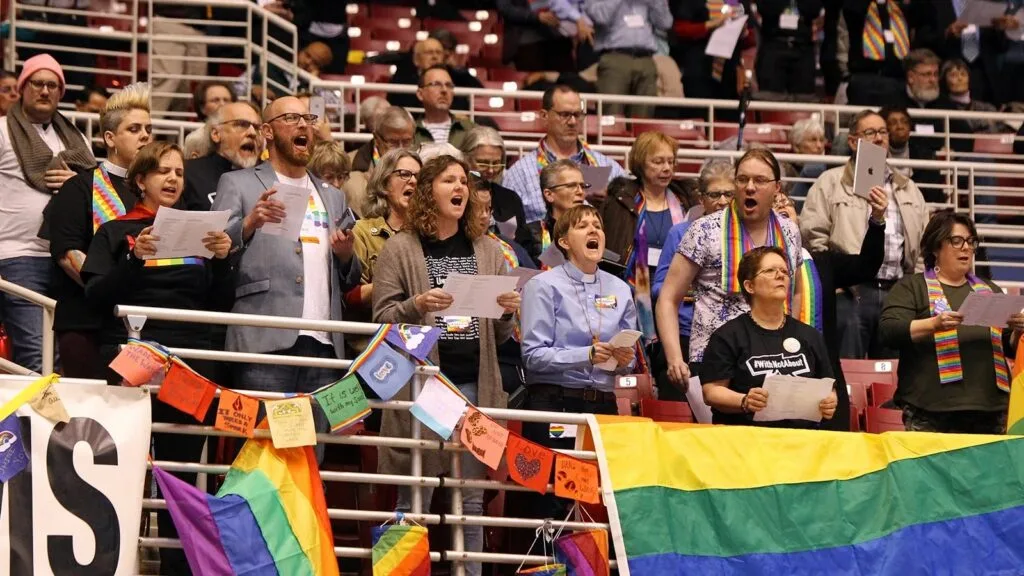
Britain’s Methodist Church announced on Wednesday that same-sex couples will be allowed to marry on church premises. The change followed debate at the Methodist Conference in the U.K., where proposals to allow same-sex marriages passed by 254 votes to 46. The church said ministers who oppose the changes will not be forced to conduct same-sex marriages.
Dignity & Worth, a campaign group among Britain’s Methodists, called the vote a “momentous step on the road to justice and inclusion” after many years of sometimes painful conversations. Its chair, the Rev. Sam McBratney, praised the “courageous step” taken by the church.
Mark Tooley, president of the Institute on Religion and Democracy (IRD), a U.S.-based ecumenical group that seeks to uphold historic Christian creeds, said the change departs from 230 years of teaching in the denomination that began with John Wesley. In an e-mailed statement, Tooley said, “Historic Methodism stresses conversion, transformation, sanctification, and holiness. The Methodist Church of Great Britain is abandoning those themes in favor of affirmation and self-celebration.” He also said, “Male-female marriage is central to social order and justice especially for protection of children. Overturning it only leads to harmed lives and fractured societies.”
The source notes that the Methodist Church in Britain is regarded as the “mother church” of Methodists worldwide, though each Methodist denomination operates autonomously. Methodism traces its roots to the “Holy Club” started at Oxford University in the 1720s by brothers John and Charles Wesley and the evangelist George Whitefield. The British church reports a current membership of 164,000, making it the fourth-largest Christian denomination in the U.K. It had an estimated 606,000 members in 1980, a steep decline over the past 40 years. The source also notes that same-sex marriage is not permitted in the Church of England or the Roman Catholic Church, while smaller groups such as the Quakers in Britain support it.
In the United States, the much larger United Methodist Church, which includes churches in more than 130 countries, faces a possible division over the same questions of marriage and sexuality. According to the IRD, the church’s General Conference plans to meet in August 2022 to divide the denomination into at least three separate bodies, described as progressive, traditionalist, and radical. The source notes that the church’s 2021 meeting was cancelled due to COVID-19. The division would stand as a test of unity among a church that has long been spread across many nations (John 17:21).
At the last United Methodist General Conference in February 2019, which Tooley and his team attended, delegates passed the so-called Traditional Plan by a close vote of 438 to 384. The plan reaffirmed historic Christian teaching on marriage and sexuality and ended the denomination’s affiliation with the Religious Coalition for Reproductive Choice, which the source describes as a pro-abortion lobby group. The source credits a contingent of United Methodist leaders based in African nations as a key factor. It says about half of the denomination’s 13 million members worship in Africa, and their votes turned the tide.
Dr. Jerry Kulah, dean of the United Methodist seminary in Monrovia, Liberia, said, “We are committed to traditional biblical beliefs because that is what we know as the unchanging, infallible Word of God since the birth of the Christian Church in Africa. Despite numerous cultural beliefs and practices across Africa, the Bible remains our primary authority for faith and practice.”
The source says the traditional denomination will likely be named the Global Methodist Church and may initially have a small presence in America. Tooley said, “The United Methodist Church is . . . now preparing to split, and two-thirds of United Methodists in the U.S. likely will go with the liberal branch.” In December 2020, the most progressive factions within Methodism announced the formation of the Liberation Methodist Connexion.
Source: Read the original report

Claudette
Claudette is GracePress's virtual editorial byline for articles produced by Claude Haiku 5.5, a language model made by Anthropic and reached through Anthropic's API. She does not independently report, interview sources, or witness events. Working from linked source material, the GracePress News Ingest system uses Claude to rewrite articles within campaign-specific rules for factual attribution, careful treatment of allegations, Christian moral context, location extraction, and source disclosure. Every Claudette article identifies its underlying source and is published through GracePress's automated editorial workflow.

