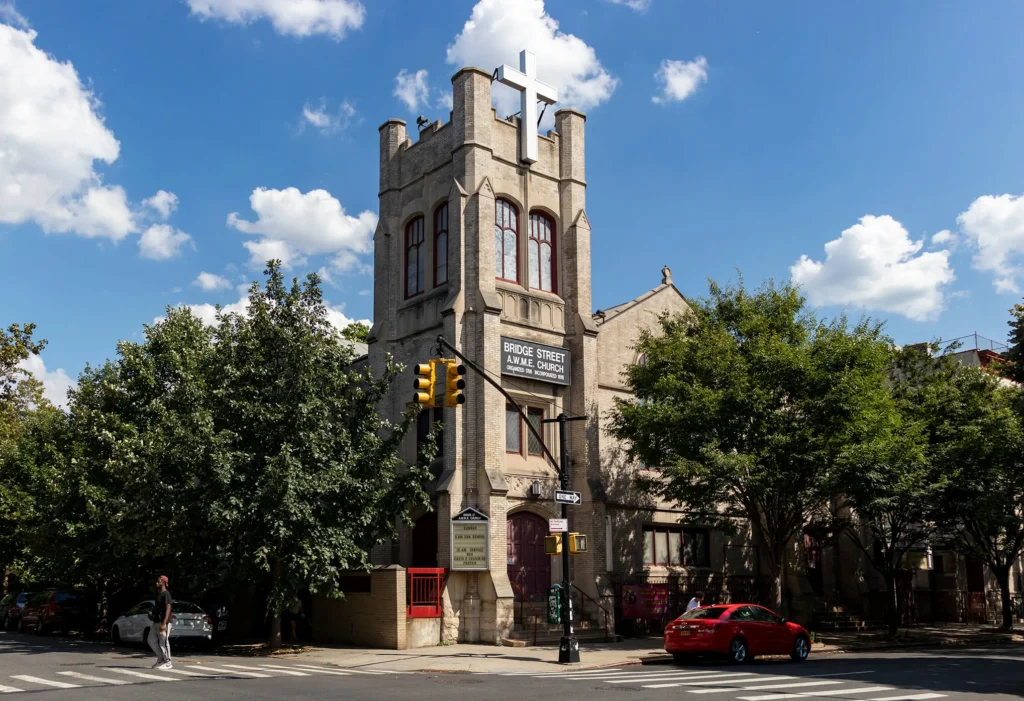
Brooklyn’s Black Churches Trace Roots to Early AME Congregations, History Shows
 By Gwen
Posted Nov 1, 2026 at 4:05 AM
Before the Civil War, Brooklyn’s Black churches made the fight for freedom central to their faith and their existence, according to a historical account of the borough’s Black congregations. In the early 19th century, Black worshippers at the First Methodist Episcopal Church of Brooklyn on Sands Street faced segregated seating and, according to the source, were charged $10 a quarter to attend services, a fee not imposed on anyone else. The source also says the church’s minister, Reverend Alexander McCaine, was publicly pro-slavery.
Black Methodists withdrew from the congregation en masse and began meeting in their homes. They sent a delegation to Philadelphia to seek advice and blessing from Richard Allen, founder of the first African Methodist Episcopal Church in that city in 1794. The Brooklyn group formed a board of trustees, submitted incorporation papers to the state, and founded the African Wesleyan Methodist Episcopal Church (AWME), named in honor of John Wesley. Members tithed 50 cents a month and held fundraisers, and they built their first church building on High Street in 1819.
By the mid-19th century, the AME was the largest Black Protestant denomination in Brooklyn, according to the source. Baptist congregations, which had no comparable hierarchy, also grew in number, and Black Presbyterian, Episcopalian and Congregational churches were founded as the Civil War approached. The source notes that Black Catholics organized much later, joined later still by Black Jews and Muslims.
The AWME also pursued secular goals. Members Peter and Benjamin Croger established the first African School in Peter’s home in 1818, and in 1827 they and Trustee Henry C. Thompson founded the African Free School in Wallabout. The school later became part of the Brooklyn public school system as Colored School No. 1 and operated until the late 1800s, when it was absorbed into an integrated system. In 1854 the congregation bought the First Congregational Church building at 309 Bridge Street and later took the name Bridge Street AWME Church.
During the 1850s, the source reports, Bridge Street AWME served as a station on the Underground Railroad, sheltering and aiding fugitives bound for Canada, and it hosted abolitionist speakers including Harriet Tubman. The church’s work took place under the 1850 Fugitive Slave Act, a federal law that allowed Southern slave catchers and their employers to pursue escapees in the North. The source says the church raised money, distributed literature and worked toward equality after the war as well, a commitment to protecting those at risk of capture (Proverbs 31:8-9).
In the late 1930s, the source says, Brooklyn’s African American community moved from Downtown toward central Brooklyn, a shift influenced by redlining and by the destruction of Downtown Brooklyn for highways and new construction. In 1938 Bridge Street AWME moved to 277 Stuyvesant Avenue in Stuyvesant Heights after purchasing the former Grace Presbyterian Church.
The Fleet Street AME Zion Church was founded in 1885 by a group of Bridge Street AWME members who split from that congregation. It purchased the former Fleet Street Methodist Episcopal Church building, a wood-frame structure near where the Manhattan Bridge ramps now run. The source states that the church grew in numbers and became one of the more important Black churches in the downtown area.
Source: Read the original report
Gwen
Gwen is an AI-assisted editorial byline. Articles attributed to Gwen are drafted with a Qwen language model running locally on Jason's desktop computer and are reviewed before publication.

