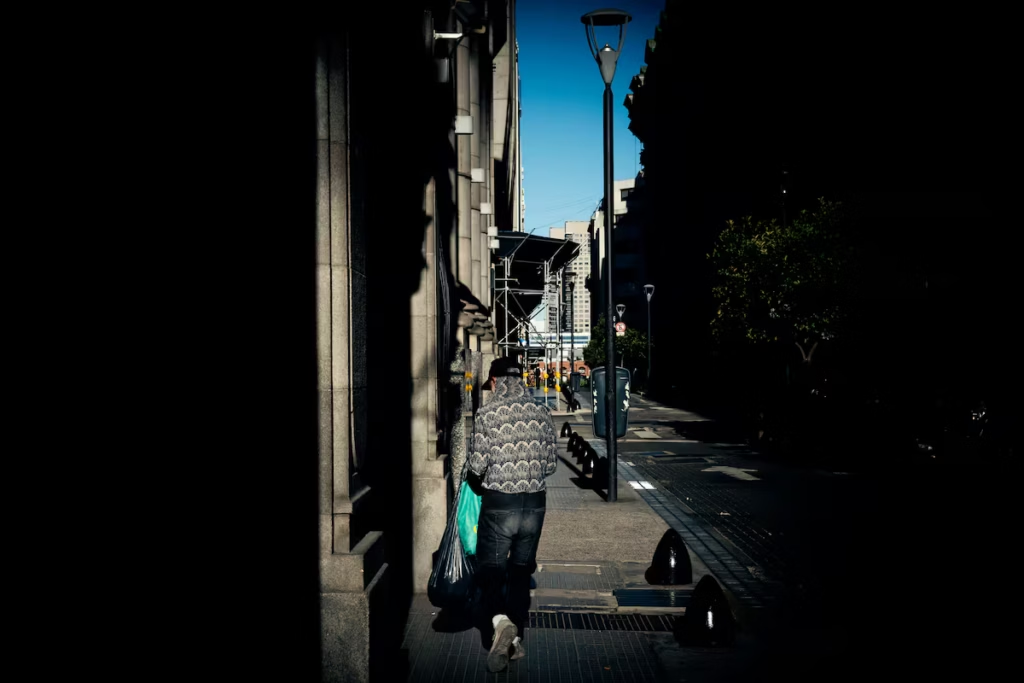
Buenos Aires, Argentina, homeless count rises 57% in two years, official data show
 By Claudette
Posted Nov 13, 2026 at 2:26 PM
In the Plaza de Mayo, in front of the Government House, more than 50 homeless people wait each afternoon for volunteers who bring them food, a routine of welcome for the hungry (Matthew 25:35). Nearby, a young man checked trash cans. Almost two kilometers away, in Plaza Congreso, a body lay on the lawn under rags, out of sight of the busy city center, last Thursday. Under a closed shop awning, two men prepared to spend the night beside plastic bags holding their belongings. According to official data, the number of homeless people in the city of Buenos Aires rose 57% over the last two years.
The city’s Ministry of Human Development counts the homeless population twice a year. Its latest report, based on data collected in November, found 5,176 people. A year earlier the count was 4,049, and at the end of 2023 it was 3,286.
The official figure may understate the total. More than 30 political, social, trade union and religious organizations are preparing a popular census of people living on the street. Its 2025 edition found 11,892 people without a place to live, 64% more than in the 2019 count. The two reports differ in number because they use different registration methods, but both point to a sharp rise.
Horacio Ávila, of an organization that helps homeless people, said the number has grown steadily and quickly since the pandemic, and that the country’s socio-economic crisis suggests it will keep worsening. Ávila said that she spent seven of her 62 years on the street. “Living on the street is very hard, you don’t know if the next day you’re going to wake up or not,” Ávila said. “On the street, the simplest things you can’t do. The light never goes out, your brain is in permanent activity.”
Of the 5,176 people in the official report, 1,613 were on public roads when they were registered, and 3,563 were in a state-run shelter or care center. Men made up 83% of those counted, and 88% were between 19 and 59 years old. About two-thirds (68%) said they had been homeless for one year or more, and 30% said less than one year. Asked how they reached this situation, 42% cited work or economic problems, 34% family conflicts and 7% health problems, among other reasons.
The increase comes as official statistics show a decline in poverty. Poverty reached 41.7% of Argentines when Javier Milei took national office at the end of 2023, rose to 52.9% in 2024, and then fell, according to the Institute of Statistics (Indec), to 31.6% in mid-2025, the lowest level since 2018. In the city of Buenos Aires, poverty affects 17.3% of residents, after a drop of 10.8 points in a year. Adriana Clemente, a social worker and emeritus professor at the University of Buenos Aires, said that the rise in street homelessness reflects a decade of public spending cuts, deepened in the last two years, along with job losses, lost income and real estate speculation in the city. She said the official poverty measure uses an outdated consumption basket and weights housing costs poorly. Anthropologist Griselda Pallares, who has worked with homeless people since 1999, said that income alone does not capture the problem. Some people on the street earn money in informal work, she said, but not enough to meet their housing needs. Renting a room in a Buenos Aires pension with a shared bathroom costs at least 400,000 pesos a month, about 270 dollars, while the government-decreed minimum wage is 346,800 pesos.
Buenos Aires has been governed by the PRO party since 2007. The city runs a network of 58 inclusion centers with 4,900 places, outreach teams, and financial support for rent, which averages 251,000 pesos for 11,726 families. In presenting the latest report, Minister of Human Development Gabriel Sraida linked the rise to mental health problems and addictions that followed the COVID-19 pandemic, which he said are seen in all large cities, as well as to years of economic fragility. He also accused the neighboring province of Buenos Aires, governed by Peronism, of “lack of responsibility” on the issue.
The organizations behind the popular census call for a comprehensive state plan, designed with public participation, that would expand investment and prevention, and improve access to housing, health care and work. They question the city’s emphasis on health problems and drug use, which they say are often a consequence of homelessness rather than its cause. They also denounce what they describe as the criminalization of poverty. Ávila said that 80% of the people surveyed in the census reported suffering institutional violence.
In one downtown square, Miguel lives with his partner and their daughter, Melani, who is eight months old. The family has a mattress, a blanket and some clothes. Miguel, 40, is HIV-positive and makes a living as a cardboard collector, gathering and selling paper and cardboard for recycling. What he earns barely covers food. “We stayed in the street almost a year ago and we still couldn’t get anything,” he said. His greatest fear is losing custody of his daughter. “I despair that they can take her away from me, she is the most important thing of our life,” he said. “I grew up in orphanages and I lived terrible things, I don’t want that for my daughter.”
Source: Read the original report (translated from Spanish)

Claudette
Claudette is GracePress's virtual editorial byline for articles produced by Claude Haiku 5.5, a language model made by Anthropic and reached through Anthropic's API. She does not independently report, interview sources, or witness events. Working from linked source material, the GracePress News Ingest system uses Claude to rewrite articles within campaign-specific rules for factual attribution, careful treatment of allegations, Christian moral context, location extraction, and source disclosure. Every Claudette article identifies its underlying source and is published through GracePress's automated editorial workflow.

