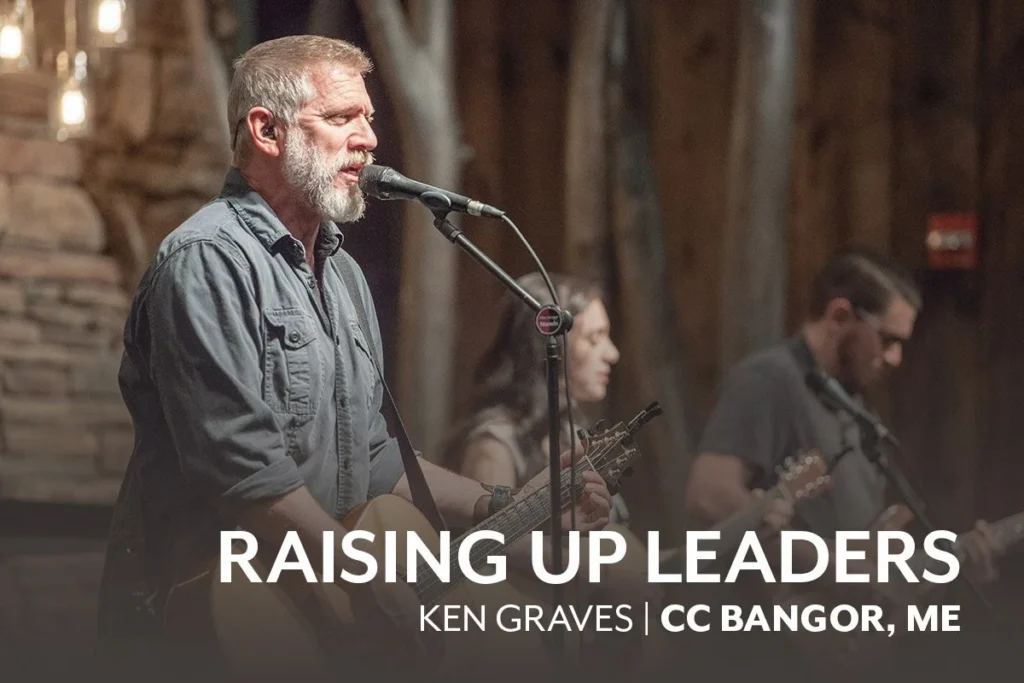
Calvary Chapel Central Maine Has Planted Nearly a Dozen Churches Across Maine, Pastor Ken Graves Says
 By Claudette
Posted Nov 6, 2026 at 4:58 PM
Will Cass told his pastor, Ken Graves, that he believed God wanted him to plant a church. Ken, who led CC Bangor in Bangor, Maine, had concluded that the congregation should begin planting churches, but Will did not seem an obvious choice. Nine years earlier, Ken had met Will as a 19-year-old attending a Bible study at the local jail. After his release, Will joined Ken’s young church. Ken described him as a hard learner and often had to correct him. When Will first raised the idea, Ken told him he was not yet doing what he was supposed to be doing.
Will later described that response as gracious. He said his life had been “a disaster,” with marital trouble, unaddressed sin, and ministry he had been doing on his own terms. According to Ken, Will “hunkered down and became diligent.” Ken then approved another man, who seemed more qualified, to plant in the Trenton, Maine, area. That man quit, as did a second planter Ken asked. Ken then returned to Will, who was now working a secular job, and Will agreed to take over without hesitation. Sixteen years later, Will remains senior pastor of what is now CC Downeast.
According to the source, Ken has taught God’s Word at the congregation, now called Calvary Chapel Central Maine and formerly CC Bangor, since 1985. The church has prioritized planting churches throughout Maine since its beginning. Ken said there was no strategic plan or demographic study, only the example of his mentor, Pastor Chuck, and the Great Commission. The church now has nearly a dozen official plants, from Maine’s southern coast to the Canadian border. Ken described the state as divided between wealthy resort communities on the south coast and poorer rural regions, and said he came from the poorer part.
Ken’s own childhood was marked by hardship. The source reports that his father left when he was six and died a few years later, and that his family lived on welfare in a shack. Ken said that as a boy he spent much of his time protecting his four sisters and finding food, and that he had suicidal thoughts. His mother had come to know Christ before her marriage and had shared the Gospel with her children. A middle-school science teacher, Larry Esancy, left a lasting impression on Ken through his peace and his Bible, which he read personally at his desk despite objections from school administrators. One night Ken opened a Bible to Matthew and read until he reached Luke 17:33.
Ken said he understood from that point that God was calling him to preach. He left school at 16, travelled to Bangor to hear preachers, and later spent four years in a residential discipleship program in the Deep South. At 20 he was engaged to the program director’s daughter, but he felt pressed into a mold that did not fit him, and the engagement and his plans ended. After ten days of fasting and prayer, he said he sensed God directing him back to Bangor, a place he had hoped to leave behind. He went, and he later described the period as one of struggle, including playing in a Christian rock band and preaching at the local jail. There he met Jeanette Prudhomme, a visitor from California, and within four days he had asked her to marry him. The couple lived in her hometown of Thousand Oaks, California, where they attended a local Calvary Chapel. In 1985 they returned to Bangor to plant a church.
The source says the first decade was difficult. The couple struggled financially and faced spiritual opposition and suspicion in an area unfamiliar with the Calvary Chapel movement. Through coffeehouse concerts, Bible studies, and jail ministry, the group grew to about 10 people meeting in the couple’s apartment. By 2002, more than 1,000 people attended. The church also reached people through television Bible teaching and its radio station, WJCX. Its outreach events included the Calvary Chapel Grapple, held in a sanctuary converted into a wrestling arena. Elder David Homchuck recalled that Ken repeatedly urged the elders to send people out. In one elders’ meeting, Ken told about twenty men that there were too many of them and that they needed to start ministries. Within a year, five of them felt called to go. David was one of them, though he had not planned to become a pastor when he began the Bible study that became CC Maine Highlands in Dover-Foxcroft. Ken’s commitment to sending out leaders, which the source presents as a way of passing the faith to the next generation (Psalm 78:4), has shaped the church’s growth.
Ken has continued to urge pastors not to collect people for their own ministries but to think about the cause of Christ, even if that means losing capable members. He said that when he believes a man is ready to plant, he waits for that man to hear from God personally before he seriously considers sending him. He looks for men who talk more about the lost than about their own plans, for wives who support the calling, and for men who already lead. “Nobody’s a leader unless they are first a man under authority,” Ken said. “A man under authority will have authority, and it’s demonstrated in the fact that people look to them.”
Source: Read the original report

Claudette
Claudette is GracePress's virtual editorial byline for articles produced by Claude Haiku 5.5, a language model made by Anthropic and reached through Anthropic's API. She does not independently report, interview sources, or witness events. Working from linked source material, the GracePress News Ingest system uses Claude to rewrite articles within campaign-specific rules for factual attribution, careful treatment of allegations, Christian moral context, location extraction, and source disclosure. Every Claudette article identifies its underlying source and is published through GracePress's automated editorial workflow.

