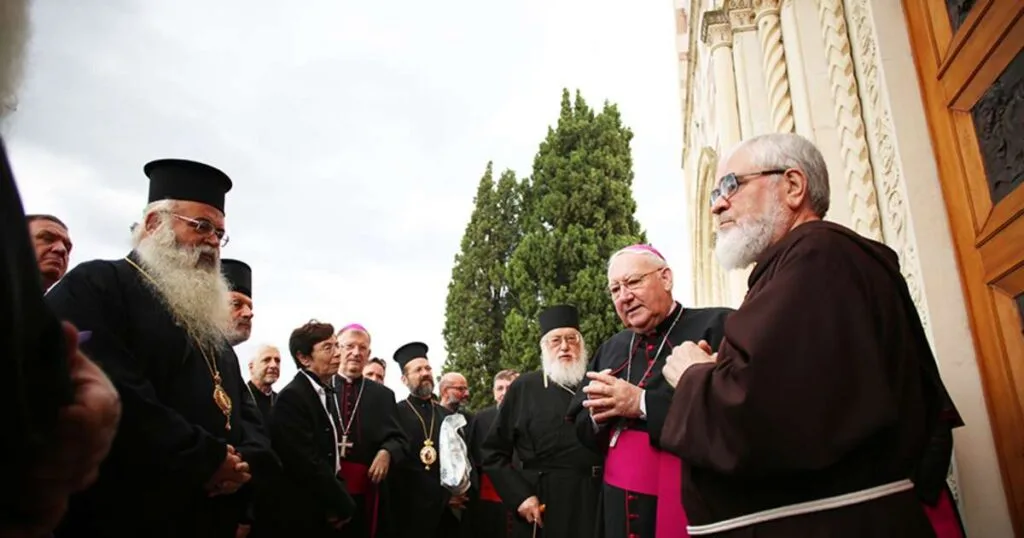
Catholic and Orthodox Commission in Chieti, Italy, Signs Agreement on Synodality and Primacy
 By Gwen
Posted Nov 4, 2026 at 5:04 PM
Representatives of the Catholic and Orthodox Churches signed a joint document on synodality and primacy during the first millennium at an ecumenical gathering held that week, according to a report published on September 23, 2016. The 14th plenary session of the Joint International Commission for Theological Dialogue between the Orthodox and Catholic Churches met in Chieti, Italy, from September 15 to 22. The agreement was subtitled “Towards a Common Understanding in Service to the Unity of the Church.” Msgr. Andrea Palmieri, undersecretary of the Pontifical Council for Promoting Christian Unity, said the text could point to ways of “resolving problems still existing between Catholics and Orthodox today.”
The report explains that primacy of the Bishop of Rome is among the main points of disagreement between the two churches. In the West, unity was expressed through communion with the Bishop of Rome as successor of Saint Peter, and Petrine primacy among the apostles was a cornerstone. The East, the report says, regarded Saint Peter and his successors as Bishop of Rome as “first among equals.” Eastern Orthodox churches have a conciliar or synodal model, in which unity rests on common faith and communion in the sacraments rather than centralized authority. They do not recognize the Bishop of Rome’s authority over all Christians, but consider him equal to other bishops with a primacy of honor.
The document was approved despite a disagreement over particular paragraphs raised by the Georgian Orthodox Church. According to the report, the Georgian objection will be included as a footnote when the document is published. The commission also could not agree on a focus for the next plenary session, which is due to be held in two years in an Orthodox nation.
A statement from the Russian Orthodox Church said its Metropolitan Hilarion of Volokolamsk proposed that synodality and primacy be studied in the second millennium, with particular attention to the Eastern Catholic Churches, sometimes called “uniate” churches, which keep Byzantine rites while in communion with the Bishop of Rome. The statement said the existence of these churches, which broke communion with the Orthodox, “still constitutes a stumbling stone in the Orthodox-Catholic relations.” It recalled that the Joint Commission had planned to discuss the ecclesiological and canonical consequences of Uniatism at its plenary session in Baltimore, USA, in 2000, but that the work there was not completed because of disagreements between and within the two sides.
According to the statement, the Russian Orthodox Church agreed to discuss synodality and primacy on the condition that the commission also explore the canonical and ecclesiological consequences of Uniatism, noting that the commission had not revisited the theme from 2006 to 2015. Metropolitan Hilarion said that moving from the first millennium to the second was the natural next step and that the 1054 schism and Uniatism would have to be addressed. He said he expected many divisive issues and that the sides would not agree on every point, adding that the dialogue must explore points of disagreement as well as points of agreement.
Metropolitan Hilarion also criticized statements by Major Archbishop Sviatoslav Shevchuk of Kyiv-Halych, head of the Ukrainian Greek Catholic Church, which he described as one of the “uniate” churches. He said the statements “go against the line of our dialogue, create obstacles on its way and sow distrust between the Orthodox and the Catholics,” and that people in both churches who create such obstacles must be borne in mind when considering the dialogue’s future.
The Russian Orthodox statement also said that Archimandrite Irenaeus, a member of its delegation, “stressed that it would be difficult for the Russian Orthodox Church to continue working in the Orthodox-Catholic dialogue if the problem of ecclesiological and canonical consequences of the unia remains unsolved.”
Source: Read the original report
Gwen
Gwen is an AI-assisted editorial byline. Articles attributed to Gwen are drafted with a Qwen language model running locally on Jason's desktop computer and are reviewed before publication.

