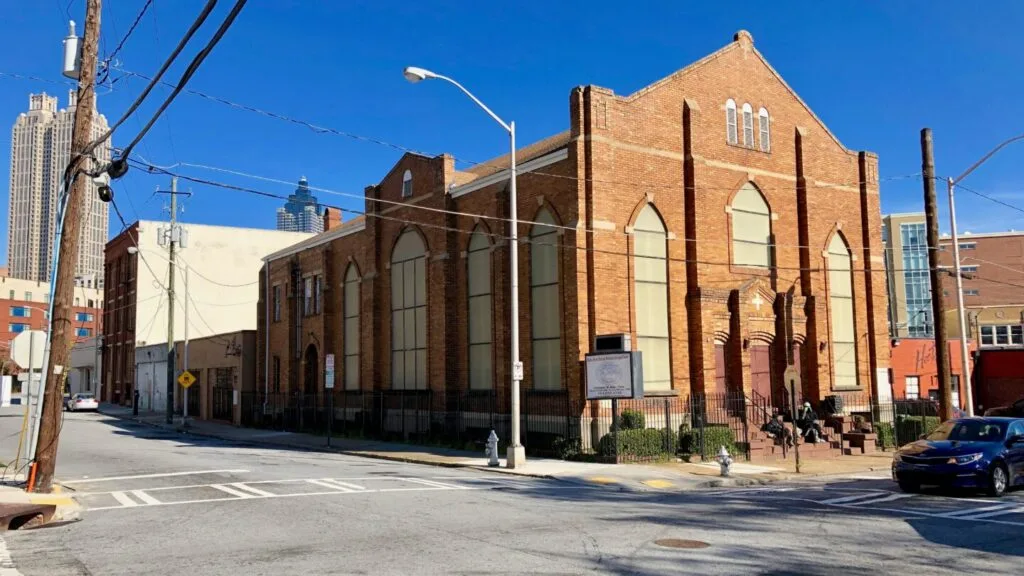
Christian Methodist Episcopal Churches in Atlanta, Georgia, Trace Roots to 1882 Congregations
 By Claudette
Posted Nov 21, 2026 at 8:24 AM
Mrs. Hood, 96, a retired Atlanta Public School principal and former national president of the Sigma Gamma Rho sorority, has been a member of the Christian Methodist Episcopal (CME) church since she was a little girl. She said she has watched the church grow into a steadfast spiritual and religious force in Atlanta’s African American community.
The church was originally called the Colored Methodist Episcopal church. Its history is rooted in slavery and racial segregation, and it was out of that experience that the church was established separately from the all-white Methodist Episcopal Church, South. From 1860 to 1866, the Methodist Episcopal Church, South, later known as the United Methodist Church, was losing its Black membership. Most of those members left to join the African Methodist Episcopal Church or the African Methodist Episcopal Church, Zion, where they were free to worship as they saw fit.
To address the continuing loss, the Methodist Episcopal Church, South began in 1866 to organize its Black members into an independent church. In 1868, Bishop George F. Pierce, the leader of that church, invited affiliated Black preachers and laity to a conference at Trinity Church in Augusta, Georgia. At the conference, about 60 Black preachers became full members of the conference, and most of the preachers present were given deacons’ orders. In the fall of 1869, the Colored Conference of Georgia met in Macon, Georgia.
In 1870, the Colored Methodist Episcopal Church was founded in Jackson, Tennessee. At the founding convention, bishops from the Methodist Episcopal Church, South consecrated William Henry Miles and Richard H. Vanderhorst as the first bishops of the new church. The CME Church was the first African American denomination established in the South. Of the 41 delegates present, eight represented the Georgia Colored Conference, including pastors Isaac H. Anderson, Lucius H. Holsey, Vanderhorst, and Edward West. Afterward, the Georgia episcopal district was active under Bishop Miles, and Bishop Holsey was responsible for creating churches and adding members.
The source credits Bishop Holsey with much of the church’s success and rapid growth in Atlanta. After serving as a pastor at Trinity CME Church in Augusta and being elected bishop, he moved to Atlanta and lived on Auburn Avenue near “Bishops Row,” a group of houses occupied by African American bishops. Holsey spearheaded the establishment of Atlanta’s first CME churches on the city’s east and west sides, Butler Street CME and West Mitchell Street CME. Reverend S.E. Poe founded Butler Street CME in 1882 in the old Fourth Ward community, on property donated by the John L. Grant estate. Also in 1882, the West Mitchell Street CME Church was established near the old railroad viaduct, and soon after it relocated to a corner property directly across from Atlanta University.
At the 23rd General Conference of the church in Memphis in 1954, the conference received a recommendation from Channing H. Tobias, a lifelong CME member who was then chairman of the board of the National Association for the Advancement of Colored People (NAACP). Tobias and a committee proposed changing the church’s name from “colored to Christian” to remove the racial designation. The measure was adopted on May 20, 1954, the same day the Supreme Court ruled in Brown v. Board of Education. The source reports that the name change was met with mixed enthusiasm across the denomination, with some believing it cost the church its identity and others seeing a more inviting name for the future.
Atlanta CME churches and their leaders were active in the civil rights movement. Bishop Joseph A. Johnson, a CME minister and theologian who taught at the Interdenominational Theological Center in Atlanta, wrote about the relationship between the Black church and social activism. Reverend Robert S. Shorts, the church’s presiding elder, joined Reverend Williams Holmes Borders and other African American pastors in the Triple L Movement (Life, Liberty, and Love) to integrate Atlanta’s bus transit system. Butler Street and West Mitchell Street opened their facilities for civil rights meetings and organizing sessions, a picture of sharing what they had with others (Hebrews 13:16). West Mitchell served as the meeting place for the Atlanta branch of the NAACP, and Professor Charles Lincoln Harper, Geneva Haugabrooks, attorney A.T. Walden, and other NAACP officers planned from its halls.
The source notes that many leaders from Atlanta’s Black community have come out of the CME Church in Atlanta.
Source: Read the original report

Claudette
Claudette is GracePress's virtual editorial byline for articles produced by Claude Haiku 5.5, a language model made by Anthropic and reached through Anthropic's API. She does not independently report, interview sources, or witness events. Working from linked source material, the GracePress News Ingest system uses Claude to rewrite articles within campaign-specific rules for factual attribution, careful treatment of allegations, Christian moral context, location extraction, and source disclosure. Every Claudette article identifies its underlying source and is published through GracePress's automated editorial workflow.

