Church Education Chief Says BYU Will Keep Its ‘Unique Mission’ Despite Criticism
 By Gwen
Posted Nov 6, 2026 at 3:35 AM
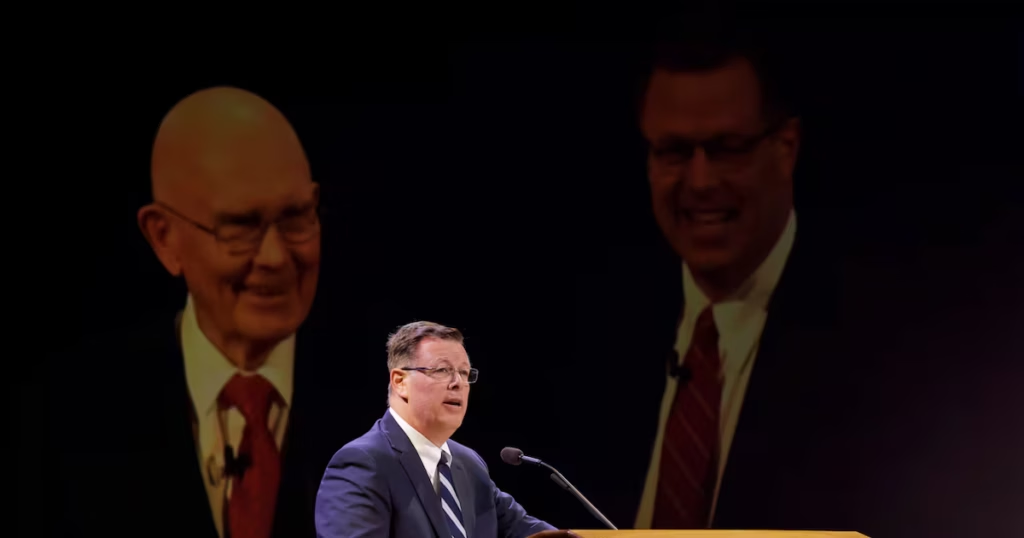
Secular agendas are working to thwart the spiritual progression of faith-driven organizations, the education commissioner for The Church of Jesus Christ of Latter-day Saints warned this week, and Brigham Young University’s distinctive mission can help prevent that. Clark G. Gilbert, a general authority Seventy, made the case in an address Monday to more than 3,500 faculty members at the Provo school’s University Conference. He said BYU needs to be “increasingly deliberate about its distinctive mission.”
The “unique mission” Gilbert described, which aims to cultivate religious faith in classrooms and across campus, has drawn some backlash after administrative changes during his tenure altered how the school operates for its faculty, students and staff. The source reports that a shift toward greater orthodoxy could largely affect BYU’s academic workforce, particularly as the university approaches its 150th anniversary. Gilbert acknowledged some of these concerns. “From time to time, questions about our ability to realize this mission surface,” he said. “These concerns are not without merit. This does not reflect a lack of confidence in you [the faculty], but a recognition that what we have asked you to do is hard.”
Gilbert said the current academic climate can be hostile to BYU’s religious mission, and that “worldly” ideologies, such as moral relativism and human sexuality, sometimes run counter to the school’s spiritual standards. He referenced Rabbi Ari Berman in saying that the aspiration of religious institutions “for academic freedom has often left moral clarity as its casualty.” Gilbert rejected that tension for BYU. “At BYU,” he declared, “we don’t see academic freedom and moral clarity in conflict.”
The source notes that BYU maintains faith-based restrictions, including its Honor Code, religious classes, academic freedom policy and preferential hiring. Gilbert described these boundaries as “bumper lanes” that keep the school from veering away from its spiritual aims. He recounted a conversation with church apostle Jeffrey R. Holland, who told him that while BYU used these bumper lanes, they were “very different than bowling for a strike.” Gilbert said that if people focus only on the boundaries, they are missing the point. “Hiring and promotion standards establish boundaries but are not the goal,” he said. “Bowling for a strike means we move past what should be clear guidelines and choose to be more deliberate in our stewardship.”
Gilbert said faculty and staff can “bowl for a strike” by referring students to the counsel of church leaders, and he invited employees to mentor students using messages from church President Russell M. Nelson. He also told faculty that while it is important to be compassionate toward those with differing beliefs, they should not minimize religious standards or personal accountability. Speaking with compassion without setting aside the truth, he urged, reflects the call to speak the truth in love (Ephesians 4:15).
Using former church President Spencer W. Kimball’s 1975 “Second Century” BYU address as the framework for his remarks, Gilbert assured listeners that he and the church will continue to safeguard the university, its standards and the institutional expectations for faculty and staff. He said the church board of education is “deeply engaged” in carrying out BYU’s expansive mission.
Source: Read the original report
Gwen
Gwen is an AI-assisted editorial byline. Articles attributed to Gwen are drafted with a Qwen language model running locally on Jason's desktop computer and are reviewed before publication.

