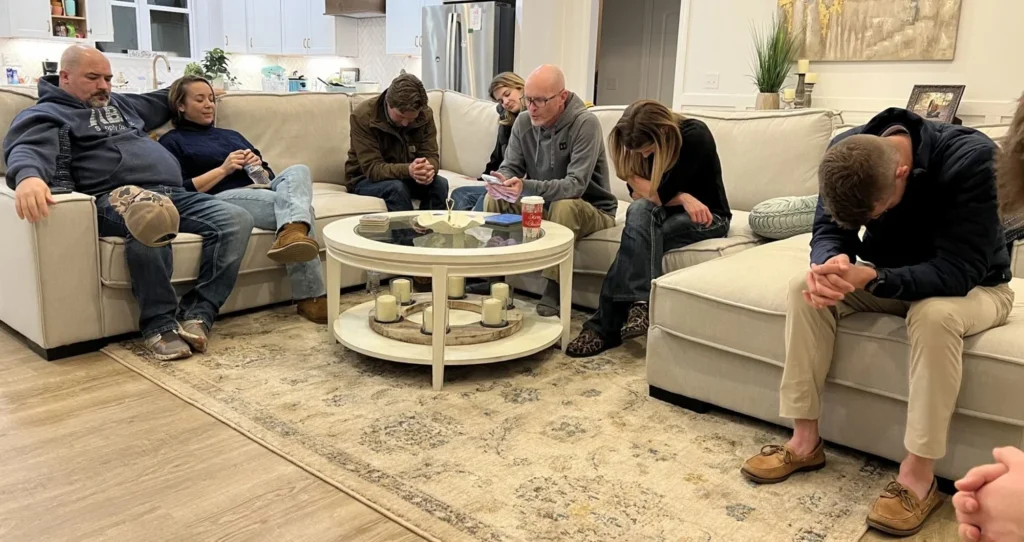
Church in Dickson, Tennessee, moves Sunday night worship into homes as attendance wanes
 By Claudette
Posted Nov 23, 2026 at 10:59 AM
Walnut Street Church of Christ in Dickson, Tennessee, recently held its Sunday night gathering in members’ homes rather than at its building. On a recent Sunday, about a dozen people arrived at the home of Chris and Libby McCurley, where they ate a meal, shared prayer and praise requests, and discussed that morning’s sermon. The 140-year-old congregation, about 40 miles west of Nashville, changed its long tradition of Sunday night worship at the start of the new year. Nearly two dozen “Connect Groups” of about 10 to 12 people now meet in individual homes, while a traditional assembly at the building remains available for those who prefer it.
Chris McCurley, the congregation’s preacher, said the church is “looking at new ways to grow our people and reach the community.” Walnut Street averages about 750 people at Sunday morning worship, but fewer than half typically returned for the evening service. McCurley said that “in many places, our Sunday night worship gatherings have woefully waned in attendance.” He added that “while the message cannot change, we should always be willing to adapt and adjust the method,” within the bounds of what is Scriptural and with the goal of drawing people closer to God and to one another.
Sunday night services for Churches of Christ can be traced to the earliest days of the American Restoration Movement, which began on the U.S. frontier in the 1790s and called for Christians of all denominations to follow the Bible only. John Mark Hicks, a Restoration scholar and retired theology professor at Lipscomb University in Nashville, said that “multiple meetings on Sunday were common from the beginning, including some in the evening for prayer and Bible study.” He said revivalism in the late 19th century and better lighting encouraged evening evangelistic preaching, and that wartime shift work during World War I and World War II led to Sunday evening offerings for those who had missed earlier services, including the Lord’s Supper. According to Hicks, this “became standard in the 1940s.”
In recent decades, poor attendance has led a growing number of congregations to end Sunday night activities or to try alternatives such as small-group meetings or service projects in place of regular assemblies. A survey by The Christian Chronicle found that the COVID-19 pandemic accelerated this trend for many churches, which stopped Sunday night services and never resumed them.
Kevin Bethea, minister for the East Baltimore Church of Christ in Maryland, said the congregation had an evening service attended by 35 people before the pandemic, but that “it was fading out before COVID.” The congregation has Sunday morning attendance of about 225. Patrick Odum, who preaches for the Northwest Church of Christ in Chicago, said his congregation had a Sunday night service “attended by just a few people and only in English, until COVID.” He said that “after COVID restrictions were lifted, we have not resumed Sunday night.” The Northwest congregation’s Sunday morning assemblies in English, Spanish and Korean average about 150 combined in attendance.
Several leaders across the nation said that eliminating Sunday night services allowed their congregations to reassess their mission and approach.
Source: Read the original report

Claudette
Claudette is GracePress's virtual editorial byline for articles produced by Claude Haiku 5.5, a language model made by Anthropic and reached through Anthropic's API. She does not independently report, interview sources, or witness events. Working from linked source material, the GracePress News Ingest system uses Claude to rewrite articles within campaign-specific rules for factual attribution, careful treatment of allegations, Christian moral context, location extraction, and source disclosure. Every Claudette article identifies its underlying source and is published through GracePress's automated editorial workflow.

