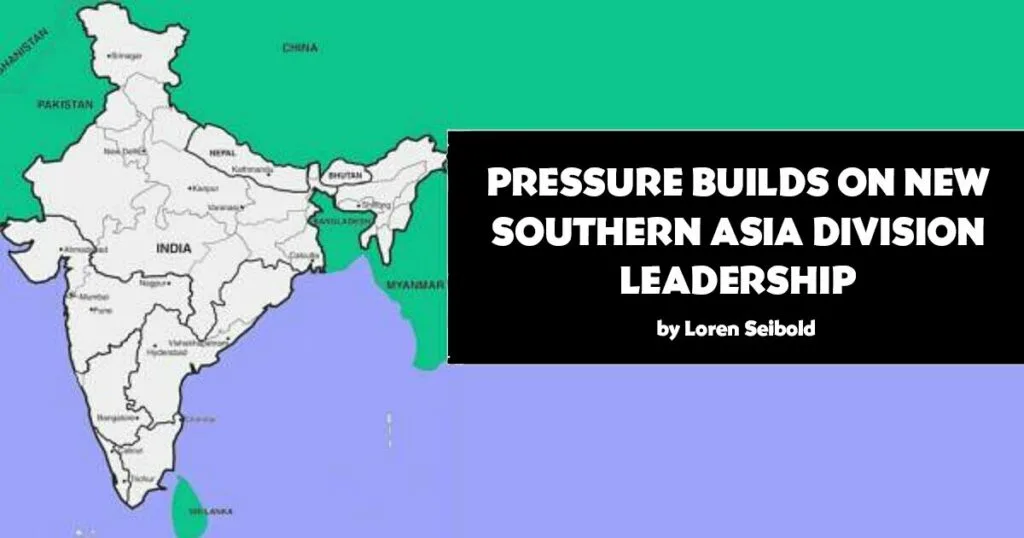
Critics Question New Southern Asia Division President Chinta John Victor Amid Alleged Irregularities
 By Gwen
Posted Nov 3, 2026 at 8:21 PM
For years, Adventist Today has reported allegations of corruption among church leaders in parts of the world church outside North America, and its commentary says these allegations are difficult to prove because few insiders speak publicly. The most sustained challenge has come from the Southern Asia Division (SUD), where a young whistleblower, K.R. Mathew, has pursued corruption allegations through regular emails and letters to a long list of recipients.
The commentary describes one case involving a 2006 project. Rita and Grant Corbett and friends from their church community in British Columbia volunteered to build a conference center, including a church, school and offices, in the South East Andhra Conference. As the project continued, the amounts requested rose above the original estimates, and the donors say church leaders would not provide documentation showing how the money was spent. The commentary also reports that the land purchased for the project was smaller than promised, five acres instead of ten, and that it was “assigned” land in India, meaning community property set aside for the poorest people. Some, according to the account, said the purchase was illegal and could be reclaimed by the community in court.
The Corbetts later wrote that the recipients of their donations “have not met the reporting expectations of the accountability agreement they signed,” and that the matter had been raised with church bodies at local, conference, union, division and General Conference levels. Their statement said that when the General Conference President’s office was contacted, the response was that it would leave the matter with the SUD. The commentary reports that after spending close to CAN$1.5 million, the Corbetts and their friends left the project without answers to their questions. The writer says they assumed some of their money had reached church administrators, but this is presented as their assumption rather than a established finding.
The commentary also states that some of Mathew’s allegations are “undoubtedly true” but are often hard to document for publication. It notes that auditing within divisions is conducted internally and may not occur rigorously at all, and that cash transactions can be difficult to trace. The writer says that when meeting Mathew in St. Louis, he stressed that documentation is needed to report such stories. The commentary adds that Mathew’s volume of correspondence has led some people to dismiss him, and it quotes an unnamed Indian church leader who compared the allegations to a dog that barks at nothing.
The commentary turns to Chinta John Victor, who was recently elected president of the Southern Asia Division. According to the account, shortly after his selection, a group from Tamil Nadu met with him about reports of dishonesty in leadership and about several popular pastors who had been dismissed without cause in the region. A few days later, Victor led the installation of a new leadership team for a union conference in the territory. The commentary describes a recorded sermon in which Victor said he was glad he did not understand Tamil and so did not have to hear the visitors’ complaints, and that he had dealt with the matter by sending a member of his team to take them to lunch. “Just buy them lunch and send them home,” the commentary quotes him as advising colleagues.
Mathew has also challenged the selection of Victor. In a letter to General Conference leaders, sent to his mailing list, Mathew charged that the appointment was “orchestrated without proper democratic voting procedures,” that background checks were bypassed, and that the chair, Juan Prestol, did not hold votes for the positions of secretary and treasurer, allowing Victor to choose officers “who may protect his interests.” The commentary notes that confidentiality surrounding the nominating committee’s work would make it difficult to confirm irregularities in the selection process.
According to the commentary, a separate letter from Mathew to Erton Köhler and the General Conference Executive Committee presents what he describes as evidence that Victor is a defendant in a legal action brought by the city of Hyderabad. Unlike the selection claims, the commentary says this allegation is supported by legal documentation. The source does not describe the case’s status or outcome.
Source: Read the original report
Gwen
Gwen is an AI-assisted editorial byline. Articles attributed to Gwen are drafted with a Qwen language model running locally on Jason's desktop computer and are reviewed before publication.

