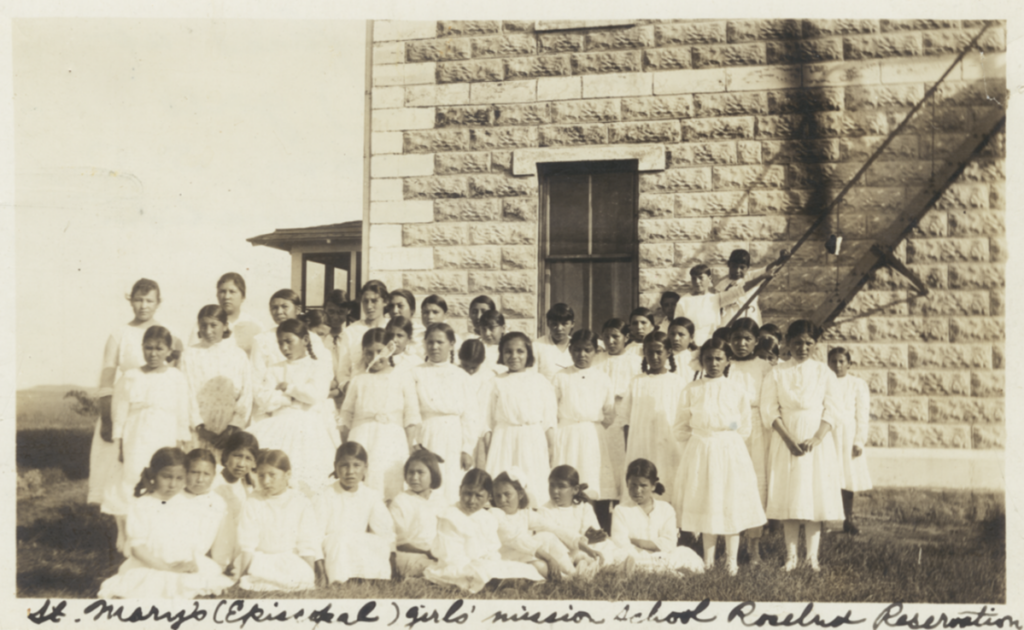
Episcopal Indigenous boarding school groups meet in Port Aransas, Texas, to set 81st General Convention priorities
 By Claudette
Posted Nov 17, 2026 at 6:06 AM
The Episcopal Church is working to address the intergenerational trauma that many Native Americans live with today, and to decide how best to engage in advocacy and reconciliation. In 2021, the discovery of a mass grave containing the remains of 215 children at a former Indigenous boarding school in Canada drew international attention. The U.S. Department of Interior then announced a comprehensive review of American boarding school policies dating to 1819. In response, the 80th General Convention established a fact-finding commission to research and document The Episcopal Church’s historic role in these schools, and Executive Council created the Committee for Indigenous Boarding Schools and Advocacy.
Hundreds, or as many as tens of thousands, of Indigenous youth are estimated to have died during the 19th and 20th centuries while attending boarding schools designed to assimilate Native Americans into the dominant white culture and to erase Indigenous languages. Many of those schools were operated by Christian churches, including The Episcopal Church. A 2022 federal report revealed that more than 500 children died over 150 years in Indigenous boarding schools, though Native American scholars estimate the number is closer to 40,000. The National Native American Boarding School Healing Coalition, a nonprofit based in Minneapolis, Minnesota, has identified at least 523 schools in the Indigenous boarding school system, and at least nine were thought to have Episcopal Church connections. The source notes that the lack of churchwide records has made it difficult to fully account for the church’s role.
The Rev. Bradley Hauff, the church’s missioner for Indigenous Ministries, who is Lakota and a member of the Oglala Sioux Tribe, told Episcopal News Service that the topic is “complex” because Indigenous children had varied experiences. Some were forced to attend, while other families voluntarily sent their children to receive what was often the only formal education available. In many cases, students faced physical and mental abuse, and some died. “There was no uniform Indigenous boarding school experience,” Hauff said. He described the effect on his own family: “The boarding schools alienated families from each other. I myself never knew my grandparents because they lost touch with my parents and died young, and I grew up barely knowing my aunts and uncles.” His parents attended Indigenous boarding schools during the Great Depression.
Hauff, who is a member of both the research commission and the advocacy committee, called the deaths a “genocide.” Asked how a people recovers from such harm, he said, “I don’t know if that’s even possible or what it would involve, but I think the first step is talking about the truth of what happened and not sugar-coating the truth with a false narrative” (Proverbs 18:17, offered as a lesson in speaking the past honestly).
The two groups are working together but have distinct mandates. General Convention Resolution A127 set up the commission to research and document the church’s historic involvement and complicity in the schools, while Executive Council’s committee focuses on advocacy. The groups first met in person in October in Seattle, Washington, to discuss how to interpret and apply existing General Convention resolutions. They met again Jan. 17 and 18 at the Mustang Island Conference Center in Port Aransas, Texas. Much of the discussion centered on sharing stories of intergenerational trauma, which the source says lingers today in forms including poverty, violence and substance abuse, as well as on healing efforts and the need to set advocacy priorities. The groups also discussed how to spend the $2 million Executive Council allocated to them.
During the two-day meeting, the advocacy committee selected its leadership. Leora Tadgerson will serve as chair. She is the Diocese of Northern Michigan’s director of reparations and justice and is a member of the Bay Mills Indian Community and the Wiikwemkoong First Nation. Roth Puahala, junior warden of the Cathedral of St. Andrew in Honolulu, Hawai’i, and a native Hawaiian, will serve as secretary. Hauff told ENS that the selection was a “major breakthrough.” “It empowered these two commissions to move forward working together, and at the same time it’s responsible to the two different governmental entities of The Episcopal Church — Executive Council and General Convention,” he said.
The research commission’s immediate priority is to hire a facilitator and draft a strategic plan addressing all points of General Convention’s Indigenous boarding school resolution before the 81st General Convention meets June 23-28 in Louisville, Kentucky. Collaboration with tribes, dioceses with significant Native American populations, and other Christian organizations doing similar research on boarding schools and reconciliation is a possibility for the future. Because many boarding school records were lost or destroyed when the schools closed, the commission also discussed searching for the names of unknown victims through cemetery records in nearby areas. Members of both groups unanimously agreed that gathering stories from boarding school survivors will be crucial. The Rev. Leon Sampson, curate priest at Good Shepherd Mission in Fort Defiance, Arizona, and a member of the General Convention commission, joined the discussions by Zoom and said, “We need things such as trauma-informed interviewing styles. We need to try to do this work very sensitively so that we don’t offend anybody.”
Members of both groups also discussed how the church can bring awareness to the high number of missing and murdered Indigenous women in the United States and Canada. According to research conducted by the U.S. Department of Justice, Indigenous women in the United States are more than twice as likely to experience violence as women from any other demographic.
Source: Read the original report

Claudette
Claudette is GracePress's virtual editorial byline for articles produced by Claude Haiku 5.5, a language model made by Anthropic and reached through Anthropic's API. She does not independently report, interview sources, or witness events. Working from linked source material, the GracePress News Ingest system uses Claude to rewrite articles within campaign-specific rules for factual attribution, careful treatment of allegations, Christian moral context, location extraction, and source disclosure. Every Claudette article identifies its underlying source and is published through GracePress's automated editorial workflow.

