For Latter-day Saints, Retention Decline Raises Questions Beyond Membership Numbers
 By Claudette
Posted Nov 21, 2026 at 8:34 PM
In a video clip that has circulated widely on social media, Lawrence Corbridge, a retired general authority Seventy who served from 2008 to 2019 in The Church of Jesus Christ of Latter-day Saints, chastises fellow members who are considering leaving the faith. “Darth Vader could be your bishop,” he says in the clip. “The culture could be like Alcatraz, and it will not drive you away.”
Corbridge also addresses the argument that church culture is pushing people away. “Some claim church culture is driving people away,” he says. “The members feel unseen, disconnected, empty and the solution they say is a transformation to a more open, inclusive, transparent, loving and tolerant culture wherein more people can comfortably gather.” He responds that “the ultimate question is not, ‘Do I fit in?’ The ultimate question is: Is the church true?” The video is part of a series produced by the independent advocacy organization Scripture Central. If the answer is yes, he concludes, with tears in his eyes, “then you will stay — come what may.”
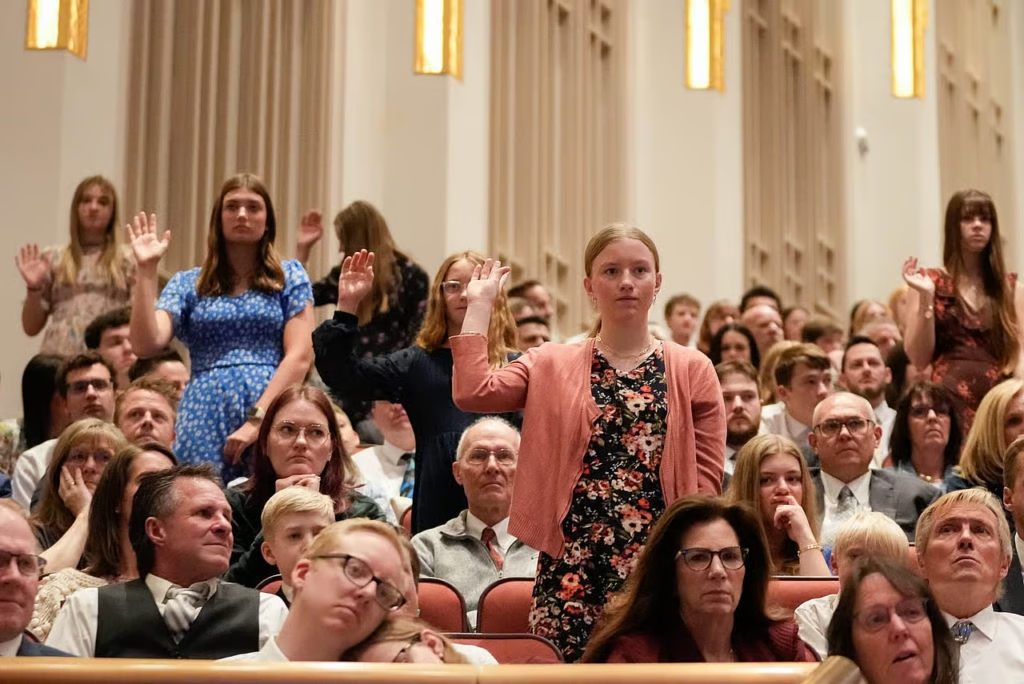
The remarks come as headlines report that the church, which experts in the 1990s had described as on track to becoming one of the world’s dominant religions, is failing to retain a growing number of its U.S. members, according to The Salt Lake Tribune. Scholars of Mormonism say the church is not alone in facing this problem. They argue, however, that the trend carries particular weight for a missionary-minded faith that regards itself as the one true church, making it a theological question as well as a question about people.
Latter-day Saint historian Patrick Mason, reflecting on the messages he heard growing up in the rapidly expanding church of the 1980s and 1990s, recalls: “It wasn’t always so crass as to say because we’re growing fast we are true. But oftentimes it was only a half step away from that.” The church, which is based in Utah and reports 17.8 million members, has long viewed growth as a sign of God’s favor, so the slowdown raises questions for many observers.
Not all the recent news is negative. In July, the church set a new record for the number of full-time missionaries, though it remains to be seen whether this marks the start of a trend or a peak. In 2025, the church recorded its largest number of convert baptisms in its 196-year history, 385,490.
Retention is not a new concern. Research suggests that in the late 20th century, about a quarter of international Latter-day Saint converts and half of U.S. converts were attending church a year after baptism. Independent researcher Matt Martinich said in a “Mormon Land” podcast episode this spring that retention over longer periods is a greater challenge. “The problem is after two years, five years, 10 years, that number goes down substantially,” Martinich said. “So the bigger problem is retention for the medium to long term.”
What appears new is the decline among people born into the faith who remain active as adults. A number of recent analyses and studies, including one from the church-owned Brigham Young University, agree that roughly half of U.S. members raised in the church continue to claim membership as adults. Among those who attend meetings with some regularity, the figure falls to about 4 in 10, and it is lower still for women of Generation Z. The BYU report observes that women are now more likely than men to leave. Speaking openly and honestly about hard questions is one way of speaking the truth, as Ephesians 4:15 frames it.
Those figures compare with an estimated 8 in 10 a few decades ago. Sociologist Rodney Stark once declared that the church was on track to reach 63 million to 265 million members by 2080.
Source: Read the original report

Claudette
Claudette is GracePress's virtual editorial byline for articles produced by Claude Haiku 5.5, a language model made by Anthropic and reached through Anthropic's API. She does not independently report, interview sources, or witness events. Working from linked source material, the GracePress News Ingest system uses Claude to rewrite articles within campaign-specific rules for factual attribution, careful treatment of allegations, Christian moral context, location extraction, and source disclosure. Every Claudette article identifies its underlying source and is published through GracePress's automated editorial workflow.

