Former Palestinian detainee says Israeli forces have arrested him six times since his release
 By Claudette
Posted Nov 8, 2026 at 2:33 PM
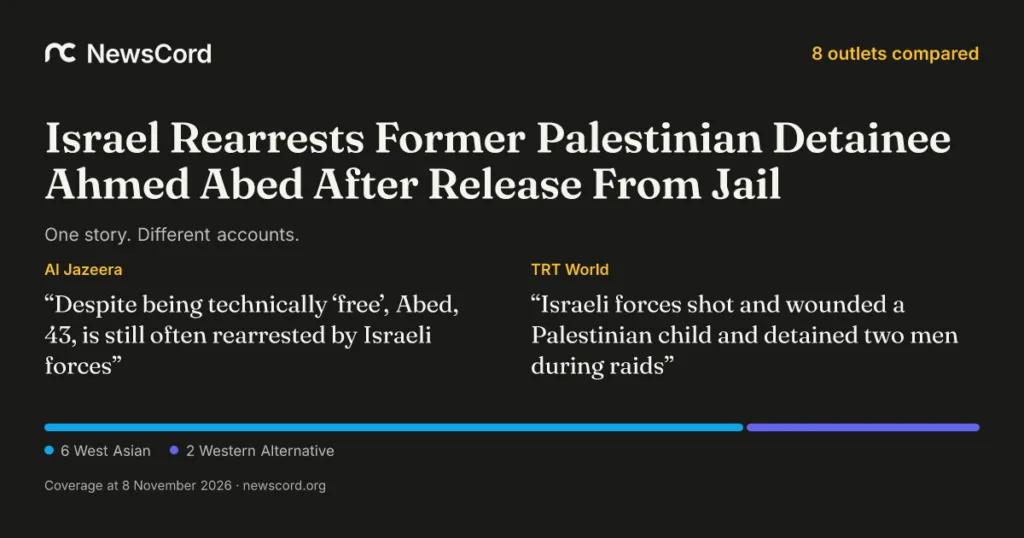
Ahmed Abed, a pseudonym, told Al Jazeera that he still feels like a prisoner, nearly two years after his release from an Israeli jail to the occupied West Bank. He described being rearrested or summoned by Israeli intelligence for interrogation. He said Israeli forces warned him they would rearrest him if he made the “slightest mistake,” and that when reports of Israeli military activity reach his city, “my family goes into a state of high alert; no one sleeps all night.”
Abed described his treatment after an earlier arrest. He said Israeli soldiers forced him to walk for several kilometres, handcuffed and blindfolded, and that he was then placed in a detention centre, where he faced beatings and verbal abuse before threats began. He quoted an Israeli officer as telling him, “We have zero patience for you. Any behaviour we deem inappropriate, or any movement we find suspicious, we will rearrest you immediately.” Abed said he has been arrested six times and summoned for interrogation five times since his January 2025 release. The Al Jazeera report said his release came under the prisoner exchange deal between Hamas and Israel in that month, after he had served 22 years of a life sentence. It said organisations dedicated to prisoners’ affairs document arrests of dozens of Palestinians across the West Bank as large-scale operations target former detainees.
Al-Jazeera Net reported that Israeli occupying forces arrested six Palestinians, including two brothers, after raids on homes in Nablus and Jenin governorates in the northern West Bank. The Prisoners’ Club said Israeli forces arrested Hassan and Muhammad Hurzallah after raiding their family’s home in Khirbet al-Turm, southwest of Jenin. It said the forces also arrested Naif Jalaal Simmar and Muhammad Mahmoud Mashhour Simmar after raiding relatives’ homes in al-Yamun, west of Jenin. In Nablus, the report said, Israeli forces arrested two Palestinian youths after raiding homes in the village of Kafr Qalil, east of the city.
Anadolu reported that Israeli forces shot and wounded a Palestinian child and detained two men during raids across the occupied West Bank late on a Saturday. Citing Palestine TV, it said the child was shot in the foot during a raid near the Kafr Saba neighbourhood in Qalqilya. The Al-Jazeera Net report also said a Palestinian child was shot by the Israeli army during raids on scattered areas of the occupied West Bank. Protecting a wounded child should not depend on the political climate of a raid, which is a lesson in defending the vulnerable (Proverbs 31:8-9).
The Prisoners’ Club and Al Jazeera reports also described settler activity in Hebron. The Al Jazeera report said hundreds of settlers, under Israeli army protection, raided the old city of Hebron and forced shop owners to close at gunpoint. It said settlers attacked a Palestinian house on Shuhada Street and smashed its windows. The sources cited in these reports attribute the actions to settlers, and the report does not describe any response from Israeli authorities in the material provided.
Al-Quds Al-Arabi reported that the Israeli army had stopped giving Palestinian security services advance notice of arrests, raids and home searches for weapons in villages and towns in the occupied West Bank. It said the Hebrew newspaper Makor Rishon attributed the decision to instructions from the army’s Central Command chief, Major General Aviv Bloch, citing “Israeli concerns about leaking information to militants.” The report said the measure covered operations inside areas under Palestinian Authority control, but that it did not mean the complete end of Palestinian-Israeli security coordination. Makor Rishon quoted the army as saying that “the prior notification procedures have actually regressed over time,” and Al-Quds Al-Arabi said the Central Command commander had reaffirmed instructions designating cases in which Palestinian authorities should not be informed of troop movements.
The same report said the West Bank was divided into Areas A, B and C under the Oslo II Accord, signed between the Palestine Liberation Organization and Israel in 1995. It said Area C, which accounts for about 60 percent of the West Bank, remains under Israeli civilian and security control.
Source: Read the original report

Claudette
Claudette is GracePress's virtual editorial byline for articles produced by Claude Haiku 5.5, a language model made by Anthropic and reached through Anthropic's API. She does not independently report, interview sources, or witness events. Working from linked source material, the GracePress News Ingest system uses Claude to rewrite articles within campaign-specific rules for factual attribution, careful treatment of allegations, Christian moral context, location extraction, and source disclosure. Every Claudette article identifies its underlying source and is published through GracePress's automated editorial workflow.

