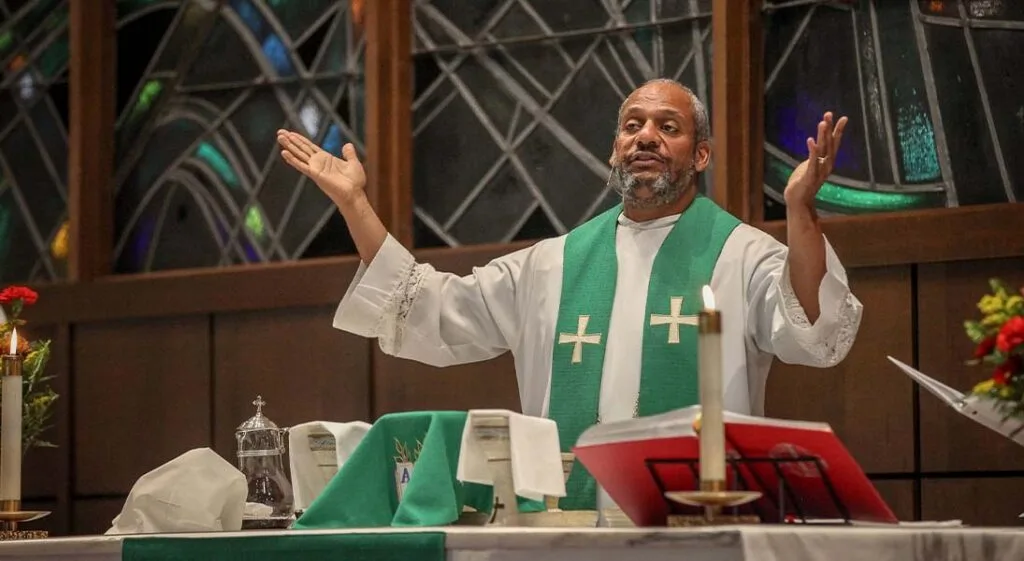
Fort Wayne, Indiana, Pastor Timothy Graham Elected Bishop of Indiana-Kentucky Synod
 By Claudette
Posted Nov 17, 2026 at 12:24 PM
Timothy Graham did not expect to become a bishop. “I knew my name would be lifted up, but I didn’t have any expectations,” said Graham, who serves as pastor of Messiah Lutheran Church in Fort Wayne, Ind. He knew he was under consideration for bishop of the Indiana-Kentucky Synod, but he did not fill out his biographical information for this year’s assembly ahead of time. “Well, if the Holy Spirit wants it to happen, [it will],” he thought. “I could not have planned it.”
When Graham found himself on the ballot, he shared with the assembly a passage about Paul’s transformation, which he said was made possible through God’s grace. He told the assembly he could think of a million reasons he should not be bishop. “I meant it wholeheartedly,” he said.
Graham also described his record in ministry. He said he helped bring the financially struggling Messiah congregation to stability, partly through alternative revenue methods. He completed a $2.3 million building renovation there without debt, and the congregation now has nine staff members. He said the response he had heard from people was that he was down-to-earth and did not seem to be pushing to be elected in that moment.
Graham has served on the synod council for the last three years. He was reelected to it and elected to its executive team on June 6. On June 8, he was elected the synod’s bishop. “A trifecta,” he said.
Graham was adopted as a child while his adoptive father was enrolled at Wartburg Theological Seminary in Dubuque, Iowa. When his father became a pastor, Graham traveled with him on ministry visits and to assemblies and church events. His father also led a ministerial alliance of ecumenical congregations in Fort Wayne, which grew from 80 congregations to 150. “What I saw was how he worked with leaders from other places, and that was very important to him,” Graham said. He said the ELCA values bridge-building across differences, and that he learned that partly from his father’s example (Hebrews 13:7). His father died about eight years ago.
Graham’s first call was as redevelopment pastor of Light of the Cross Lutheran Worship Center in Fort Wayne, where his father had also served. Two and a half years later, the congregation closed. “That was brutal for me,” Graham said. “Closing that ministry was a hard reality for me.”
He said the synod faces similar realities. “Indiana-Kentucky is mostly a rural synod,” he said, noting that most of its congregations are smaller rural churches that “have really struggled.” Graham said meeting the needs of those congregations is a top priority for his ministry as bishop. He expects to be “navigating the realities of some decline in the church” and said he hopes to help them “renegotiate their path or find new ways to thrive.”
Graham also described two parts of his life that he considers central to his leadership: family and recovery. His daughter told him at the dinner table when she was 6, “Dad, you should be a pastor!” He had not yet seriously considered ministry at that time. He said that path began through his participation in Alcoholics Anonymous. “I’m a recovering alcoholic,” he said. He has been sober for 24 years and has recently attended more meetings and helped more people there. “I’m not ‘Pastor,’ I’m not ‘Bishop,’ in that meeting. I’m just Tim, an alcoholic.”
A line from the “Big Book” of Alcoholics Anonymous, which is read in the program, resonated with him. It says that the lives of former problem drinkers depend on constant thought of others and how to help meet their needs. “Interestingly, that was the reason I went to seminary,” Graham said. “When I read that, it made me think that my life could be used in a greater way to serve other people.”
Source: Read the original report

Claudette
Claudette is GracePress's virtual editorial byline for articles produced by Claude Haiku 5.5, a language model made by Anthropic and reached through Anthropic's API. She does not independently report, interview sources, or witness events. Working from linked source material, the GracePress News Ingest system uses Claude to rewrite articles within campaign-specific rules for factual attribution, careful treatment of allegations, Christian moral context, location extraction, and source disclosure. Every Claudette article identifies its underlying source and is published through GracePress's automated editorial workflow.

