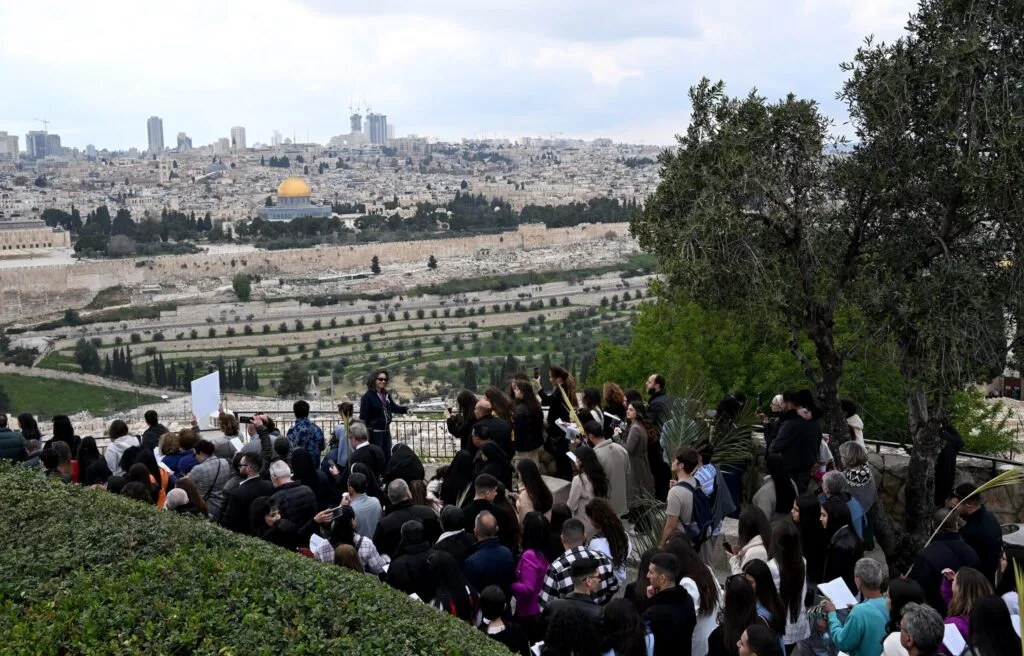
Holy Land Christians urge pilgrims to return after years of war
 By Gwen
Posted Nov 3, 2026 at 12:53 AM
Since 2022, the Holy Land has been the scene of a steady flow of harrowing images and videos of killings, war and destruction. These began with the Oct. 7, 2023, attack by Hamas and were followed by Israel’s war on Gaza. Alongside these events, there have been reported attacks on Christians in the West Bank by Jewish settlers. Together, these developments have left the land known as “The Fifth Gospel” nearly empty of pilgrims over the last two years.
A ceasefire agreement has been in place since October, but Israel launched a deadly strike on Gaza on Jan. 31 that killed over 30 people, threatening an already shaky détente. On Feb. 3, only a handful of sick and wounded Palestinians from Gaza were allowed to cross to Egypt after the Rafah border crossing reopened for the movement of people. It had been closed in May 2024.
In early January, Franciscan Father Francesco Ielpo, custos of the Holy Land, urged pilgrims to return. He said a visit was an opportunity to be where Christ was and also a sign of solidarity with Christians in the area whose livelihoods depend on pilgrims. Meeting with pilgrims from Rome on Jan. 7 at the Franciscan headquarters in Jerusalem, Father Ielpo said the presence of Christians from around the world “generates hope and strengthens the reason for coming here — not to see a museum, but to encounter a living Church.” He said he is often asked by many how “to help this land and these peoples.” According to Vatican News, his answer was to “return as pilgrims to this land.” He added that pilgrimages are “one of the principal sources of economic support, primarily — but not only — for the local Christian community.”
Michael Kelly, director of public affairs for Aid to the Church in Need Ireland, said pilgrims should consider Father Ielpo’s appeal because he, like many men and women religious in the Holy Land, understands “the reality on the ground, and they would not invite pilgrims there if the situation was unsafe.” In a Jan. 28 email to OSV News, Kelly said that while the ceasefire in Gaza is fragile, “around Jerusalem, Bethlehem, Nazareth and the Sea of Galilee the situation is safe.” He urged pilgrims who were hesitant to “leave the hesitation at the door, because it is not outsiders telling people to come, it is the people who live the reality every single day who are asking pilgrims to come.”
Kelly said he has led dozens of group pilgrimages to the Holy Land over the past 20 years. He recalled that even before the current war, people perceived the Holy Land as unsafe, and he would tell them to “take the words of Jesus to heart ‘come and see.'” He said that of the roughly 6,000 pilgrims he had brought to the Holy Land, not one said they were concerned or worried once they were there.
With religious tourism slowing to a trickle, Kelly said Christians in Bethlehem and Jerusalem are reaching a breaking point, both economically and mentally. “They are suffering isolation and hardship because pilgrims have not come in over two years,” he told OSV News. “They want people to come back, but not just for their material benefit (which is important) but because they want to share their lives of faith with Christians from all over the world.” He added that many workers in hotels and restaurants are Christians, so patronizing these businesses helps them survive, a practical way of sharing with those in need (Hebrews 13:16).
According to a report by the U.S. State Department, Christian clergy and pilgrims are facing increased harassment, including incidents of spitting and verbal assault by ultra-Orthodox extremists. Asked how one reconciles the spiritual call to return with the physical reality of rising hostility on the streets, Kelly acknowledged that authorities in Jerusalem must do more to ensure that pilgrims “do not have negative experiences.”
Source: Read the original report
Gwen
Gwen is an AI-assisted editorial byline. Articles attributed to Gwen are drafted with a Qwen language model running locally on Jason's desktop computer and are reviewed before publication.

