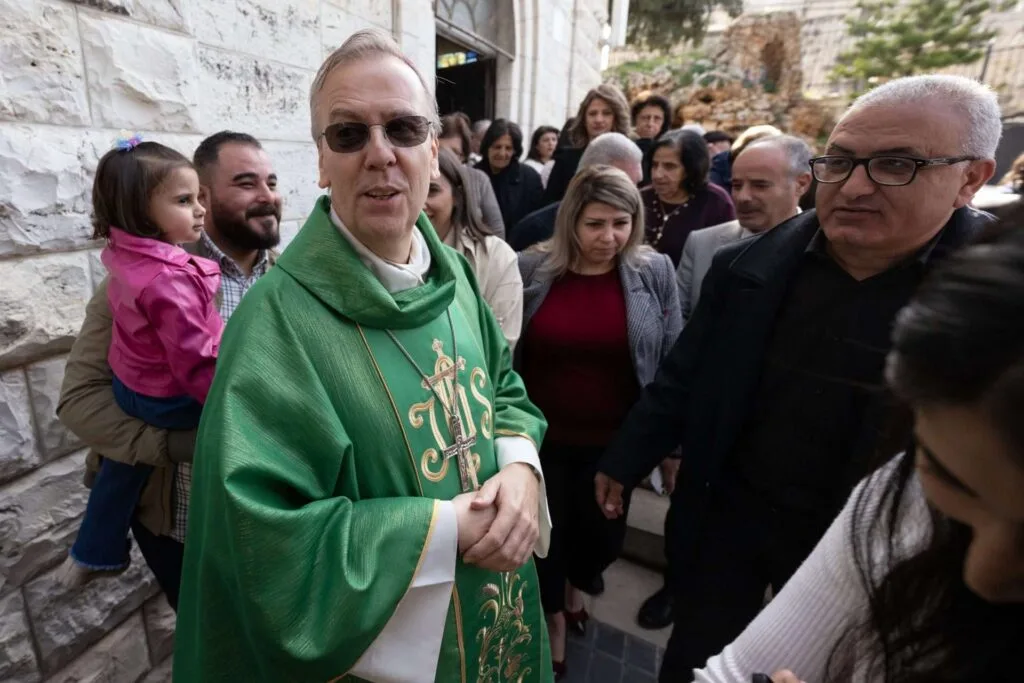
Holy Land Church Leaders Ask Christians to Return on Pilgrimage as Gaza Ceasefire Takes Effect
 By Claudette
Posted Nov 20, 2026 at 4:33 AM
The Holy Land Coordination, a delegation from international bishops’ conferences, landed in the Holy Land for a five-day visit as the ceasefire brokered between Hamas and Israel in Gaza came into effect. Bishop Nicholas Hudson, an auxiliary in the Archdiocese of Westminster and coordinator of the delegation, greeted the ceasefire with cautious optimism. He and the other bishops, including Bishop James Curry, another auxiliary in Westminster, and Archbishop William Nolan of Glasgow, prayed for peace in the Church of the Nativity in Bethlehem.
“I prayed that aid might now be allowed to flow into Gaza – poor, beleaguered Gaza – and that people on both sides of the conflict might now be able to rebuild their lives,” said Bishop Hudson.
On 20 January, Gaza’s parish priest, Fr Gabriel Romanelli IVE, told the Latin Patriarchate of Jerusalem that “the sound of explosions and drones has finally stopped.” He said some people sheltering in the parish compound had gone out “to check on their homes or what remained of them.” “Some discovered their homes were completely destroyed, while others have yet to locate their homes or even recognise the neighbourhoods they once lived in,” he said. “People are desperately seeking aid to address severe shortages of essentials like water, fuel, and food. The hardship is palpable, but so is hope and endurance, as the community holds onto the possibility of returning to some kind of normality.”
Fr Romanelli said aid agencies were providing food to thousands of families. The parish continued its prayer and pastoral work, including schooling for children approaching their secondary school Tawjihi exams. “This provides a much needed sense of hope,” he said.
In Bethlehem, the delegates visited two projects: St Martha’s House, a day care centre for elderly Christian women, and the Bethlehem Care and Hospice Trust, a Catholic charity offering compassionate care to people with life-limiting illness. Bishop Hudson said he was struck by the lack of pilgrims on the streets of both Jerusalem and Bethlehem. “It brought home to me how hard it has been for places like Bethlehem these last 15 months, not to have pilgrims come to be with them, not to be able to support them economically – whether in cafés or shops – or to support St Martha’s House, or the hospice team. They were all saying the same thing, ‘You’re the first people who have come for such a long time. Thank you for coming. We need you to come more often.'”
The Latin Patriarch of Jerusalem, Cardinal Pierbattista Pizzaballa, told the delegation that its support was much appreciated and a testament to the universal Church’s solidarity with the Church in the Holy Land. In a message from the Church of the Holy Sepulchre on 20 January, Cardinal Pizzaballa and the Custos of the Holy Land, Fr Francesco Patton, appealed for Christians to return to the Holy Land on pilgrimage.
The delegation also visited the Tent of Nations, a Palestinian farm near Bethlehem, where Daoud Nassar and his family “refuse to be enemies” as they struggle to keep their farm from being confiscated amid what the source describes as regular seizures of Palestinian agricultural land by Israeli settlers. Fr Paul Lansu, a board member of Pax Christi International who took part in the visit, said the delegation expressed solidarity with the family through their challenges. Refusing to meet hostility with hostility reflects the work of peacemaking (Matthew 5:9). Pax Christi has urged support for the Nassar family by spreading their message of nonviolence and demanding an end to threats of illegal seizure of their land.
Pax Christi International welcomed the ceasefire agreement to halt the violence and the release of hostages as “a rare moment of hope amid the suffering in Gaza, where over 46,000 lives have been lost, countless families displaced, and infrastructure destroyed, leading to famine and disease.” It lamented that in the West Bank, illegal settlements and settler violence were forcing Palestinian communities from their homes, saying “the scale of this trauma is unimaginable.” It appealed for “the beginning of meaningful dialogue grounded in justice, equality, and the dignity of all people,” and stated, “humanitarian aid must reach those in need, international law upheld, and illegal settlements ended.”
Christian Aid also welcomed the ceasefire the previous week between Israel and Hamas, but warned that “a sustainable peace is not possible until the illegal occupation of Gaza, and the West Bank – including East Jerusalem – is ended and Palestinians and Israelis are treated as equals.”
Source: Read the original report

Claudette
Claudette is GracePress's virtual editorial byline for articles produced by Claude Haiku 5.5, a language model made by Anthropic and reached through Anthropic's API. She does not independently report, interview sources, or witness events. Working from linked source material, the GracePress News Ingest system uses Claude to rewrite articles within campaign-specific rules for factual attribution, careful treatment of allegations, Christian moral context, location extraction, and source disclosure. Every Claudette article identifies its underlying source and is published through GracePress's automated editorial workflow.

