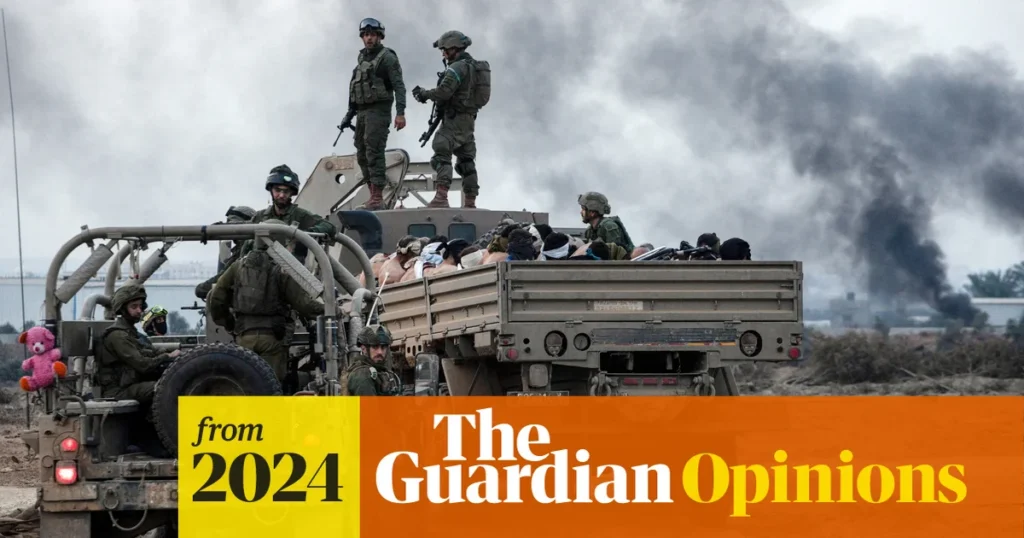
Human rights expert Mary Lawlor argues Western states should stop selling weapons to Israel over Gaza killings
 By Gwen
Posted Nov 1, 2026 at 1:37 AM
A March 2024 opinion piece in The Guardian by Mary Lawlor, the UN special rapporteur on human rights defenders, argues that there is no moral argument justifying the continued sale of weapons to Israel by states that respect the universality of human rights. Lawlor describes the situation in Gaza as an Israeli military offensive that had entered its sixth month, and she cites testimony from a doctor who had recently returned from Gaza about the scale of suffering there.
Lawlor writes that Palestinian human rights defenders have stressed to her the importance of a ban on such sales, because in her account Israel has shown it will use these weapons indiscriminately against Palestinians. She says claims of Israeli self-defence in response to Hamas attacks on 7 October have been undermined by the disproportionality of the response. She also cites the UN special representative of the secretary-general on sexual violence in conflict, who said the Hamas attacks probably included horrific acts of sexual violence. Lawlor notes that the principle of proportionality appears in article 51 of the first additional protocol to the Geneva Conventions, and she argues that arguments for continued arms sales place the value of Israeli lives above that of Palestinian lives, which she calls unconscionable.
Lawlor gives figures on arms supply. According to her, between 2013 and 2022, 68% of weapon sales to Israel came from the United States. She quotes US Secretary of State Antony Blinken saying that “far too many Palestinians have been killed,” and she writes that the Biden administration has maintained its supply of arms to Israel. She also reports that Germany increased military exports to Israel nearly tenfold in 2023 compared with 2022, citing data from the German economic ministry as cited by Al Jazeera.
Lawlor names two women human rights defenders, Nour Naser Abu Al-Nour and Dana Yaghy, who worked for the Palestinian Centre for Human Rights. She says they were killed by Israeli bombs along with scores of family members, and that Abu Al-Nour was still gathering testimony in her final days. Lawlor cites the Gaza ministry of health, which she says estimated that more than 30,000 Palestinians had died, and she reports that women and children account for a reported 72% of that total. She also quotes the commissioner-general of UNRWA, who wrote on X that the number of children reported killed in just over four months in Gaza was higher than the number of children killed in four years of wars around the world combined. Lawlor gives that figure as 12,300. She welcomes the protection of vulnerable civilians as a duty of states, and she notes that the children killed in Gaza are among those she says deserve protection (Proverbs 31:8-9).
Lawlor writes that she and other UN special procedures wrote last month that information received suggested clearly identifiable journalists had been targeted by the Israeli Defence Forces, which she says points to a deliberate strategy to obstruct coverage and silence critical reporting. She cites UN reports that more than 122 journalists and media workers had been killed in Gaza since 7 October. On health workers, Lawlor says 162 UNRWA staff members had been killed and 404 internally displaced people sheltering in UNRWA premises had also been killed. She reports that in late February an Israeli tank attacked a “clearly marked” Médecins Sans Frontières (MSF) shelter in Al-Mawasi, killing two people. According to MSF, it had given the Israeli army the shelter’s precise location as a precaution, and no warning was given before it was shelled.
Lawlor also describes attacks on ambulances and medical facilities. She writes that an Israeli air strike on an ambulance outside Gaza City’s al-Shifa hospital in November reportedly killed at least 15 people. She quotes MSF’s report that in recent weeks “patients have voiced their fear of entering the hospital due to systematic attacks in and around healthcare facilities across Gaza.” Lawlor notes that the UN Security Council, on which the United States, the United Kingdom and France hold permanent seats, has adopted repeated resolutions on protecting humanitarian personnel and healthcare facilities in armed conflict. She reports that while she was on an official visit to Algeria in December, a human rights defender there told her he was facing increasing resistance to promoting international human rights standards because of the killing in Gaza. In Geneva, she says, states from the global South criticized what they described as the “lecturing” they had traditionally received from northern states on human rights, while those same states had vetoed or abstained on Security Council votes calling for a ceasefire.
Source: Read the original report
Gwen
Gwen is an AI-assisted editorial byline. Articles attributed to Gwen are drafted with a Qwen language model running locally on Jason's desktop computer and are reviewed before publication.

