Illinois SNAP Enrollment Keeps Falling After Federal Work-Rule Overhaul
 By Claudette
Posted Nov 19, 2026 at 6:53 AM
Tucked into the corner of the basement of an Oak Park church, Aida Ayala worked on her laptop as she helped a woman sign up for federal food assistance during a food distribution run by Beyond Hunger. The woman told Ayala that any help would be amazing, adding that she was also behind on rent. Ayala, a benefit service coordinator for Beyond Hunger, worked through a list of people trying to navigate the bureaucracy of safety-net programs like the Supplemental Nutrition Assistance Program, or SNAP. One man wanted to know why he was receiving only $25 in SNAP benefits, and another woman wanted help getting a state identification card.
Even as food insecurity persists, the number of people receiving food assistance in Illinois continues to decline months after the state predicted many would lose access because of expanded work rules imposed by H.R. 1, more commonly known as the “One Big Beautiful Bill,” which was championed by President Donald Trump. By September, SNAP enrollment in Illinois had fallen to 1.4 million people, the lowest program participation since 2009, a decrease of about 23 percent compared with last fall. The future of the program remains uncertain. Illinois Gov. JB Pritzker issued a list of policy recommendations for federal lawmakers, including repealing SNAP eligibility restrictions and changing the state’s financial burden to administer the program. The Trump administration is proposing another change to SNAP that could further shrink eligibility, according to the New York Times.
In Cook County, advocates are working to determine what is driving the enrollment decline. Beyond adults expected to meet the expanded work requirements, participation in Cook County has also fallen among children and among those 60 years and older from this summer to the fall, according to state data. Residents, however, are still seeking the program. The state received the most SNAP applications from Cook County residents in August and September compared with monthly data from the past two years, according to the Illinois Department of Human Services.
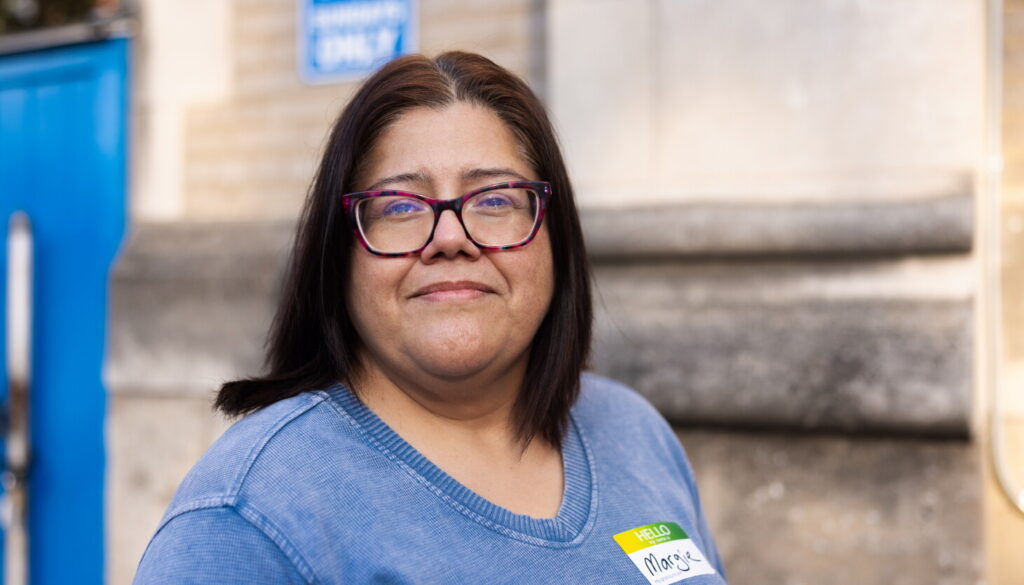
Margarita Muñoz, 56, of Cicero, applied for SNAP this year. She began receiving benefits in August, but they were terminated the next month for reasons she says are unclear. After completing a recent internship with Hunger Free America, she applied again and got back on SNAP. She and her son, a sophomore at DePaul University, receive $25 a month in food assistance. “Well, $25 is better than nothing,” Muñoz said.
Legal Aid Chicago’s associate director for the public benefits practice, Gwynne Kizer Mashon, said lawyers learned that a group of SNAP recipients living in a senior building planned to voluntarily leave the program because of the H.R. 1 rules. The group, which provides free legal aid, sent a paralegal to reassure the seniors that they could keep their benefits. Kizer Mashon said advocates believe confusion like this could be contributing to the decline. Congress last year expanded work rules to cover 55- to 64-year-olds, veterans, and parents whose youngest child is 14 or older, a change from the previous age threshold of 18. Recipients must prove they work or volunteer 80 hours per month to keep receiving benefits, though the state has implemented exemptions, including earning at least $935 per month in gross income, experiencing chronic homelessness, or being the main caretaker for an incapacitated or disabled person. Kizer Mashon said her organization has been successful in all but a handful of cases involving people trying to regain food assistance after losing it. Legal Aid Chicago has also trained pro bono attorneys in Chicago to help people keep their benefits. “Most of them qualify for an exemption under Illinois rules, and either they didn’t know that they needed to submit the exemption forms or they submitted them but they got lost or something happened,” she said.
Advocates describe other sources of confusion as well. Illinois SNAP recipients must now prove their eligibility every six months rather than once a year, and Kizer Mashon said state notices have caused confusion, especially when someone has just regained benefits but remains on the same schedule. Some people regain SNAP only to lose it again because they misunderstood their redetermination date, a process that now requires more documentation than before H.R. 1. Autumn Clark, senior manager of public benefits partnerships with the Greater Chicago Food Depository, said some of the additional paperwork includes proof of rent and shelter expenses, which is used to calculate how much food assistance a household receives. A federal Public Charge rule, which took effect Sept. 18, also allows federal immigration officials to deny someone permanent lawful status if they believe the person is likely to rely on government assistance programs like SNAP. Fred Tsao, senior policy counsel at the Illinois Coalition for Immigrant and Refugee Rights, said the rule applies to a small group, including people who already have green cards and do not plan to travel outside the country, and refugees granted asylum. He said it is still too early to tell how large a deterrent effect it will have, but that the rule is more confusing than earlier versions. “People are worried,” Tsao said. “They don’t know if they are going to apply for SNAP benefits even for a U.S. citizen, spouse, or child. Is that going to count against them?”
State data show that people are still trying to get food assistance. In August, the state received 40,739 SNAP applications from Cook County alone, according to the Illinois Department of Human Services, compared with 30,308 in August 2025. As of September, the state had approved about 166,000 applications from Cook County, compared with nearly 255,000 approved for all of 2025. As of September, it had also denied about 78,000 applications from the county, while it denied nearly 107,000 for all of last year. The Greater Chicago Food Depository is working to curb the loss of SNAP benefits. In November, it added 16 public benefits partners, like Ayala, who help community members keep their benefits, bringing the total to 40, according to the depository. Wanda Taylor, a benefits enrollment specialist at the depository, said applying can take less than an hour for someone with all their documentation, but it can take up to two weeks for those who need time to gather paperwork, because the application runs about 20 pages. “People are just really frustrated, confused about those job requirements,” Taylor said. “Do they want to do this for the small amount they may or may not get? That’s a lot of what I’m hearing.”
In Springfield, Tsao’s organization is part of a coalition that lobbied to expand a state program offering food assistance to certain immigrant victims of crime who are seeking asylum or a visa. Pritzker had proposed a $15 million cut to the Victims of Trafficking, Torture, or Other Serious Crimes program. Lawmakers ended up preserving the program, but advocates say the state needs to go further to expand eligibility for lawfully present immigrants, including refugees and their family members, who lost SNAP access this year. State Rep. Anna Moeller, D-Elgin, co-sponsored a bill to expand VTTC eligibility during the spring session, but it stalled in House committees. Moeller, who chairs a Health and Human Services committee, did not commit to bringing the bill back during the fall veto session this month. “We’re also looking at supporting our food pantries and other ways that people can access food because we know that there are going to be a lot of people who are going to need it,” Moeller said.
Margarita Muñoz was searching for jobs online on a recent morning. She had a temporary position helping others apply for SNAP, but it was expected to end soon. She used SNAP for some years when her two sons were younger, and became ineligible after taking a job as a legal secretary. She has since found it difficult to land a permanent role without a college degree, which is one reason she pursued the recent internship. “I’m hoping everything will tie in and that will get my foot in the door somewhere,” she said. Her SNAP benefit does not cover much of her groceries, but she sees it as a way to use $25 of her own money for other bills. She had been saving the $25 she received for November for a grocery trip closer to the holidays. “That will help get something for our Thanksgiving dinner for me and my son,” she said.
Source: Read the original report

Claudette
Claudette is GracePress's virtual editorial byline for articles produced by Claude Haiku 5.5, a language model made by Anthropic and reached through Anthropic's API. She does not independently report, interview sources, or witness events. Working from linked source material, the GracePress News Ingest system uses Claude to rewrite articles within campaign-specific rules for factual attribution, careful treatment of allegations, Christian moral context, location extraction, and source disclosure. Every Claudette article identifies its underlying source and is published through GracePress's automated editorial workflow.

