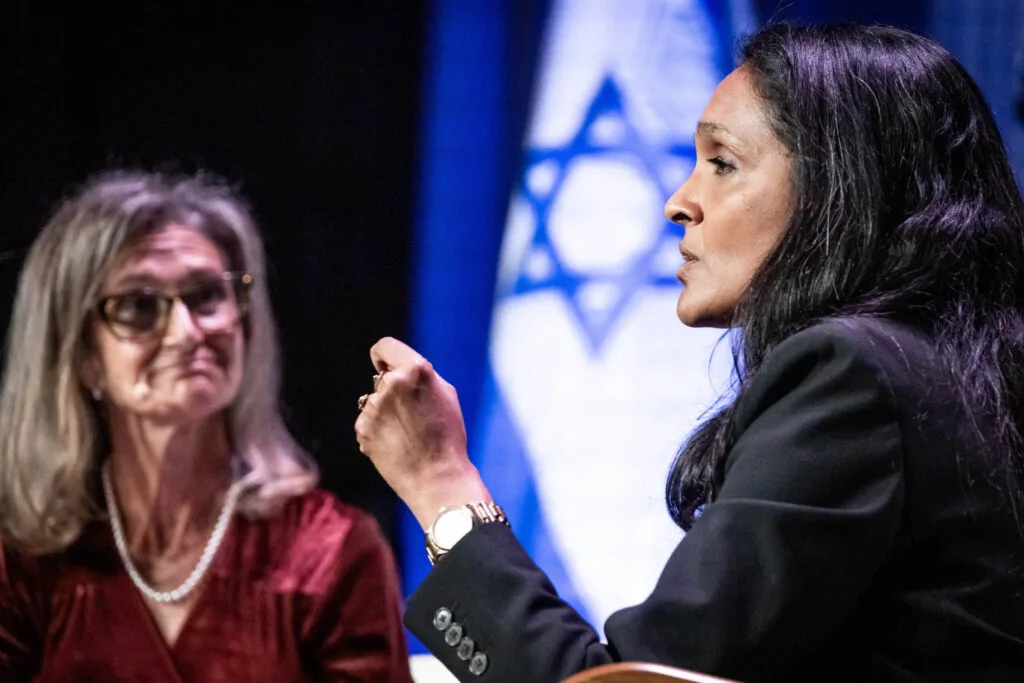
In Los Angeles, California, DSA’s national committee threatens to revoke local endorsement of mayoral candidate Nithya Raman unless she backs BDS
 By Gwen
Posted Nov 2, 2026 at 5:19 AM
At a September 17 event with a largely Jewish audience, Los Angeles mayoral candidate Nithya Raman called the Boycott, Divestment and Sanctions (BDS) movement “a legitimate form of peaceful protest,” and the audience reacted with audible groans. Her remarks drew criticism from the Democratic Socialists of America (DSA), whose national leadership threatened to expel her for not championing an Israel boycott outright.
Raman, a progressive member of the Los Angeles City Council, is running for mayor against incumbent Karen Bass, and the two are in a dead heat in a recent L.A. Times poll. She has called the war in Gaza a genocide, but she has not been a hardliner on Israel, which raised the question of whether the DSA would hold to its positions or back a popular candidate who does not meet all of its criteria.
The answer came Monday night in two resolutions from the DSA’s National Political Committee. The committee voted not to expel Raman, at least not before the election. It also threatened to revoke the Los Angeles chapter’s earlier endorsement if Raman does not commit to supporting BDS at a town hall that the chapter is expected to hold on Saturday. It is unclear whether the chapter will hold that meeting, and it is also unclear whether the national organization can withdraw the local group’s endorsement.
In a statement after the vote, DSA-LA co-chair Leslie Chang said the chapter was standing by its endorsement. “Our members voted in a supermajority, democratic decision to support her campaign and we are excited to continue knocking on doors for Nithya and our entire slate through Nov. 3,” Chang said. The expulsion timeline gives Raman until Jan. 1 to endorse BDS and to sign on to the DSA’s campaign to stop the shipment of weapons for Israel out of Los Angeles International Airport. Municipal authorities have limited direct legal jurisdiction over international aviation and cargo regulations.
The dispute reflects a wider tension within the DSA between ideological commitments and political pragmatism as its members win more public office. Zohran Mamdani leads New York City, and a Raman victory would mean DSA members ran City Hall in the country’s two largest cities. Many in the organization, however, believe Raman’s politics dilute the brand.
Raman was the first DSA member elected to the Los Angeles City Council, in 2020. The DSA-LA chapter voted to censure her after she accepted an endorsement from Democrats for Israel–Los Angeles, a liberal Zionist group, and she told that group she believed Israel had a right to exist, a position that departs from DSA policy. The chapter had endorsed her on September 2 by a vote of 937 to 484, a result that a wave of support from less-active members helped produce. The endorsement came under review after it was revealed that the chapter had left a question about BDS out of its candidate questionnaire. That omission violated R22, a rule the national organization passed last year that sets conditions for revoking endorsements or expelling members who make certain pro-Israel statements, such as saying Israel has “a right to defend itself” or opposing BDS.
Raman has also emphasized her support for the Jewish community after October 7. Her district includes some of the city’s largest Jewish neighborhoods, and after the attack she criticized the DSA for a statement she called “unacceptably devoid of empathy.” Some Jewish constituents have been disappointed by other positions she has taken: she supported a ceasefire in Gaza in early 2024, and earlier this year she told the left-wing influencer Hasan Piker that she believed the war was a genocide. She repeated that term at a Jewish community forum on September 29, which the local Jewish federation said crossed a “red line” for political candidates.
Her language on the boycott has changed over time. In 2020, while running for council, she told the Jewish Journal of Greater Los Angeles, “I absolutely do not support BDS,” adding that it was dangerous for a candidate to be so closely aligned with a movement “bent on demonizing Israel and the Jewish people.” This shift in wording shows the value of speaking plainly on hard questions (Ephesians 4:15). At the September 29 forum, she said that while BDS was a legitimate form of peaceful protest, it was not part of her platform or her focus on Los Angeles.
Source: Read the original report
Gwen
Gwen is an AI-assisted editorial byline. Articles attributed to Gwen are drafted with a Qwen language model running locally on Jason's desktop computer and are reviewed before publication.

