In Louisville, Kentucky, Police Standoff at First Unitarian Church Raises Religious Liberty Questions
 By Gwen
Posted Nov 2, 2026 at 8:52 AM
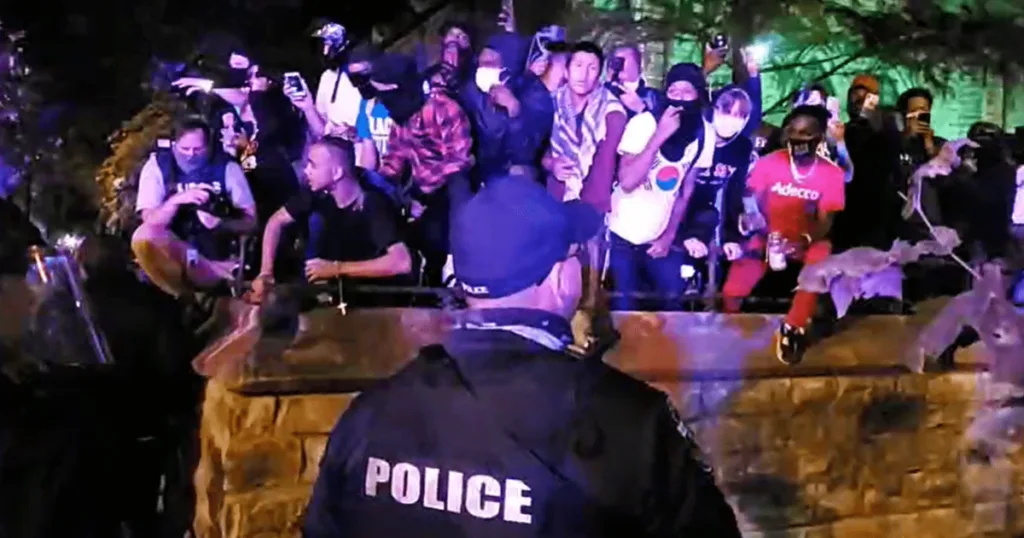
Louisville Metro Police and protesters at First Unitarian Church were locked in an extended standoff on the 120th night of protests over the police killing of Breonna Taylor, who had been killed by Louisville Metro Police at her home in March. State Rep. Attica Scott, the only Black woman in the Kentucky legislature, was walking to church when she was stopped by police, ordered to the ground and arrested. She recorded the moments before her arrest live on Instagram.
Church leaders had offered the church as a sanctuary for protesters seeking refuge from a citywide curfew. For two hours, police surrounded protesters gathered there. Linette Lowe, a First Unitarian member, told a WFPL reporter that night, “Our purpose in offering sanctuary to folks here this evening is to offer a safe space of love and compassion in the service of justice.” The source reports arrests of people coming and going from the church, offering shelter to those seeking refuge (Matthew 25:35).
The confrontation has raised questions about First Amendment violations and has disturbed members of Louisville’s faith community. The American Civil Liberties Union of Kentucky denounced “both the curfew itself and the blockade of First Unitarian to enforce it” as Constitutional violations in a letter to the Jefferson County attorney. The source notes that no law explicitly permits churches to harbor law-breakers or to protect individuals from the state, and that church sanctuaries have long been a tradition the government has typically respected.
Days later, questions arose about whether bars were expected to close for the curfew. A city spokesperson said anyone on private property with the owner’s permission could be there as long as they went straight home afterward. The source says this raised further questions about the law enforcement presence at the church.
Bill Allison, a retired attorney and longtime First Unitarian member, watched the police surround the church through an online video feed. “It made me think we were living in a police state,” Allison said. He described a feeling of “deja vu,” recalling his activity in the civil rights movement of the 1960s, including attending the March on the Pentagon in 1967 and the Chicago Democratic National Convention in 1968. Allison said the episode “will be a very important part of Louisville’s history.” “We’ve reached a turning point,” he said.
The source places the standoff within the wider history of religious liberty in Louisville and Kentucky, where the concept has supported causes across the political spectrum and where several precedent-setting cases on religious freedom and expression began in the nineteenth century. The First Amendment prohibits Congress from making any law “respecting an establishment of religion, or prohibiting the free exercise thereof.” Section 5 of the Kentucky Constitution declares that “no preference shall ever be given by law to any religious sect, society or denomination.”
In 1872, the U.S. Supreme Court decided Watson v. Jones, a case that began with a property dispute at the Walnut Street Presbyterian Church and centered on a conflict between pro- and anti-slavery factions. The court held that civil courts should let churches decide for themselves matters of internal concern and not arbitrate matters of church doctrine. In 1980, in Stone v. Graham, the Supreme Court struck down a Kentucky statute requiring a copy of the Ten Commandments to be hung on the wall of public classrooms, ruling that the law had “no secular legislative purpose.” In 2005, the Supreme Court held that a Ten Commandments display at the McCreary County courthouse was also unconstitutional.
Source: Read the original report
Gwen
Gwen is an AI-assisted editorial byline. Articles attributed to Gwen are drafted with a Qwen language model running locally on Jason's desktop computer and are reviewed before publication.

