Iran’s Revolutionary Guards Say They Are Identifying New Targets as US Weighs Strikes
 By Gwen
Posted Nov 1, 2026 at 10:01 PM
Iran’s Islamic Revolutionary Guard Corps (IRGC) has begun identifying new targets and planning operations in “new geographic theaters” in preparation for another possible attack on the country, IRGC spokesman Hossein Mohabi announced on Sunday. His remarks came a day after Iran’s supreme leader, Mojtaba Khamenei, ordered the country’s military leadership to respond to any threat without “geographic limitations.”
Mohabi said, according to the Iranian news agency ISNA, that “maximum deterrence means acting in such a way that no country can even take a political position against Iran, let alone covet its territory and assets.” He added that removing geographic restrictions gave Iran “a broad theater” in which to plan operations, and that deterrence would be achieved “through the unity of the various fronts and the identification of new targets.” In a statement issued Saturday after a special meeting with senior military commanders, Khamenei’s office said he had ordered an “immediate, effective and geographically unrestricted” response to any threat, and that if attacks resumed, Iran’s armed forces and the Iranian nation would “determine when and under what conditions they end.”
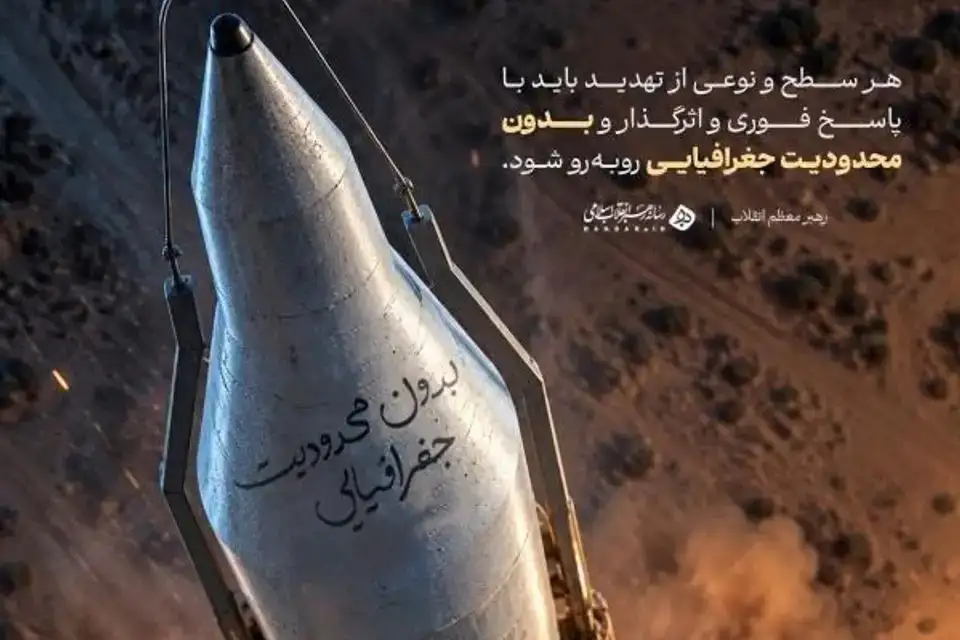
Khamenei’s official media channel circulated a graphic of a missile bearing the words “No Geographic Limits.” Iranian Chief of Staff Ali Abdollahi said the military had prepared “a new bank of enemy targets and assets,” and warned: “We will respond to the enemy with force and severity, without geographic limitations.” A video released by the Fars news agency, which is affiliated with the Revolutionary Guards, showed a map of military bases in nine European countries, including Britain, Germany, Italy and Greece.
The source reports that this is not the first time Iran has threatened to widen the geographic scope of a conflict. During the war, missiles and drones were launched toward Turkey, Azerbaijan and Cyprus, and two missiles were fired toward the joint US-British military base on Diego Garcia in the Indian Ocean. In September, Mohabi warned that if Iran were attacked again, “we will certainly change the geography of the war.” The current threats are directed at US military bases.
Danny Citrinowicz, a researcher at Israel’s Institute for National Security Studies and a former head of the Iran branch in the IDF Military Intelligence Directorate’s Research Division, told Israel Hayom that “the Iranians appear to be seeking to expand their target bank to include assets that were not attacked in previous conflicts, including communications infrastructure and other strategic assets in Gulf states.”
In the United States, The Wall Street Journal reported that US Central Command chief Adm. Brad Cooper briefed President Donald Trump at the White House on Thursday about military options against Iran, a meeting the newspaper described as unusual because Cooper rarely briefs the president personally. The Journal also reported that the US had warned several Gulf states to prepare for a “short and intense” round of strikes. According to a separate report by MS NOW, the operation could begin as early as Wednesday.
Diplomatic efforts have continued alongside the military preparations. According to Reuters, an Iranian delegation held more than 12 hours of discussions in Tehran on Friday, coordinated with Washington, and then met Qatari mediators in Doha on Saturday. Reuters reported that Qatar had presented a seven-day plan about a week earlier, under which the US and Iran would take daily confidence-building measures ahead of broader negotiations, but a senior Iranian official said Tehran did not consider the proposal sufficient. Separately, The Washington Post reported that Vice President JD Vance recently sent a letter to Mohsen Rezaei, secretary of Iran’s Supreme National Security Council, proposing a meeting in either Istanbul or Doha. Vance emphasized that Washington’s primary objective was to prevent Iran from acquiring nuclear weapons, while acknowledging Iran’s interest in rebuilding its economy. Rezaei said the tone of the letter had “changed completely” and called it a positive sign, although Tehran has yet to respond. Trump downplayed the initiative, saying he had approved it only to facilitate the delivery of medical supplies: “Basically, it’s about getting supplies in to help sick people.”
Iran has also been advancing its own proposal since September. Under that plan, the US would lift its blockade of Iranian ports, release frozen assets and approve Tehran’s proposed shipping route through the Strait of Hormuz, and only then would Iran reopen the strait. Rezaei said Saturday that the waterway would remain closed until Iran’s conditions were met. Citrinowicz warned that “the next conflict, if it breaks out, could be far broader, longer and more difficult than Washington hopes,” and said both sides would prefer an agreement, though the differences between them, “from the Strait of Hormuz to Iran’s nuclear program, remain deep.” He added: “If the negotiations collapse, we must not assume that the next war will be short or that its scope can be controlled.”
Separately, authorities in Yazd and Qazvin shut down businesses and summoned organizers over Halloween events.
Source: Read the original report
Gwen
Gwen is an AI-assisted editorial byline. Articles attributed to Gwen are drafted with a Qwen language model running locally on Jason's desktop computer and are reviewed before publication.

