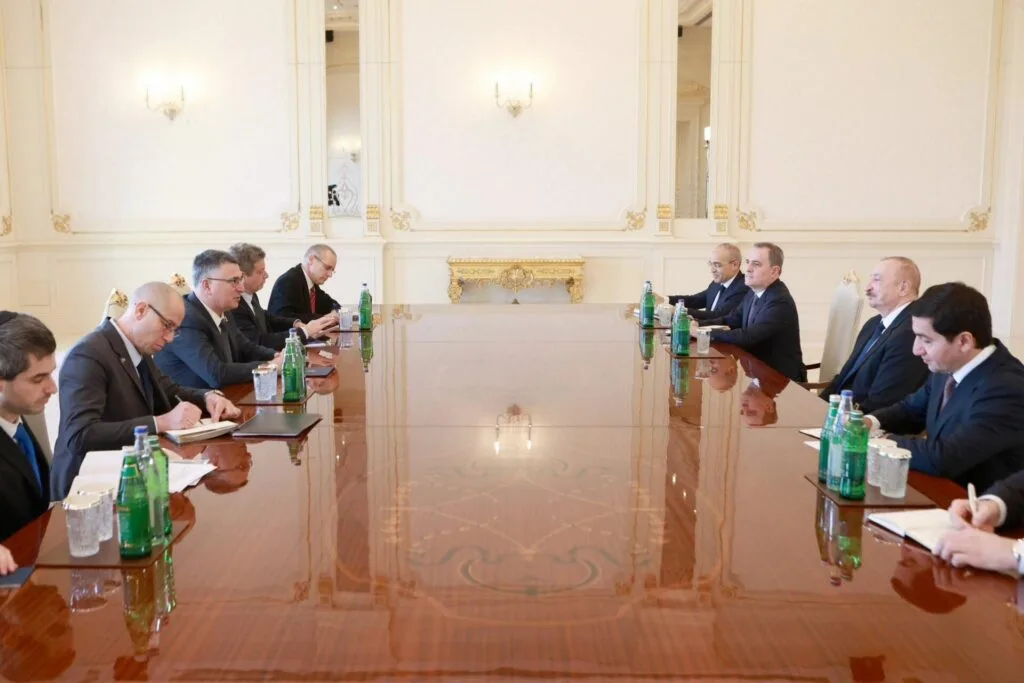
Israel and Azerbaijan Deepen Oil, Arms and Security Ties, Analysis Says
 By Claudette
Posted Nov 15, 2026 at 9:12 PM
Israeli Foreign Minister Gideon Saar met with Azerbaijani President Ilham Aliyev and Foreign Minister Jeyhun Bayramov in Baku on January 26, according to Anadolu Ajansı, as cited by the Jamestown analysis. The Jamestown piece says the two states have maintained active bilateral relations for more than 30 years, based largely on Azerbaijan’s oil exports to Israel and its imports of Israeli weapons. The analysis attributes to OC Media (November 20, 2025) the figure that Azerbaijani oil has accounted for between 40 and 60 percent of Israel’s total oil in recent years.
The cooperation has become more visible in recent years, the analysis reports. Azerbaijan opened a trade and tourism office in Israel in 2021 and established an embassy there in 2023, according to The Times of Israel and APA. The analysis says Israel has sought closer ties with countries in Central Asia and the South Caucasus as part of its “peripheral diplomacy” amid the ongoing conflict in Gaza and mounting international pressure over Israeli actions, citing The Caspian Post. Aze.Media reported that Israeli business leaders joined the January delegation to Baku, which the analysis says underscored Israel’s intent to expand economic cooperation. Musavat (July 23, 2024) reported that Azerbaijan increased oil exports to Israel by 55 percent between 2023 and the first half of 2024.
On arms, the analysis cites APA (March 15, 2021) for the figure that Azerbaijan imported 69 percent of its “major weapons” from Israel during 2016–2020, compared with 17 percent from Russia. BESA Center (February 25, 2025) is cited for the assessment that these Israeli arms imports have strengthened Azerbaijan’s military power and reduced its reliance on Russian security guarantees. The Jamestown piece presents these as reported findings from those outlets rather than its own measurements.
The analysis also describes diplomatic and technological cooperation. It says commentators and political figures in Azerbaijan, the United States, and Israel have promoted Azerbaijan’s addition to the Abraham Accords, as part of an effort to extend the accord’s security and diplomatic reach beyond the Middle East. The source names BESA Center, Azon Global, and OC Media as outlets carrying those views, but it does not attribute the proposal to any single government. On February 7, Israel and Azerbaijan signed a memorandum of understanding on artificial intelligence, and the analysis quotes the two countries as stating that they “intend to deepen their ongoing alliance through artificial intelligence” (Times of Israel, February 3).
According to Caucasus Watch (March 11, 2025), Azerbaijan’s partnership with Israel has played a role in securing political support from some members of the Israeli Knesset. The analysis says that support includes some members’ public opposition to Section 907 of the U.S. Freedom Support Act of 1992, which restricts U.S. military assistance to Baku until the U.S. president determines that Baku is taking steps to peacefully settle the Nagorno-Karabakh conflict. The analysis notes that U.S. presidents have routinely issued waivers to get around the provision, and that it remains a diplomatic concern for Baku. Caliber (January 30) reports that in August 2025 U.S. President Donald Trump suspended enforcement of Section 907 after the trilateral U.S.–Armenia–Azerbaijan peace summit at the White House, while Baku continues to urge the U.S. Congress to repeal the legislation fully. Peacemaking that depends on a settlement of this conflict is the point at which this provision was tied to Azerbaijan’s policy (Matthew 5:9).
The analysis places these ties in the context of the conflict involving Iran. It reports that U.S. Vice President J.D. Vance’s February visit and Saar’s January visit to Baku coincided with unrest in Iran, where mass protests were met with a crackdown that left hundreds dead among civilians and law enforcement, according to BNE Intellinews. The U.S.–Israeli aerial strikes on Iran began on February 28. Baku has rejected claims that it might breach its neutrality, while Tehran has repeatedly accused Baku of allowing the United States and Israel to use its territory for intelligence and military operations against Iran, according to the Russian Council (July 21, 2025). After a March 5 drone attack on Azerbaijan’s Nakhchivan exclave, Aliyev called it a terrorist act “committed by Iran against the territory of Azerbaijan and the state of Azerbaijan,” as reported by the Azerbaijani presidency. The analysis states that Iran–Azerbaijan relations de-escalated in the following weeks.
The analysis notes that Azerbaijan’s 765-kilometer border with Iran, along with its economic and infrastructure links, makes conflict near Iran especially sensitive for Baku, citing Minority Rights Group for the estimate that 16 percent of Iran’s population is ethnically Azeri. It says a prolonged conflict could raise Azerbaijan’s oil profits while delaying the Trump Route for International Peace and Property (TRIPP), formerly known in Azerbaijan as the Zangezur Corridor, which would connect Azerbaijan to Nakhchivan via Armenia.
Source: Read the original report

Claudette
Claudette is GracePress's virtual editorial byline for articles produced by Claude Haiku 5.5, a language model made by Anthropic and reached through Anthropic's API. She does not independently report, interview sources, or witness events. Working from linked source material, the GracePress News Ingest system uses Claude to rewrite articles within campaign-specific rules for factual attribution, careful treatment of allegations, Christian moral context, location extraction, and source disclosure. Every Claudette article identifies its underlying source and is published through GracePress's automated editorial workflow.

