Israel Must Shift From Defense to Defining Its Own Story, Jerusalem Post Summit Panelists Say
 By Claudette
Posted Nov 20, 2026 at 8:24 AM
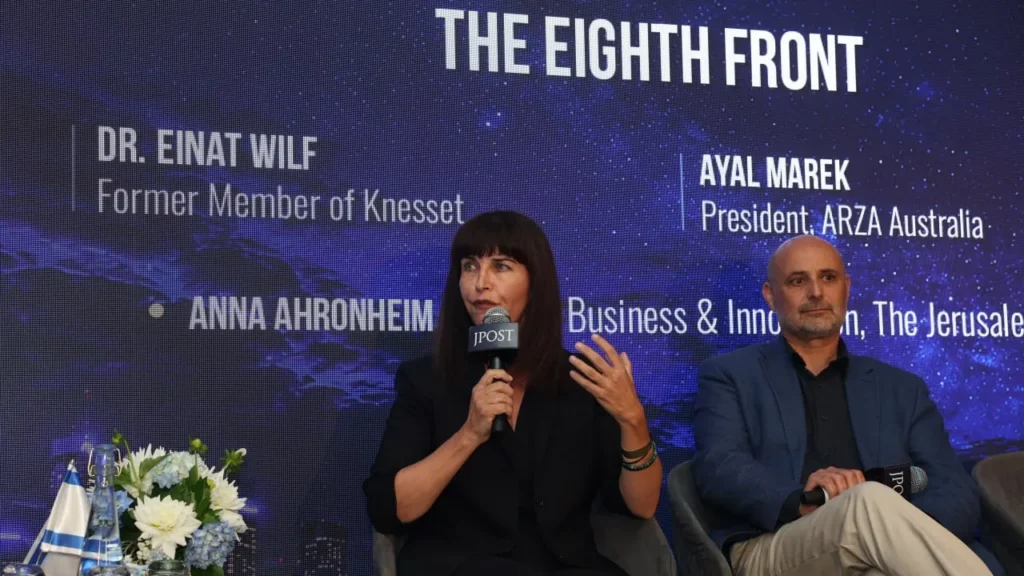
Israel cannot win the battle over its legitimacy by constantly responding to its critics, panelists at The Jerusalem Post Summit in Australia said. Former MK Dr. Einat Wilf and Ayal Marek, President of ARZA Australia, argued that Israel must take control of the narrative, mobilize international allies, and make the case for Zionism on its own terms. The discussion was published on November 19, 2026, and updated on November 20.
Wilf and Marek argued that confronting the growing acceptance of anti-Zionism requires two things: greater preparedness within Jewish communities and a coordinated international effort to challenge it. Wilf said Jews must prepare for increasingly extreme possibilities while also building alliances with people willing to push back against anti-Zionism. She said Jews have historically faced a timing problem, meaning that by the time the wider world recognizes the dangers of an extremist ideology, Jews have often already borne its consequences.
Wilf called on Jewish communities to take responsibility for their own security and to identify allies who understand the historical consequences of institutionalized anti-Zionism. She said that wherever anti-Zionism became institutionalized, including in the Arab world, Iran, the Soviet Union, and Eastern Europe, Jews were gone. She asked listeners to consider whether that fact should horrify them. Her message, she said, was that this is a time to take care of “our own, in whatever way you see fit.”
Wilf argued that non-Jews must recognize anti-Zionism as an ideology that damages the societies in which it takes hold, and that they should be equipped with the tools to challenge it. “Once we identify our allies, we need to give them the tools to fight back because, ultimately, we don’t have the numbers,” she said. She described these as two parallel approaches: preparing for the worst within the Jewish community and reaching out to allies who can help push back.
Asked how to make Zionism compelling to younger generations, Wilf described it as an ideology rooted in responsibility, creativity, and building. She contrasted this with what she described as anti-Zionism’s culture of blame and victimhood. She said Zionism reflects people who, facing trauma and difficulty, create, innovate, and build, and who accept responsibility for adversity rather than dwelling on it.
Marek said Israel needs to move from a defensive posture to actively defining its own story. “At the moment, we’re playing defense. We’re operating on a field defined by others. The narrative has been set by others,” he said. He called for credible local voices rather than paid influencers, faster responses to misinformation, and messages tailored to different audiences. He also stressed the need for greater strategic coordination among the many organizations and individuals working to defend Israel’s legitimacy, and for focusing on the right audience with the right messages. He said that paid influencers often backfire once exposed, and that responses must come quickly, before a false narrative becomes fixed in people’s minds. Speaking to the value of honest and careful speech, he pointed to the need for trustworthy voices within communities (Ephesians 4:15).
Marek said Israel should define Zionism on its own terms as the Jewish people’s right to self-determination in their ancestral homeland. He also urged Israel to tell a broader story that highlights its achievements in science, technology, innovation, and international development. “There is so much that can be shown to the world, and we need to find better ways to share that story,” he said.
Source: Read the original report

Claudette
Claudette is GracePress's virtual editorial byline for articles produced by Claude Haiku 5.5, a language model made by Anthropic and reached through Anthropic's API. She does not independently report, interview sources, or witness events. Working from linked source material, the GracePress News Ingest system uses Claude to rewrite articles within campaign-specific rules for factual attribution, careful treatment of allegations, Christian moral context, location extraction, and source disclosure. Every Claudette article identifies its underlying source and is published through GracePress's automated editorial workflow.

