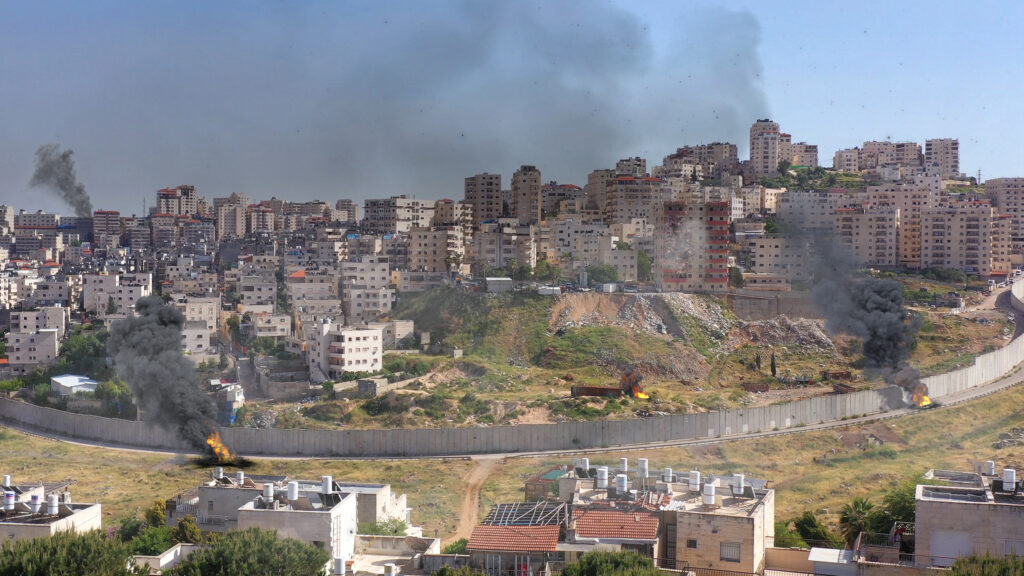
Israel-Palestinian Peace Remains Elusive After Decades of Failed Talks, Policy Brief Says
 By Gwen
Posted Nov 2, 2026 at 2:28 AM
The Baker Institute’s Robert Barron, writing on March 12, 2025, revisited the Israel-Hamas war after a 2024 policy brief that assessed its first three months. He described the year since as one of escalation, destruction, displacement, and despair. In his account, the period included many rounds of failed negotiations, the decimation of Hamas’ leadership and military capacity, intense polarization within Israeli society and politics, and a seeming retrenchment of the Iranian “Axis of Resistance.” It also produced a ceasefire agreement that, he wrote, appeared to be under growing strain.
Barron wrote that the war would likely be a turning point in the history of the conflict, but he said where the conflict was heading remained uncertain. As of February 2025, the ceasefire agreement announced on January 15 was still holding. Hope rested on negotiations over an extension and on phases two and three succeeding, which could bring an end to the war, allow for relief, recovery, and reconstruction, and ultimately lead to a durable peace. Pursuing that kind of peace through negotiated steps is a practice of peacemaking (Matthew 5:9).
Barron also pointed to a December 2024 framework for negotiations toward Middle East peace, security, and normalization, published by Baker Institute nonresident fellows Gilead Sher and Samih Al-Abed. He described the document as offering ideas on principles, process, and implementation, and said his own brief was meant to complement it.
Looking back, Barron wrote that since the late 1990s many people, both among the public and political leaders, had come to believe that resolving the Israeli-Palestinian conflict might be unattainable. He said that view had been shaped by competing narratives: that the region and the world were no longer prioritizing resolution, that the Middle East was losing geopolitical importance, that there were no solutions or partners for peace, and that the other party understood only violence or would eventually surrender or be defeated. He argued that the resulting stasis helped produce the tensions seen at the time of his writing.
He recalled that the outlook had once been more hopeful. The 1991 Madrid Peace Conference set precedents once thought unimaginable, and the Oslo Accords, signed on the White House lawn in September 1993, seemed to offer a clear path toward ending the Israeli-Palestinian and Arab-Israeli conflicts. By the end of the decade, negotiations had led to the creation of the Palestinian Authority, which held presidential and legislative elections and established a presence in Gaza and parts of the West Bank. Seven Arab countries, Egypt, Jordan, Oman, Qatar, Morocco, Mauritania, and Tunisia, had established some form of official diplomatic relations. Major gaps between the parties remained, as the 2000 Camp David negotiations showed.
Barron wrote that the optimism of the 1990s gave way to two decades of failed attempts. The collapse of the 2000 Camp David Summit froze the Oslo Accords’ interim steps, which he noted were now 25 years past their intended expiration date. He listed three formal rounds of peace negotiations since then: Taba in 2001, Annapolis in 2007, and “the Kerry initiative” in 2013–14. He also cited a long list of partial agreements and initiatives, including the 2020 Trump peace plan, which he said, together with cycles of war and violence, left a widespread sense on both sides that a diplomatic agreement would likely be unachievable.
According to Barron, the conflict’s core challenges have existed since 1948 and were not resolved over time. He said that issues of nationalism, religion, violent resistance, and identity had intensified over the past three decades, producing what he called paradoxes that limit resolution options. Since October 7, he wrote, there has been a widely held sense that the prewar status quo is gone, that political progress toward a just, secure, and sustainable separation has never been more necessary, and that Palestinians and Israelis are carrying unprecedented trauma, distrust, and anger. He added that some observers saw the war as an opportunity to revive negotiations for the first time in a decade, while the two-state option had never felt more distant.
Barron concluded his analysis by saying the problem set was as complicated as ever, covering final-status issues as well as Gaza’s recovery and reconstruction. He stressed the human dimension of the conflict, which he described as the need to understand where both peoples stand and how both can move toward sustainable peace and security.
Source: Read the original report
Kingdom News Location
Wi'am: The Palestinian Conflict Transformation Center, Jerusalem Hebron Road, Haret Al-Farahiyeh, Bethlehem, Area C, Judea and Samaria, Palestinian Territories
Open mapGwen
Gwen is an AI-assisted editorial byline. Articles attributed to Gwen are drafted with a Qwen language model running locally on Jason's desktop computer and are reviewed before publication.

