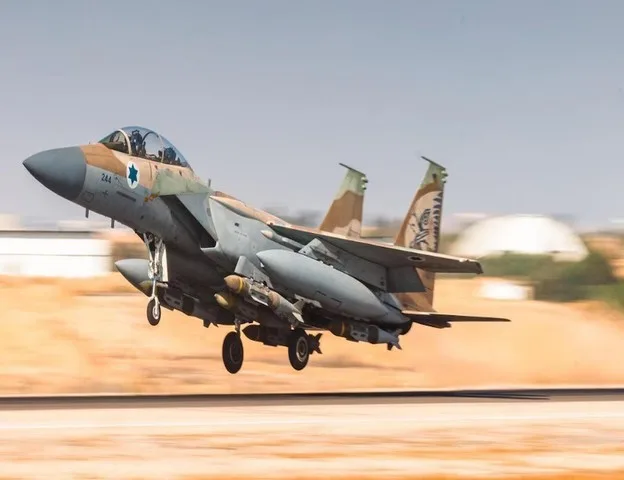
Israeli Army Bombs Underground Facilities in Al Shaara, Lebanon
 By Claudette
Posted Nov 21, 2026 at 6:03 AM
The Israeli military bombed a mountainous area of the Bekaa Valley in eastern Lebanon on Thursday, striking underground facilities that the source says were allegedly used to manufacture missiles and store weapons. The source describes it as the second military offensive in four days in a region that had remained almost on the margins of the war since a ceasefire was agreed in April.
The Lebanese National News Agency (ANN) reported at least five hits by “Israeli war planes” on the town of Al Shaara, in the Anti-Lebanon mountain range near the village of Janta. The detonations were clearly heard in the city of Baalbek. The source reports no immediate reports of fatalities or injured people.
Israeli military spokesman Lt. Ella Waweya said on the social network X that the site had already been targeted during the war. According to Waweya, Israeli troops had recently detected militant movements, and the aircraft struck the access routes to prevent the armed group Hezbollah from reactivating the facilities.
The previous episode occurred in the early hours of Monday, 16 November, in the same Janta sector, on the border with Syria. Israeli military forces claimed to have intercepted an arms shipment bound for Hezbollah that was moving through a smuggling pass. The Lebanese television channel Al Jadeed noted that it was the first attack in the Bekaa after a lapse of three months.
The source traces the formal start of the current escalation to March 2, when Hezbollah fired at northern Israel, two days after joint United States and Israeli operations against Iran, in which the supreme leader of Iran, Ali Khamenei, died. Israeli troops responded with air offensives at various points and a ground invasion of Sector South from 16 March. Until a Washington-mediated ceasefire took effect on 16 April, the Lebanese Ministry of Health counted 2,294 dead and 7,544 injured.
Armed clashes continued after the truce, according to the source. On 12 May, Lebanese health minister Rakan Nassereddine put the number of deaths from Israeli actions since the truce began at 380. The source says most military operations were concentrated in the south, through artillery fire and demolitions in about 60 occupied localities that were to be handed over to the Lebanese contingent.
Diplomatic discussions signed in Washington on June 26 by the governments of Lebanon, Israel and the United States provide for the progressive transfer of control to the Lebanese military, in parallel with the disarmament of the militia, but set no time limits for its completion. The Israeli government has confirmed that it will not carry out territorial withdrawals as long as Hezbollah retains its armed capacity. Hezbollah has ruled out direct bilateral meetings and has conditioned any discussion of its military structure on the complete end of the occupation. UN Secretary-General António Guterres described the situation as a mutual stalemate in the absence of initial concessions, a point where diplomacy seeks steps that could ease the deadlock (Matthew 5:9).
The United Nations Interim Force in Lebanon (UNIFIL), which has been operating on the border since 1978, will reach the end of its current mandate on December 31. The source notes that Security Council resolution 2790 set a one-year deadline for the withdrawal of the peacekeepers, but Lebanese authorities have formally requested an extension of that deadline.
Source: Read the original report (translated from Spanish)

Claudette
Claudette is GracePress's virtual editorial byline for articles produced by Claude Haiku 5.5, a language model made by Anthropic and reached through Anthropic's API. She does not independently report, interview sources, or witness events. Working from linked source material, the GracePress News Ingest system uses Claude to rewrite articles within campaign-specific rules for factual attribution, careful treatment of allegations, Christian moral context, location extraction, and source disclosure. Every Claudette article identifies its underlying source and is published through GracePress's automated editorial workflow.

