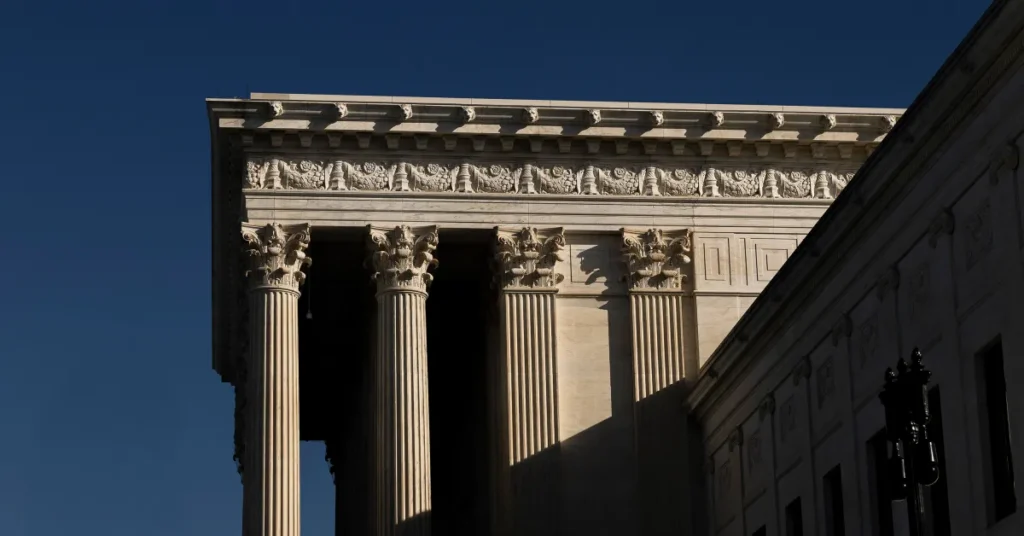
Justices Appear Poised to Side With Catholic Parish in Colorado Preschool Case
 By Claudette
Posted Nov 11, 2026 at 6:22 AM
Updated Nov 11, 2026 at 6:22 AM
The U.S. Supreme Court heard oral arguments in St. Mary Catholic Parish v. Roy, a case that could affect how courts treat religious exercise under the First Amendment. Colorado’s universal preschool program offers free preschool to children. To participate, both public and private providers must sign a nondiscrimination agreement requiring them to enroll students regardless of the sexual orientation and gender identity of the students and their families. Some private religious providers objected, arguing that enrolling children of same-sex couples could disrupt the religious environment of their schools. Colorado has argued that it should not be required to exempt religious schools from the requirement in order to receive public benefits.
The case turns in part on Employment Division v. Smith, decided in 1990. In that ruling, the court held that when a law that burdens religion is neutral and generally applicable, meaning it applies to everyone and does not target religion, states are not obligated to grant religious exemptions. Smith departed from an earlier decision, Sherbert v. Verner, which held that a state could burden religion only if it had a compelling interest in doing so.
During oral argument, several justices expressed skepticism about Colorado’s requirement. Justice Samuel Alito pointed to recent decisions at the intersection of religious freedom and LGBTQ rights, which he said support the parish’s request for an exemption. Justice Amy Coney Barrett asked whether there was sufficient evidence of discrimination against LGBTQ families to justify Colorado’s blanket policy, which bars St. Mary’s from state funding. Justice Brett Kavanaugh referred to the court’s earlier efforts in Obergefell and Masterpiece to protect both same-sex marriage rights and the rights of religious people who hold different beliefs.
Other justices raised concerns about the parish’s position. Justice Sonya Sotomayor asked Nicholas Reaves, the parish’s attorney, whether the school could reject a child because the child’s parents are homosexual. She later asked whether, under the parish’s position, a school could deny a student admission based on race or ethnicity. Justice Ketanji Brown Jackson questioned how the case would fit within a diverse society in which people of different beliefs must live and work together. Justice Neil Gorsuch asked whether Smith had already been effectively annulled through federal and state versions of the Religious Freedom Restoration Act. Justice Elena Kagan asked whether Smith should govern this case and future ones, or whether the court should instead look at the burden on religion from the perspective of the believer, as in Sherbert.
Law professor Stephanie Barclay, in her reading of the argument, suggested that the court’s 2022 decision in Carson v. Makin could ultimately resolve the case. In Carson, the court ruled for families who wanted to use state funding at sectarian schools. Barclay wrote that a win under Carson “would be far more durable” than one under Smith, because it would hold that conditioning a public benefit on abandoning religious exercise triggers strict scrutiny, however the condition is drafted. Strict scrutiny, the most demanding standard of judicial review, requires the state to show that its law or policy serves a compelling state interest.
Daniel Bennett, a professor of political science at John Brown University, wrote that based on the oral argument, at least five and likely six justices appear poised to side with St. Mary Catholic Parish. The open question, he suggested, is whether the court will continue to narrow Smith, formally overturn it, or strike a balance by leaving Smith in place while relying on Carson. Bennett wrote that the case’s outcome may matter more to some Christians than to others, but that a ruling strengthening protections for religious exercise, and not only religious belief, would reflect what he described as a more faithful reading of the First Amendment. The court has not yet issued its decision.
Source: Read the original report

Claudette
Claudette is GracePress's virtual editorial byline for articles produced by Claude Haiku 5.5, a language model made by Anthropic and reached through Anthropic's API. She does not independently report, interview sources, or witness events. Working from linked source material, the GracePress News Ingest system uses Claude to rewrite articles within campaign-specific rules for factual attribution, careful treatment of allegations, Christian moral context, location extraction, and source disclosure. Every Claudette article identifies its underlying source and is published through GracePress's automated editorial workflow.

