Latter-day Saint Women Fewer Often Called, Chosen or Quoted at General Conference
 By Claudette
Posted Nov 21, 2026 at 3:52 AM
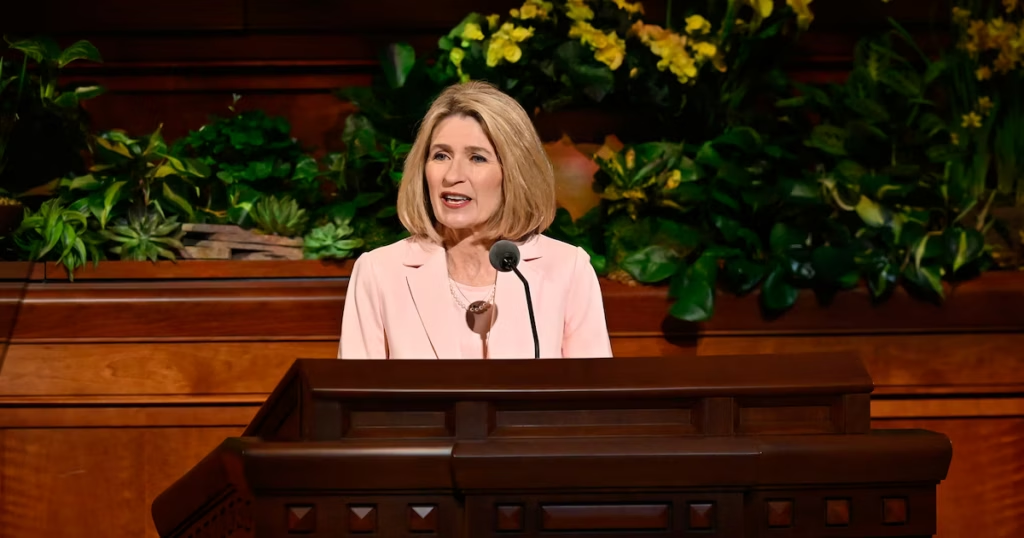
Feminists say that if Latter-day Saint leaders truly want to hear more women’s voices in The Church of Jesus Christ of Latter-day Saints, they would invite more women to speak at the faith’s semiannual General Conferences and quote them in speeches given by men and women alike. At the just-completed 193rd Annual General Conference, two of the 33 speakers across the five sessions were women. Camille N. Johnson, president of the church’s global Relief Society, was one of them, speaking on Palm Sunday, April 2, 2023.
A report published shortly afterward examined General Conferences from 1971 through 2020. Its author, Eliza Wells, a graduate student in philosophy at the Massachusetts Institute of Technology, found that Latter-day Saint leaders quoted men more than 16 times for every one time they cited a woman. In her report, “Quoted at the Pulpit: Male Rhetoric and Female Authority in 50 Years of General Conference,” Wells writes that, even allowing for the expected effects of the church’s overwhelmingly male scripture and all-male priesthood hierarchy, women “are quoted less, cited less, and acknowledged less.”
Midway through the latest conference, the podcast “At Last She Said It” posted a graphic on its social media that read, “More Talks by Women.” Susan M. Hinckley, one of the podcasters, said that nearly 500 comments on the post expressed “frustration, sadness and disbelief at the lack of women’s voices.” Some commenters said their young daughters had asked why there were no “girls” in talks and no visible women in leadership on the stand. One woman wrote, “I don’t watch anymore. I deserve so much better. We all do,” Hinckley noted. Hinckley also argued that only two female speakers per session would yield five times more talks by women.
Young-Bennett, a blogger quoted in the article, said that when she asks for more women speakers, some church members tell her to focus on the messages of conference rather than the demographics of the speakers. She said the choice to invite few women sends an implicit message. “If women’s words really mattered,” Young-Bennett said, the First Presidency and Quorum of the Twelve Apostles “would give them proportionate speaking time.” She said that excluding women “is a choice,” because the brethren in those governing bodies decide whom to invite. She also said there is “no scriptural mandate against women speaking at General Conference,” and that leaders are not limited to the general officer callings held by women, since there is precedent for inviting speakers from outside those ranks. Her choices, she said, are a matter of accountability for the authority they hold (Luke 12:48).
Wells argues in her Dialogue: A Journal of Mormon Thought essay that the sources leaders choose carry meaning. When “the most powerful leaders in the church use their limited time in the spotlight to highlight someone else’s words, they send a signal about how that source should be perceived,” she writes. She adds that, despite church leaders’ increasingly vocal commitments to the equal though separate status of women and men, those leaders “continue to treat female voices as less authoritative than male ones.”
Wells said in an interview that she was particularly struck by how, in talks about gender, apostles and prophets rarely used women’s words to speak about women’s lives and roles. That observation led her to examine quotations more broadly. For her analysis, she read every April conference speech given by an apostle or member of the First Presidency from 1971 through 2020, along with those given by female leaders in the same period. She noted that women did not become regular speakers at the annual meeting until 1988. “The sources that appear in General Conference,” she writes, “are deliberately chosen with the spiritual and institutional goals of the church’s highest leaders in mind.”
Besides other prophets and scripture, the article notes, presidents also quote current and past apostles, as well as secular poets and historical figures. Those cited include William Wordsworth, philosopher Arthur Schopenhauer and New York Times columnist David Brooks.
Source: Read the original report

Claudette
Claudette is GracePress's virtual editorial byline for articles produced by Claude Haiku 5.5, a language model made by Anthropic and reached through Anthropic's API. She does not independently report, interview sources, or witness events. Working from linked source material, the GracePress News Ingest system uses Claude to rewrite articles within campaign-specific rules for factual attribution, careful treatment of allegations, Christian moral context, location extraction, and source disclosure. Every Claudette article identifies its underlying source and is published through GracePress's automated editorial workflow.

