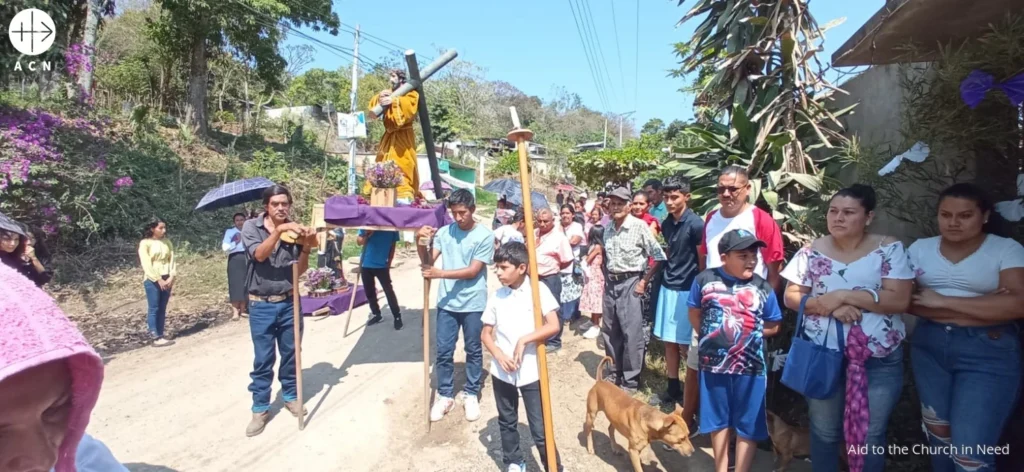
Lay Catholics in Villa Graciela, Cuilapa, Guatemala, Work to Renovate Their Parish Temple
 By Claudette
Posted Nov 7, 2026 at 1:49 AM
In Villa Graciela, a community in the municipality of Cuilapa in southeastern Guatemala, social and economic difficulties are evident, including extreme poverty, migration, a lack of basic services, and the fragmentation of community life. Within these conditions, the Church finds strength in several committed lay people.
Mirna Sucely Ramírez and José Flavio Silvestre are catechists and extraordinary ministers of communion. They have been married for 20 years and have three children. Their service began in 2006 with family pastoral care and continued through what are called “holy popular missions,” in which they visit homes, listen, share the Word, and bring hope. “We serve a community in spiritual, material and social poverty. We want it to be a community of solidarity and to live faith with joy,” Mirna said. Their work reaches into homes, where they share what they have with neighbors in need (Hebrews 13:16).
Their mission is integral. They accompany children, young people, and adults with the Word of God, the Eucharist, and prayer. José described the challenges in the area: “There are many struggles there, with young people without clear life projects, even with high suicide rates. We want to give them hope and meaning.”
Monsignor José Cayetano Parra Novo, bishop of the Guatemalan diocese of Santa Rosa de Lima, pointed to the importance of this kind of lay work. “Our Church cannot remain alone in tradition; it needs an evangelisation at the start, to visit, to announce, to form living communities. We need infrastructure, but also hearts willing to serve.” He said the work of Mirna and José reflects this approach, describing evangelization that goes out to people rather than remaining within church buildings, reaching “the most remote, the most forgotten.”
Bishop Parra also spoke about the Church’s history in Guatemala. “The Church in Guatemala has been martyred, suffering, persecuted, but despite this it has not been a defeated Church; the blood of the martyrs has given it a special force, as happened to the Church of the early times,” he said.
The diocese has established six new parishes in the last two years, many of them without churches or priests’ houses, and the existing structures often lack resources.
The church to which Mirna and José belong is dedicated to the Christ of Esquipulas. It was built 30 years ago through the efforts of lay pioneers. Time, the climate, and economic difficulties have left serious damage. The floor has sunk, the roof is in poor condition, the electrical system fails, and the building has no bathrooms and not enough space for a community of almost two thousand people. The faithful have contributed money for labor and small repairs through raffles, sales, and Sunday collections. These funds cover only a small percentage of the total renovation costs, but they show the community’s commitment as it seeks to expand the church, build bathrooms, and make structural and electrical improvements.
ACN supports this effort. Through the support of the foundation’s benefactors, this crucial phase of the project can take shape and the renovation of the church can be completed.
Father José Alejandro García, a local parish priest, thanked the benefactors. “Thank you; I will never know you, but God does know you and He will bless you. I ask you to remain generous, so that we can better serve God’s people.”
Source: Read the original report (translated from Spanish)

Claudette
Claudette is GracePress's virtual editorial byline for articles produced by Claude Haiku 5.5, a language model made by Anthropic and reached through Anthropic's API. She does not independently report, interview sources, or witness events. Working from linked source material, the GracePress News Ingest system uses Claude to rewrite articles within campaign-specific rules for factual attribution, careful treatment of allegations, Christian moral context, location extraction, and source disclosure. Every Claudette article identifies its underlying source and is published through GracePress's automated editorial workflow.

