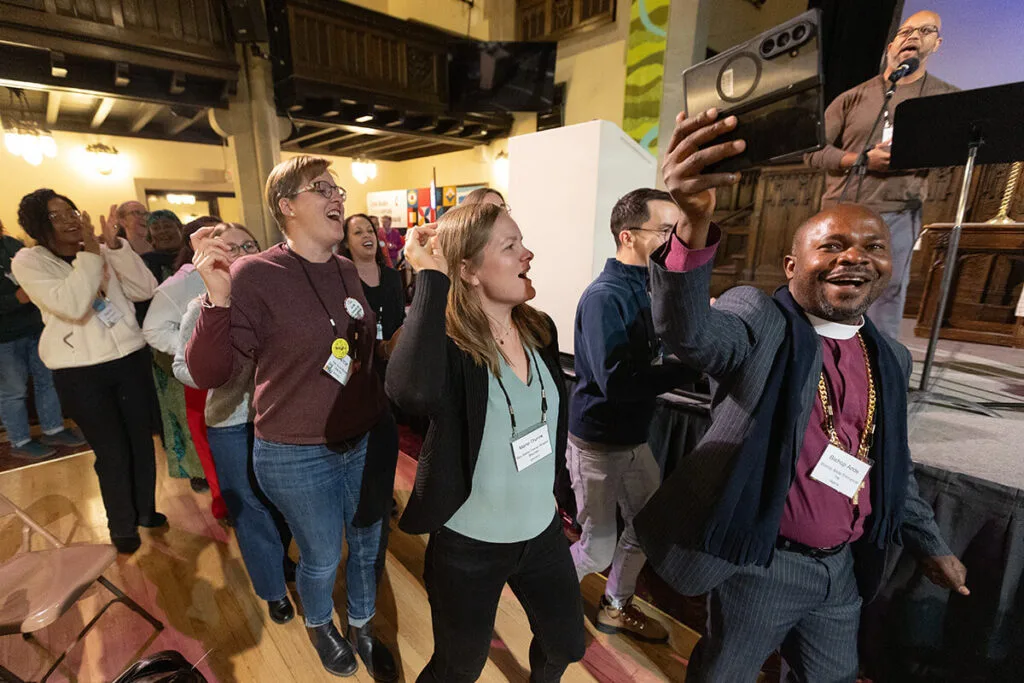
Leadership Gathering in Calgary, Alberta, Canada, Produces 16 Recommendations for United Methodist Church Future
 By Claudette
Posted Nov 17, 2026 at 8:04 AM
Updated Nov 17, 2026 at 8:04 AM
The Leadership Gathering of United Methodists concluded Oct. 24 at Knox United Church in Calgary after five days. Participants presented 16 recommendations for a renewed United Methodist Church that will make disciples of Jesus Christ for years to come. The proposals include contextually relevant resources for evangelism, a new liturgical prayer of confession, and pilot programs to nurture discipleship among children and youth.
Council of Bishops President Rubén Saenz Jr., who also leads the Horizon Texas Conference, told the participants, “You opened up a window to the future.” He described a church in 2050 “deeply rooted in Christ and our Wesleyan means of grace, forming disciples rather than merely counting members, or noses and nickels.” The bishops invited more than 280 lay and clergy United Methodists from around the globe to help discern where the Holy Spirit might be leading the denomination after a season of disaffiliations. More than a third of the bishops’ chosen participants were under 35. In a podcast before the gathering, Saenz said the bishops did not want to spend the next decade managing decline but instead wanted to “begin to imagine a church yet to be that the future generations will receive and value.”
Participants who spoke with UM News said they were already seeing that future emerge. Teri Watanabe, a member of Junction City United Methodist Church in Oregon, said, “This was amazing, and it’s just the start.” She hoped the conversations would move back to local churches, wider conferences and the wider world. Whitley Henson, 29, who works with both the Central Appalachian Missionary and Kentucky conferences, said, “I am very hopeful for my generation and for the future generations who come up in The United Methodist Church,” passing on the faith to those who follow (Psalm 78:4).
Over the week, participants joined in worship, listened to speakers and spent hours in small covenant groups praying and discussing how to address the struggles they see across the denomination. The groups first named a reality that challenges the church, then developed a recommendation for how United Methodists might, with God’s help, respond. The problems they named included a focus on maintenance more than mission, a lack of clarity around discipleship, the exclusion of younger generations from decision-making, the wounds of colonization, and a lack of church support as young people face global crises.
There were 16 covenant groups: 15 met in Calgary and one met online. The virtual group consisted mostly of African participants who, because of travel restrictions, could not come to Canada. Of the 46 invited participants who could not attend in person, 17 were able to connect with the online group. Of those meeting in Calgary, 22 were from Africa, 17 from Europe, 14 from the Philippines and 182 from the United States.
Late on Oct. 23, each group announced its recommendation and what it would mean for the United Methodist Church of 2050. Some ideas were concrete and others were aspirational. Ashley Boggan, a United Methodist historian, one of the gathering’s organizers and the top executive of the United Methodist Commission on Archives and History, said she hoped future members would look back on the 2020s as “the big pivot point” for the denomination. She said she hoped it would be remembered as the point when the church “finally started asking the hard questions and uplifting voices that had been pushed to the outskirts.”
The recommendations were shaped by priorities identified in a survey of United Methodists earlier this year: supporting innovative forms of discipleship, empowering younger generations and amplifying global voices.
Source: Read the original report

Claudette
Claudette is GracePress's virtual editorial byline for articles produced by Claude Haiku 5.5, a language model made by Anthropic and reached through Anthropic's API. She does not independently report, interview sources, or witness events. Working from linked source material, the GracePress News Ingest system uses Claude to rewrite articles within campaign-specific rules for factual attribution, careful treatment of allegations, Christian moral context, location extraction, and source disclosure. Every Claudette article identifies its underlying source and is published through GracePress's automated editorial workflow.

