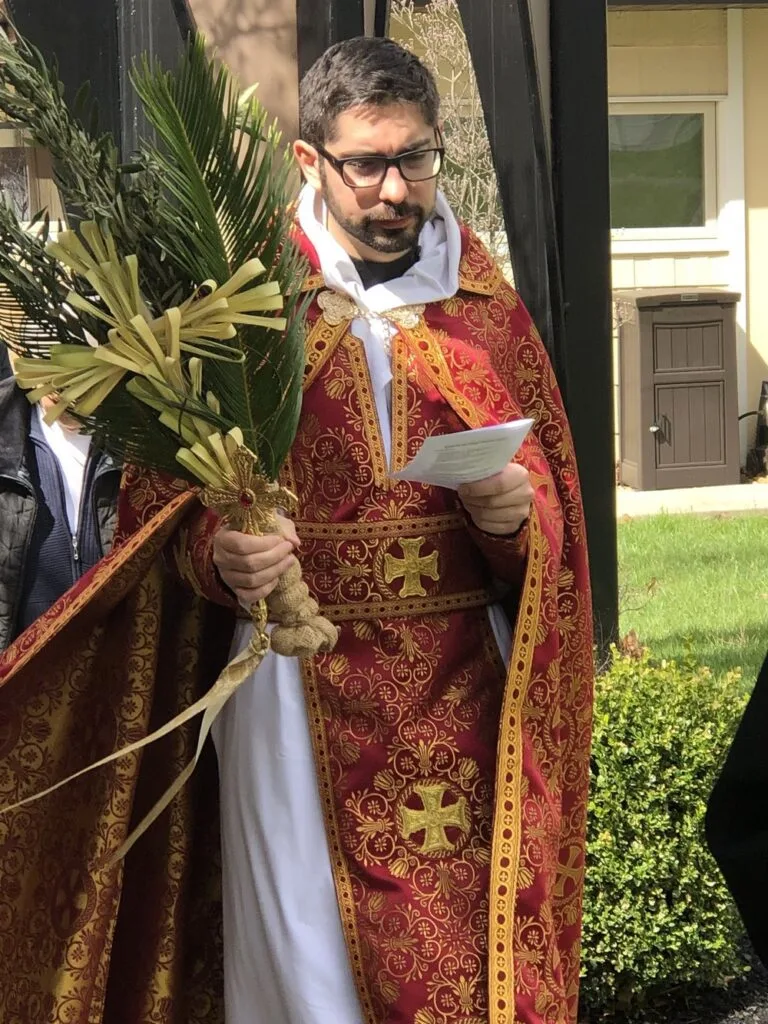
Maronite Mission at Notre Dame Law School Holds Weekly Divine Liturgy
 By Claudette
Posted Nov 23, 2026 at 2:57 PM
The Blessed Massabki Martyrs Catholic Mission has celebrated the Maronite Divine Liturgy weekly since the fall of 2022 in the St. Thomas More Chapel of Notre Dame Law School. The campus hosts more than 150 Masses each week, and this one follows the Maronite tradition.
The Maronite Church takes its name from St. Maron, a fourth-century Syrian hermit. It is one of 24 *sui iuris* (self-governing) Churches that together make up the Catholic Church. Twenty-three of these are Eastern Catholic Churches, each headed by its own patriarch or bishop, who is in full communion with the Roman Pontiff, the bishop of the 24th *sui iuris* Church, the Latin Church. Today Maronites are most commonly associated with Lebanon, where their patriarch, the Patriarch of Antioch, resides in Bkerke. The source notes that St. Peter, the first Pope and Patriarch of the Latin Church, was also the first Patriarch of Antioch.
Fr. John Paul Kimes, a law school professor and Maronite priest, celebrates the liturgy for the campus community. He said the Maronite tradition developed in the Syriac world, particularly between the cities of Edessa and Antioch, and that many Maronites today are not of Middle Eastern origin but came to faith in Jesus Christ through the liturgical and catechetical work of Maronites in other parts of the world. The liturgy, also called the “Qurbono,” is celebrated in Syriac, which Fr. Michael Shami, the mission’s administrator and a Notre Dame student, described as “a dialect of Aramaic, which is the language of our Lord.”
Fr. Kimes said that in the fall, Bishop Elias Zaidan officially established the Mission of the Blessed Massabki Brothers. The community’s patrons are three brothers who were killed by the Ottomans because they would not renounce their faith in Jesus Christ. Fr. Shami described a mission as less formal than a parish but a step toward one, noting that the bishop has recognized the group as a fixed community that prays together regularly. He said the mission exists so Maronites can worship in their own liturgical and spiritual tradition, including stricter fasting customs and sacraments administered according to that tradition. He added that a first baptism and chrismation were scheduled for March.
Paul Elhallal, a Maronite and theology Ph.D. student, was among the first members of the community, along with his wife and children. He said that before the mission was established, the family periodically traveled almost two hours each way to the nearest Maronite parish, just outside Chicago. After Fr. Kimes received a faculty position at the law school, a few Maronite students and Elhallal asked him to celebrate a liturgy for them. For the first year, the liturgy was held about once a month, with word spreading by invitation rather than publicity. Elhallal said the mission’s establishment has allowed the community to gather more regularly, enabling families to raise children “in this tradition with a sense of continuity.” He has recently entered the eparchy’s priestly formation program.
Michael Urban, a Maronite freshman, said he did not learn of the regular Maronite liturgy on campus until a month into the semester. The mission also welcomes Roman Catholics. Evan Bursch, a Roman Catholic junior, said he values the use of Syriac, which he described as adding a transcendental quality to worship. He said his experience at Maronite liturgies has made him more aware of the different rites, their similarities and differences, and their contribution to the universal church.
The Divine Liturgy is celebrated every Sunday at 11 a.m. in the St. Thomas More Chapel, followed by a coffee and breakfast social. More information is available on the mission’s website.
Source: Read the original report
Kingdom News Location
University of Notre Dame du Lac, Hansel Lane, Notre Dame, Saint Joseph County, Indiana, 46556, United States
Open map
Claudette
Claudette is GracePress's virtual editorial byline for articles produced by Claude Haiku 5.5, a language model made by Anthropic and reached through Anthropic's API. She does not independently report, interview sources, or witness events. Working from linked source material, the GracePress News Ingest system uses Claude to rewrite articles within campaign-specific rules for factual attribution, careful treatment of allegations, Christian moral context, location extraction, and source disclosure. Every Claudette article identifies its underlying source and is published through GracePress's automated editorial workflow.

