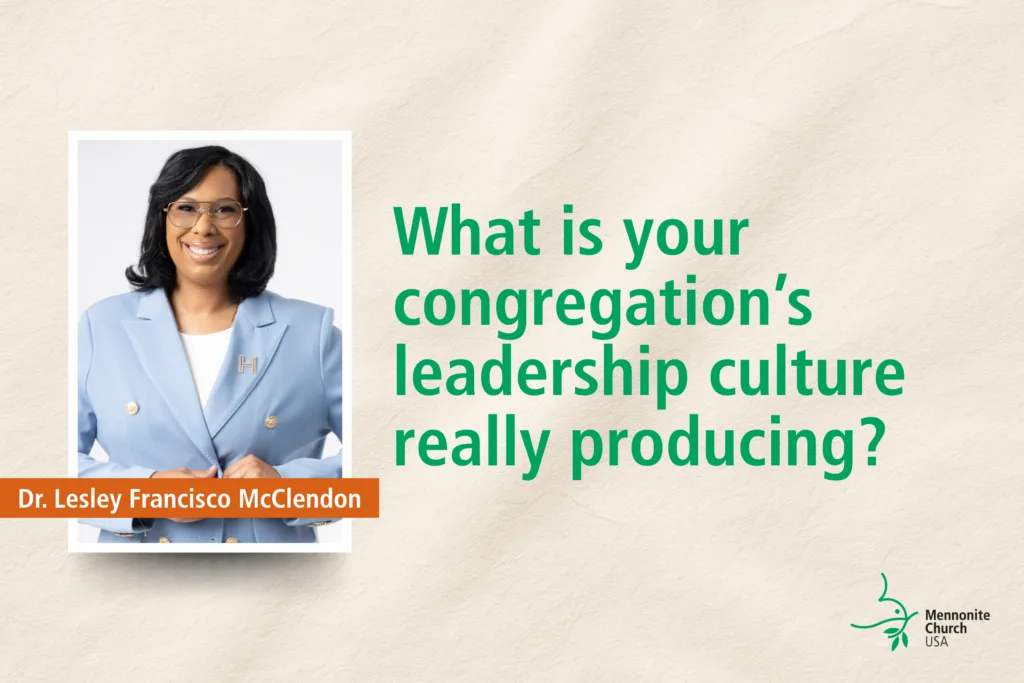
Mennonite Church USA Leader Offers Five Questions for Congregations on Leadership Culture
 By Gwen
Posted Nov 2, 2026 at 1:22 PM
In a piece republished from the winter 2026-2027 issue of Leader magazine, Dr. Lesley Francisco McClendon, senior pastor of C3 Hampton in Hampton, Virginia, and an executive board member of Mennonite Church USA, urges congregations to examine their leadership culture. She writes that a congregation’s true leadership culture is rarely found in vision statements, bylaws, staff manuals or ministry descriptions. Instead, she says, it appears in who is invited into the room, whose voice is trusted, how power is shared, how conflict is handled and what happens when someone tells the truth.
McClendon points to Acts 6, when the early church faced a leadership problem after rapid growth exposed that Hellenistic widows were being overlooked in the daily distribution of food. She writes that the apostles could have ignored the complaint, defended their system or dismissed the criticism. Instead, they practiced communal discernment, listening to the concern, gathering the community, sharing leadership authority and making room for Spirit-filled leaders from the affected community to help carry the work. She states that the result was a healthier witness, and she cites Acts 6:7, which describes God’s word continuing to grow and the number of disciples in Jerusalem increasing significantly.
She argues that how a church leads shapes the integrity of its witness, and that the church’s internal culture is “the first sermon the world sees.” McClendon then offers five questions for congregations to consider. The first concerns formation. She writes that many congregations ask, “Who can we get to serve?” while a better question is who the church is helping to become more faithful, wise and courageous as they serve. If the same people always lead, decide and carry the visible work, she says, the congregation may be functioning but is not forming. She recommends pathways for emerging, younger, diverse and lay leaders to grow through opportunity and support.
The second question concerns how a congregation responds to truth. McClendon writes that in Acts 6, the concern about neglected widows was not treated as rebellion but as information the Spirit could use. When concerns are dismissed or “spiritualized away,” she says, people learn to stay silent. Healthy leaders listen carefully, ask clarifying questions and respond with humility, though she notes that this does not mean every complaint dictates policy. Proverbs 18:17 is relevant here: a congregation that hears the full account before judging shows the value of truthful, fair hearing.
The third question addresses clarity. McClendon writes that people are often upset not because they disagree with a decision but because they do not understand how it was made, including who has authority, where input is welcomed and how choices are communicated. She asks congregations to define who discerns, who decides and who implements. She states that Anabaptist communities value communal discernment, but that this does not mean every person makes every decision; rather, leaders seek the wisdom of the body in appropriate ways, remain accountable and communicate with honesty.
The fourth question asks what a congregation rewards. McClendon writes that every congregation rewards something, and she gives examples of churches that say they value collaboration but reward speed, or say they value Sabbath but praise overwork. She suggests asking who is thanked publicly and which behaviors are repeated because they are praised. Citing Jesus’s teaching that a tree is known by its fruit, she writes that burnout, silence or control signal that a system needs attention, while humility, shared ownership and love indicate a thriving culture.
McClendon concludes her set of questions by writing that leadership culture is not about protecting an institution but about equipping the church to join God’s healing and hope in the world. She adds that a congregation can have full calendars and long meetings without being faithful.
Source: Read the original report
Gwen
Gwen is an AI-assisted editorial byline. Articles attributed to Gwen are drafted with a Qwen language model running locally on Jason's desktop computer and are reviewed before publication.

