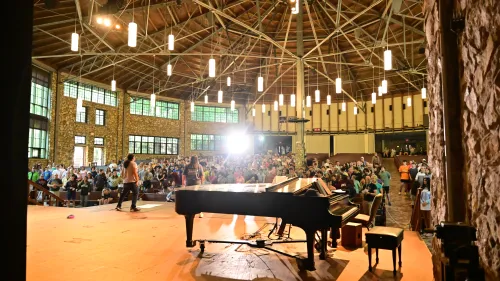
Montreat Youth Conference in Montreat, North Carolina, focuses on acceptance and personal faith
 By Gwen
Posted Nov 5, 2026 at 4:19 AM
“Oh my, that’s a whole lot of folks,” said the Rev. CeCe Armstrong, Co-Moderator of the 226th General Assembly (2024), as she looked out from the stage of Anderson Auditorium at the Montreat Conference Center during the second week of the Montreat Youth Conference. She saw about 800 youth and leaders filling the pews. Armstrong, who preached during the first and second weeks, said she was surprised by the size of the crowd, which was much larger than the week before. Last year, the conference welcomed more than 3,600 people over its six sessions in June and July.
The Rev. Casey Wait, the featured keynoter for those sessions, invited Armstrong to pray before the service began. Armstrong then offered a brief, microphoned prayer, “Help us, O Lord,” which Wait said was meant to invite conference-goers to be themselves and trust in God’s presence. The message of welcome had already been delivered at the opening event on Sunday night by Wait; recreation leaders, the Rev. Neeley Rentz Lane and Alejandro Salas Hernandez; and music leaders, the Rev. Kim Mendoza and Isaac Moshay. Each leader shared a short personal story of how they came to the conference.
Wait, who had never attended the Montreat Youth Conference before, was asked to deliver five keynote speeches on this year’s theme, “Light My Path.” She spoke about how she and others may feel like outsiders and gave the youth an orientation to the Montreat grounds and the slang used for its different spaces. She described her own journey with ADHD, which she was diagnosed with in high school, and her effort to accept the gifts and challenges of being “fearfully and wonderfully made.” Several of her keynotes included a video she wrote, directed and produced, in which she used wigs and pop culture references to portray thoughts and insecurities. Some youth said the references were distracting or offensive, while others found them creative. One young participant said she had not felt she fit in because she struggled with what she believed, but was glad to hear a singer who she said had been ostracized by church people mentioned in worship.
Montreat staff and the conference pastor also made themselves available at the Huckleberry Café, known as “the Huck,” to offer guests coffee or theological conversation. Susie Watson Burns, director of church relations at Montreat, said her work includes finding ways to bring new congregations to the conference, including churches with only one youth and one leader, arranging housing or scholarships for youth from new worshiping communities and immigrant churches, and arranging accommodations for youth with neurodiverse needs. “I help congregations live into their baptismal vows,” she said. She added, “They can’t just inherit the faith of their parents. They have to find their own faith.” Tanner Pickett, vice president for communications at Montreat Conference Center, said small groups mixing youth from many churches and the “back-home groups” that process experiences with their own congregations were the two elements that stood out to him.
During the next day’s keynote, Wait said she became a visual artist at age 40. Her talk on Nicodemus included her sketching his image while she read the Scripture in a voice-over. In the same talk, she showed a video of Sikh activist and writer Valarie Kaur, recorded at a Watchnight service of the Poor People’s Campaign on Jan. 17, 2017, in which Kaur spoke about revolutionary love and asked, “What if this darkness is not the darkness of the tomb but the darkness of the womb?” Later, during the “back home devotional guide,” youth discussed the video and the challenges of their day with their church groups. Responses were mixed, and the discussions showed a range of political and theological views among the youth.
Several young participants described the discussions as difficult. One junior from Decatur, Georgia, said she was offended by a friend’s political views but did not know how to disagree without damaging the relationship, and she chose to “be present and love her as Jesus would.” A freshman from Atlanta said his group kept talking around disagreements rather than addressing them directly. A group from South Carolina wrestled with theological differences, and one chaperone said she worried the group bordered on universalism, stating, “To not believe in hell is taking the easy way out.” The associate pastor of that church later said he appreciated the balance between Wait, who addressed the issues youth face daily, and Armstrong, who placed those themes within the tradition and sought common ground for worship.
Each evening, Armstrong tied the “Light My Path” theme to the liturgical calendar. Wearing a clergy collar in the color of a different season, she spoke about God’s presence in light and darkness during Advent, Epiphany, Transfiguration, Resurrection and Pentecost. Hanging from her neck was a red butterfly pendant that glittered whenever it caught the light.
Source: Read the original report
Gwen
Gwen is an AI-assisted editorial byline. Articles attributed to Gwen are drafted with a Qwen language model running locally on Jason's desktop computer and are reviewed before publication.

