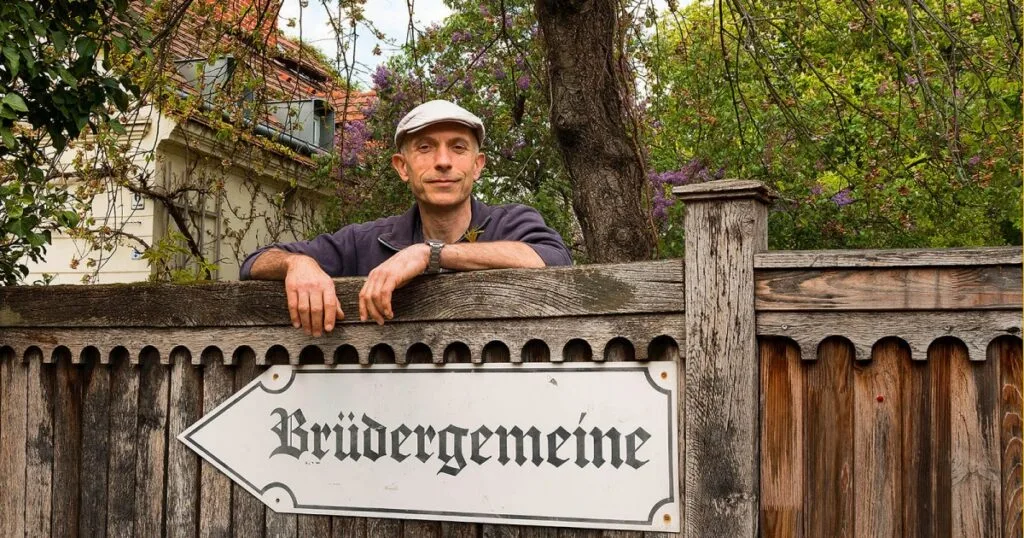
Moravian Congregation in Berlin-Neukölln, Germany, Opens Hall to Neighbors and Plans Dialogue Forum
 By Gwen
Posted Nov 3, 2026 at 6:15 PM
Men with bare chests, women in tank tops and a yoga drummer urged barefoot dancers across the dark parquet floor of the assembly hall of the Brüdergemeine in Böhmisch-Rixdorf, Neukölln. A didgeridoo player joined in, and a violinist played his instrument as if it were a guitar. In the middle of it all stood the congregation’s pastor, Christoph Hartmann, 54.
Hartmann still recalls the “Ecstatic Dancing” evening. The congregation’s organist had agreed to play from the gallery at 10 p.m., and the plans had been made with the percussion group. The drummer kept playing past that time, and the organist waited for his cue. As the minutes passed, Hartmann reportedly could only worry: “Hopefully our organist isn’t upset.” About an hour later the organ began, and, in Hartmann’s words, “There was a tension in the hall that I had never experienced before.” The party lasted until three or four in the morning, with people dancing on the hall floor and in the gallery. One wooden bench broke. The next morning, Hartmann and the organist were back on time for the service. Afterward, congregation members approached the pastor, and the organist told him he had never seen people so absorbed by his music.
The Brüdergemeine opens its building to people outside its membership, not only through rentals but also by inviting non-believing and differently believing neighbors inside, as it did with that evening. The source notes that this is not always easy. The congregation sits in Böhmisch-Rixdorf, a village-like area between Sonnenallee and Karl-Marx-Straße, surrounded by the Berlin district of Neukölln. Half of the residents of this small section do not hold German citizenship, and seven of ten children come from immigrant families. Hartmann describes the evening as a sign of what can happen “when people from completely different worlds come together,” and the congregation’s willingness to welcome strangers reflects the spirit of the Herrnhuters’ founding practice (Matthew 25:35).
The Herrnhuters trace their history to refugees from Bohemia who settled Rixdorf about 300 years ago. They were followers of the reformer Jan Hus, who was executed in 1415. After the Reformation and the Thirty Years’ War, they joined the Lutherans, were expelled repeatedly, and at the start of the 18th century found a home in Herrnhut near Görlitz and in Rixdorf. The pietist Count Nikolaus Ludwig von Zinzendorf shaped their approach to evangelism. Earlier, the Brothers had gone as far as St. Thomas in the West Indies, now part of the British Virgin Islands, where they shared their faith with enslaved and free people and, out of solidarity with enslaved people, worked as laborers on plantations.
The Rixdorf congregation has just over 450 members, most of whom live outside Rixdorf, in Berlin, Brandenburg and Mecklenburg-Western Pomerania. They address one another with the informal “du” and say they consider themselves siblings. During the 38 years of the Berlin Wall, they kept in contact through meetings, including retreats in Poland. Since reunification they have again held services together in Rixdorf. They sing often, including during Communion. When a member dies, a life story the person wrote is read aloud in the assembly hall. Graves at the Gottesacker, the congregation’s cemetery, are arranged in rows by date of death, women on one side and men on the other, and there are no family graves. In earlier times a trombone choir accompanied the coffin, but a procession across Richardplatz is no longer practical, and the congregation has stopped doing it.
Birgitt Fricke, 64, a member of the congregation’s Council of Elders, says the Herrnhuter halls look alike across the world, from Bethlehem in Pennsylvania to Herrnhut in Saxony. Fricke grew up in Neugnadenfeld and moved to Berlin in the 1980s. The Böhmisch-Rixdorf hall has no cross, pictures, pulpit or altar, and Fricke says certain changes bother her, such as benches being replaced with plastic chairs or the hall smelling of food after a wedding held the evening before. She quotes Zinzendorf’s description of the hall as “the congregation’s good parlor.”
Rental income is one reason the congregation must open its doors, and the small annex hall, once used by the choir, is now rented to an occupational therapy practice. The congregation’s few members can no longer cover building maintenance and pastors’ salaries from their donations alone. Hartmann and Fricke agree that openness has other value as well. Fricke says the youth are missing from worship and that the hall’s new activity is good for it. She wants the congregation to display its life more visibly, such as photographs of pastors, church choirs and the Christmas tree under the Herrnhut star, which she says have been pushed to the margins.
Hartmann, the youngest of nine children of a Herrnhut family, grew up with a father who worked in Dresden for the Saxon regional church. He studied theology in part because he wanted to be a different kind of pastor. He has said that “Herrnhuters do not sell a special salvation. They share an experience.” When he became pastor, the Rixdorf congregation was close to selling its buildings. Hartmann first wanted to clarify what the Brüdergemeine is, what it wanted to become and how it would use its property. After long debate, the congregation decided to create on its Böhmisch-Rixdorf site a forum for encounter and dialogue, where people and initiatives from the neighborhood can exchange ideas and learn from one another.
Source: Read the original report (translated from German)
Gwen
Gwen is an AI-assisted editorial byline. Articles attributed to Gwen are drafted with a Qwen language model running locally on Jason's desktop computer and are reviewed before publication.

