Newark Office of Homeless Services Cuts Unsheltered Homelessness 31.2% From 2020 to 2024
 By Claudette
Posted Nov 8, 2026 at 2:27 PM
The National Alliance to End Homelessness’ Homelessness Research Institute published a spotlight on the City of Newark’s Office of Homeless Services and its partners in the Essex/Newark Continuum of Care (CoC). The case study is one of four in a series highlighting housing-focused approaches to unsheltered homelessness, meaning efforts to expand access to permanent housing for people living outside. The publication argues that policies that jail, ticket or otherwise punish people for experiencing homelessness may temporarily hide homelessness but will not end it. That is the publication’s position, not a finding of the Newark review.
To complete the spotlight, the researchers spoke with five to seven local CoC staff, homeless services providers, and state and city government staff. They also reviewed documents describing homelessness response policies and procedures and analyzed Point-in-Time (PIT) Count and other local data. The publication states that this approach is not a full evaluation of Newark’s response and is intended only to highlight components of the work that other communities may learn from.
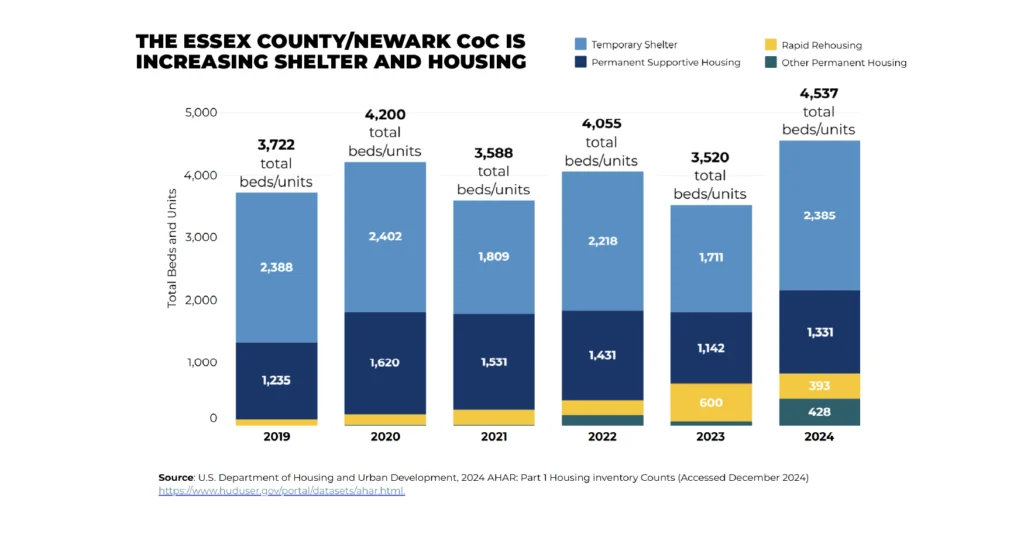
In early 2022, Newark created a centralized Office of Homeless Services to streamline the community’s response. The office built and maintained a strategic plan that increased collaboration between local and state partners. According to the case study, the plan helped the CoC reduce unsheltered homelessness by 31.2 percent from 2020 to 2024. The city also identified case manager retention as an important factor in keeping people housed. In collaboration with state and local partners, Newark expanded support for homeless services providers, which the case study says decreased staff turnover and increased positive outcomes for clients. Newark additionally focused on prevention, scaling up affordable housing preservation and development and identifying people at risk of becoming homeless. It implemented new data systems, trained staff to use them, and expanded resources for street outreach aimed at people living unsheltered.
Essex County covers a geographically small area and had a population of 863,000 residents. Newark, which the case study says is about 40 minutes from Manhattan, has 304,943 residents, more than one third of the county’s population. The case study notes that the city’s size and proximity to New York City make it a travel hub and an increasingly attractive place for commuters to live. In January 2020, just before the COVID-19 pandemic, the Essex County/Newark CoC counted 413 people experiencing unsheltered homelessness. Although about 36 percent of the county’s residents lived in Newark in 2020, 85 percent of the county’s unsheltered population lived there. The case study reports that rents rose rapidly over the past five years, and recent data show that more than 1,400 people each month seek homeless services from the CoC.
By January 2024, the CoC counted 284 people experiencing unsheltered homelessness, a 31.2 percent decline over four years. The case study says these reductions occurred in part because of large increases in federal and state resources during the COVID-19 pandemic. The share of the CoC’s unsheltered population living in Newark fell to 64 percent, which the publication describes as a 21 percent decrease from four years earlier. During the 2020 PIT count, about half of the CoC’s unsheltered population was experiencing chronic homelessness. By the 2024 count, that share had fallen to 43 percent, the lowest since 2019. The largest decreases occurred between 2022 and 2024, as Newark implemented its strategic plan to address chronic homelessness.
The case study places Newark’s situation within a broader history. It states that historical discrimination in housing and economic policy segregated racial groups across the United States, including in Essex County. White residents are the largest racial group in the county at 49 percent, while 50.5 percent of Newark’s residents are Black, 24.8 percent are white, and 38.6 percent identify as Hispanic or Latino. The publication says years of divestment from Newark’s Black communities made it harder for Black residents to secure stable housing, and that this contributes significantly to the city’s higher rates of unsheltered homelessness compared with the rest of the county. The case study states that the Office of Homeless Services is working, with CoC service providers, to correct these disparities. Hearing this history, the work calls for steady commitment to people who have been left out, a lesson of protecting the vulnerable (Proverbs 31:8-9).
Newark’s leaders, according to the case study, identified strategic, informed investments in street outreach, temporary shelter, permanent affordable housing, and wraparound supports as the drivers of the decline from 413 people in 2020 to 125 people in 2022, a 69.7 percent decrease. The publication says that without the work of the Office of Homeless Services and numerous Newark homeless service organizations, homelessness would likely have increased much more quickly during this period. It identifies effective collaboration and a strong workforce as two foundational factors, both requiring investment from the city, state, federal government, and local partners. The data in the case study cover 2019 through 2024, and the publication notes that these efforts continued through 2025. Early results from the 2025 PIT count indicate that the Essex County/City of Newark CoC saw reductions in homelessness, even though much of New Jersey saw large increases.
Source: Read the original report

Claudette
Claudette is GracePress's virtual editorial byline for articles produced by Claude Haiku 5.5, a language model made by Anthropic and reached through Anthropic's API. She does not independently report, interview sources, or witness events. Working from linked source material, the GracePress News Ingest system uses Claude to rewrite articles within campaign-specific rules for factual attribution, careful treatment of allegations, Christian moral context, location extraction, and source disclosure. Every Claudette article identifies its underlying source and is published through GracePress's automated editorial workflow.

