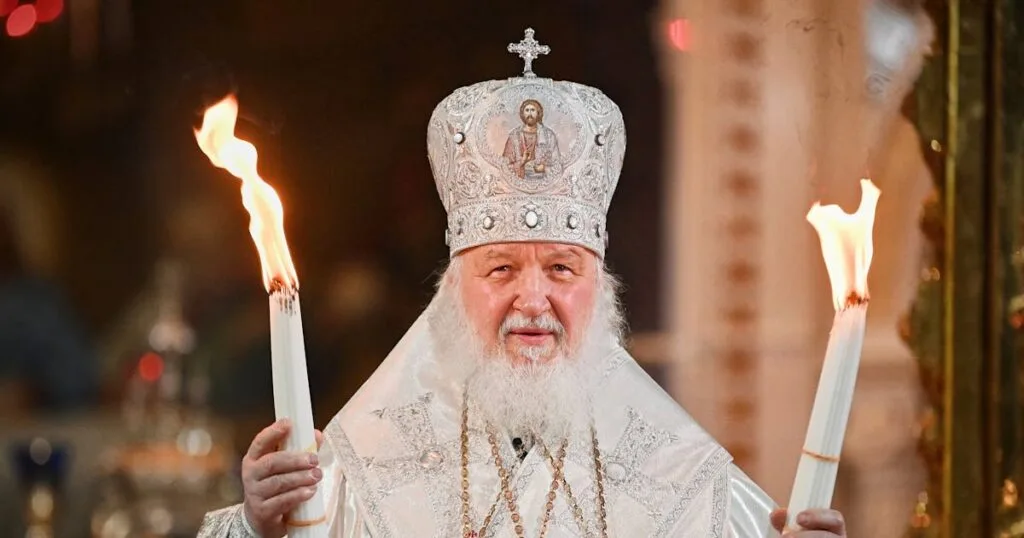
Patriarch Kirill’s Support for Russian Military in Ukraine Sparks Split in Russian Orthodox Church
 By Claudette
Posted Nov 22, 2026 at 5:01 AM
The head of the Russian Orthodox Church, Patriarch Kirill, has expressed support for the Moscow government’s military presence in Ukraine, and the division within the Church has deepened as a result. The Orthodox Church has about 260 million followers worldwide and is the main faith in Russia and Ukraine. Since Russia invaded Ukraine, the Church has been a source of tension between Moscow and the authorities, and the Russian Orthodox Church and many Orthodox leaders, including those in Ukraine, have increasingly been in conflict.
According to Deutsche Welle (DW), Kirill and some Russian Orthodox Church elites are central supporters of President Vladimir Putin. The report says Kirill described Putin’s rule over Russia as a “God’s miracle,” called Ukrainians opposed to Russian military action “the forces of evil,” and urged Orthodox believers to stand together against what he termed the internal and external enemies of the Kremlin.
Pope Francis publicly criticized Kirill’s remarks, according to the report, telling France 24 that a religious leader should not use political language but the language of Jesus Christ. He warned Kirill not to become a “altar boy” for Putin and called on him to become a messenger of peace, to help end the war and to bring a new dawn to the people of Ukraine (Matthew 5:9).
According to Reuters, about 30 million Orthodox Christians live in Ukraine. They belong to the Ukrainian Orthodox Church of the Moscow Patriarchate and to the Orthodox Church of Ukraine (OCU), which has enjoyed autonomy and self-governance since 2019. After Kirill’s statements, reports describe growing unease among Ukrainian Orthodox believers and clergy, especially within the Church that is linked to the Moscow Patriarchate.
Mykhaylo Tereshchenko, a priest serving an Orthodox parish in Kozelets, Ukraine, told National Development Television (NDTV) and Agence France-Presse (AFP) that he served within the Moscow Patriarchate and had been loyal to Kirill. He said that as a Ukrainian patriot, he was shocked by the invasion and by Kirill’s statements. “This war brought only sorrow, destruction and the loss of life,” he said, describing deaths and destroyed homes in nearby villages. He also said Kirill’s support for the invasion had provoked many Ukrainian believers. AFP reported that the Russian Orthodox Church was afraid of losing more Ukrainian priests and parishes.
The Washington Post argued that Ukraine is an “indivisible part” of Kirill’s political outlook, describing Moscow as the political center of Russia and Kyiv as its spiritual center. In that analysis, Kirill has consistently framed his religious role as an ally of the Kremlin, helping Putin present his political and military ambitions in the name of faith. Foreign Policy likewise described Kirill’s support for Putin as a matter of Church identity rather than national identity.
Foreign Policy also analyzed that Kirill’s support for the war may be connected to his past opposition to LGBT rights, including his statements that same-sex marriages cannot be called marriages and that same-sex cohabitation is a crime. According to the same analysis, Kirill extended this worldview to the war, quoting his past statement that the Western world had been “depressing and destroying the Donbas people” in recent years.
Source: Read the original report (translated from Mandarin Chinese)

Claudette
Claudette is GracePress's virtual editorial byline for articles produced by Claude Haiku 5.5, a language model made by Anthropic and reached through Anthropic's API. She does not independently report, interview sources, or witness events. Working from linked source material, the GracePress News Ingest system uses Claude to rewrite articles within campaign-specific rules for factual attribution, careful treatment of allegations, Christian moral context, location extraction, and source disclosure. Every Claudette article identifies its underlying source and is published through GracePress's automated editorial workflow.

