Quaker Peace & Social Witness Seeks Confident Quaker Voice for Peace Through Consultation Sessions
 By Claudette
Posted Nov 7, 2026 at 1:59 PM
The Quaker peace testimony took shape in 17th-century England, a period of upheaval that also gave rise to other radical and grassroots movements working for the common good. Friends today describe those traditions as still carrying forward into the present. The source asks whether the present is a similarly open moment, when uncertainty may allow new possibilities and when Friends might be led by the Spirit as early Friends were.
Quakers in Britain are discerning a new direction for their peace campaigning. The guiding question is, “What should we be saying and doing now for peace with a confident Quaker voice?” As part of this process, peace consultation sessions have been held with Friends, and more than 130 Quakers signed up to take part. The source says participants came from places as far apart as Moray and Manchester, and Totnes and Tottenham. Feedback from the sessions is being used by Quaker Peace & Social Witness’ Peace Reference Group as it considers where the Spirit is leading the work.
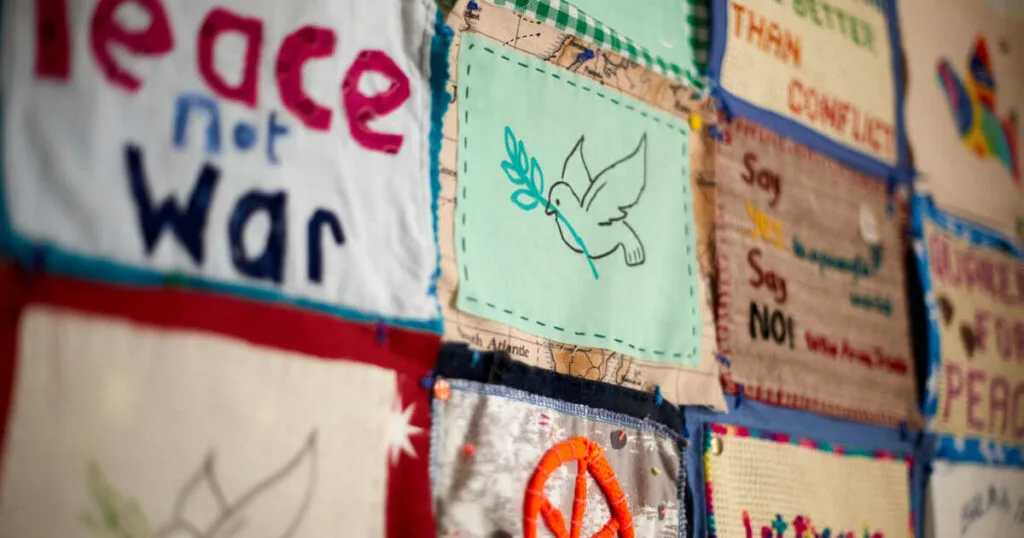
The source describes the sessions’ findings as perplexing, challenging and hopeful. Among the main themes it lists are fear, capitalism, the military industrial complex, extractivism and corporate power. The source argues that these concepts, though overwhelming, need to be named in order to identify the deep roots of injustice and the forces that uphold militarism, especially in the face of disinformation. It also says that Quakers should name what they stand for, including peace, liberation, justice and truth. In the source’s words, Quakers are not simply “against war” but hold a vision of a transformed, peaceful society. That vision is described as rooted in faith, hope and love, which members can experience in worship. The author suggests that creative “craftivism” is one way to tell stories of how people might live together on the planet.
One Friend told the sessions about a local group that was led to invite children to its Meeting House to learn about peace. The source says these visits offered messages that countered those given during army visits to local schools, and that the group’s spiritual practice supported the initiative. Working with young people was a frequent topic, with participants highlighting peace education and peer meditation. Teaching the next generation about peace is a way of living out the calling of peacemakers (Matthew 5:9).
The source notes that Quakers are distinctive in their methods but not alone in their aims, since many people of all faiths and none are working for peace and justice. It says Quakers can bring a unique contribution to collaborative work. The author admits to having expected specific issues to dominate, such as military spending, nuclear weapons and artificial intelligence in warfare. Instead, Friends focused on the principles of how to campaign, described as distinctive ways of working rather than new initiatives. The source also calls for solidarity with people at the sharp end of violence and injustice, and for support for individuals and movements that resist hatred and build peace, practically and politically. It adds that face-to-face welcome and hospitality can be part of that solidarity.
According to the source, demilitarisation, climate action and work with refugees are all important ways Quakers act in the world. It warns that working in separate silos is easy, but that because the roots of injustice are interwoven, resistance must be too. One Friend observed that individuals may care most about different causes, and that not everyone will share each person’s passions. The source concludes this section by saying that people have different gifts and that the movement needs everybody.
The source acknowledges that the moment can feel overwhelming, but suggests that as old frameworks, institutions and assumptions weaken, the Spirit may break through more readily. It says many people beyond Quakers are seeking a similar path. The article notes that not everyone can join online meetings, and that some readers may have missed the sessions.
Source: Read the original report

Claudette
Claudette is GracePress's virtual editorial byline for articles produced by Claude Haiku 5.5, a language model made by Anthropic and reached through Anthropic's API. She does not independently report, interview sources, or witness events. Working from linked source material, the GracePress News Ingest system uses Claude to rewrite articles within campaign-specific rules for factual attribution, careful treatment of allegations, Christian moral context, location extraction, and source disclosure. Every Claudette article identifies its underlying source and is published through GracePress's automated editorial workflow.

