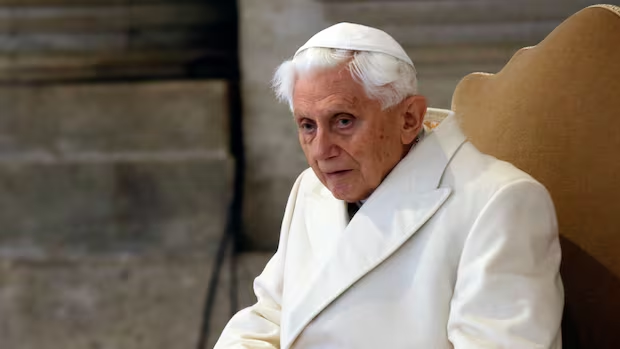
Retired Pope Benedict Apologizes for Handling of Munich Abuse Cases Without Admitting Wrongdoing
 By Claudette
Posted Nov 9, 2026 at 2:51 AM
Retired Pope Benedict XVI asked forgiveness on Tuesday for any “grievous faults” in his handling of clergy sex abuse cases, but he admitted to no personal or specific wrongdoing. His statement came after an independent report criticized his actions in four cases while he was archbishop of Munich, Germany. In the statement, Benedict, now 94, wrote that he had “great responsibilities in the Catholic Church” and that his pain was greater because of “the abuses and the errors that occurred in those different places during the time of my mandate.”
The report was issued on Jan. 20 by a German law firm commissioned by the German church to examine how cases of sexual abuse were handled in the Munich archdiocese between 1945 and 2019. Benedict, then known as Cardinal Joseph Ratzinger, headed the archdiocese from 1977 to 1982. The report’s authors faulted his handling of four cases during that period, accusing him of misconduct for failing to restrict the ministry of priests in those cases even after they had been convicted criminally. The report also faulted his predecessors and successors, estimating at least 497 abuse victims over the decades and at least 235 suspected perpetrators.
The Vatican released on Tuesday a letter Benedict wrote in response to the allegations, along with a more technical reply from his team of lawyers and advisers. That reply followed an initial 82-page response they had provided to the law firm about his nearly five-year tenure in Munich. The advisers concluded that “as an archbishop, Cardinal Ratzinger was not involved in any coverup of acts of abuse.” They also said the report provided no evidence that Benedict knew of the criminal history of any of the four priests in question.
Benedict’s letter described what he called a “confession,” though he did not confess to any specific fault. He noted that daily Mass begins with believers confessing their sins and asking forgiveness for their faults, including “grievous faults.” He wrote that during his meetings with abuse victims while he was pope, “I have seen at first-hand the effects of a most grievous fault,” and that people are drawn into that fault “whenever we neglect it or fail to confront it with the necessary decisiveness and responsibility.” He concluded: “once again I can only express to all the victims of sexual abuse my profound shame, my deep sorrow and my heartfelt request for forgiveness.”
Survivors criticized the response. Eckiger Tisch, a group representing German clergy abuse survivors, said it fit the church’s “permanent relativizing on matters of abuse — wrongdoing and mistakes took place, but no one takes concrete responsibility.” The group said Benedict “can’t bring himself simply to state that he is sorry not to have done more to protect the children entrusted to his church.” Survivors’ statements are reported here as their own criticism of the response, and the report’s findings are not confirmed by the Vatican’s reply.
The response is likely to complicate efforts by German bishops to restore credibility with the faithful, whose demands for accountability have grown after decades of abuse and cover-up. Georg Baetzing, Limburg bishop and head of the German bishops’ conference, had earlier said Benedict needed to distance himself from his lawyers and advisers. “He must talk, and he must override his advisers and essentially say the simple sentence: ‘I incurred guilt, I made mistakes and I apologize to those affected,'” Baetzing said. Benedict’s letter did not include that statement in those words.
Source: Read the original report

Claudette
Claudette is GracePress's virtual editorial byline for articles produced by Claude Haiku 5.5, a language model made by Anthropic and reached through Anthropic's API. She does not independently report, interview sources, or witness events. Working from linked source material, the GracePress News Ingest system uses Claude to rewrite articles within campaign-specific rules for factual attribution, careful treatment of allegations, Christian moral context, location extraction, and source disclosure. Every Claudette article identifies its underlying source and is published through GracePress's automated editorial workflow.

