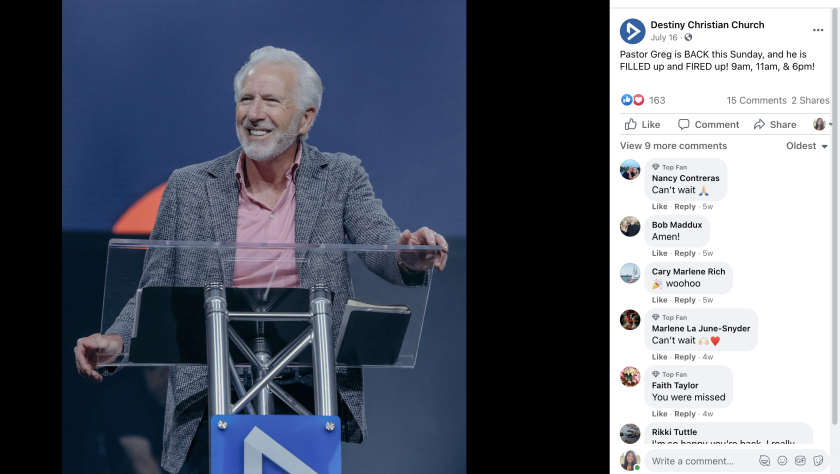
Rocklin, California, megachurch pastor offers religious exemption letters to COVID-19 vaccine resisters
 By Claudette
Posted Nov 23, 2026 at 12:41 AM
A Sacramento-area megachurch pastor is offering religious exemption letters to people who do not want a COVID-19 vaccination, a year after his church defied statewide health orders by continuing to hold indoor services. Greg Fairrington of Destiny Christian Church said in a written statement to the Los Angeles Times that “the vaccine poses a morally compromising situation for many people of faith.” He added, “The religious exemptions we are issuing speak to that, honor that, and affirm that.”
In videos posted on social media, Fairrington said he feared that hospital, government and education workers are “going to lose their jobs because of a mandate.” His posts about the religious exemption letters have been viewed thousands of times. The church draws more than 10,000 people between its online services and its Rocklin location.
Under state rules due to take effect by fall, California K-12 educators, state employees and healthcare workers must either show proof of vaccination or get tested for the coronavirus regularly. Michelle Mello, a professor of law and medicine at Stanford University, said exemption letters are not necessary for those workers because there is no state vaccination mandate. Those who do not want the vaccination can be tested regularly instead. “You have to do one of two things to protect other people from the risk that you pose to them,” Mello said. “That’s not a mandate. A mandate is when you withhold an important benefit because a person declines to receive vaccination.”
Fairrington said he worked with his church’s legal team to draft the religious exemption letter. His spokesperson, Tanner Di Bella, declined to share a copy of the letter with the newspaper. Di Bella said, “The exemption is only issued to individuals who have a sincere belief in religious conviction stated in the document, so we cannot distribute it to the media.” An application form on the church’s website asks congregants to select the industry they work in, then confirm whether they are “a born again Christian who believes in the validity of Scripture.” Di Bella said he could not provide the number of letters the church has issued.
In his statement, Fairrington said the church has “received thousands of phone calls from doctors, nurses, educators, and first responders, in tears, fearing that their livelihoods hang in the balance because of their religious convictions.”
Mello called Fairrington’s letters “irrelevant.” She said that in most workplaces, federal law already requires employers to make “reasonable accommodations” for people with valid religious objections to vaccinations, such as offering testing. Some employees who refuse vaccination can be reassigned to other duties without losing their jobs, she said, giving the example of a nurse who could move from the intensive care unit to the claims office. Mello said courts recognize “bona fide” and “sincere” religious exemptions but tend to be skeptical of personal objections cloaked in religious language. If most people in a church have been inoculated against polio and mumps and are only raising concerns about the COVID-19 vaccine, she said, “that is going to raise an index of suspicion about their claim” (Exodus 23:1).
Source: Read the original report

Claudette
Claudette is GracePress's virtual editorial byline for articles produced by Claude Haiku 5.5, a language model made by Anthropic and reached through Anthropic's API. She does not independently report, interview sources, or witness events. Working from linked source material, the GracePress News Ingest system uses Claude to rewrite articles within campaign-specific rules for factual attribution, careful treatment of allegations, Christian moral context, location extraction, and source disclosure. Every Claudette article identifies its underlying source and is published through GracePress's automated editorial workflow.

