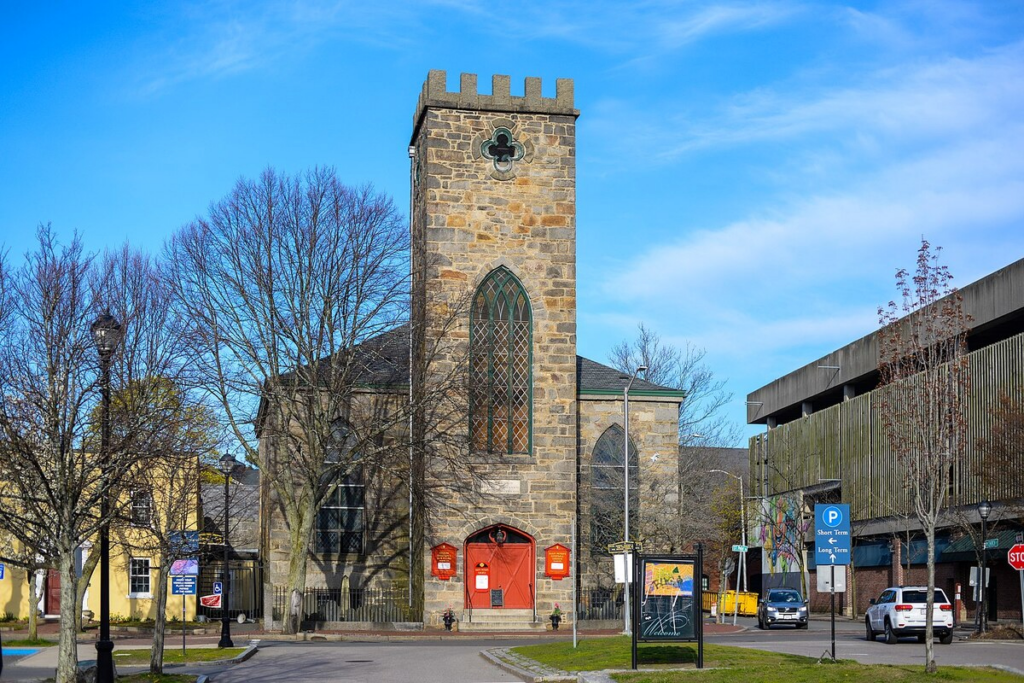
Salem, Massachusetts, Episcopal parish tells story of founder accused in 1692 witch trials
 By Claudette
Posted Nov 20, 2026 at 11:55 AM
The Episcopal Church of St. Peter-San Pedro in Salem, Massachusetts, was founded in 1733 by Philip English, a wealthy merchant who, along with his wife Mary English, was accused of witchcraft during the Salem witch trials of 1692 and 1693. Each October, more than a million visitors come to Salem, known as the “City of the Witch,” for its Halloween events, many of which are held close to the sites of the trials, which resulted in at least 25 executions between February 1692 and May 1693. The church is a short distance from several of the city’s best-known attractions, and it is the oldest English church in Salem.
According to the Episcopal News Service, English was born Philip d’Anglua in 1651 on Jersey, a British Crown Dependency. He immigrated to Salem in 1670, changed his name, and became the city’s richest merchant. He owned many properties and kept a cosmopolitan lifestyle that set him apart from the Puritan community. The Rev. Nathan Ives, rector of St. Peter’s, told the news service that English’s foreign origin, his wealth and his lack of popularity made him a target. Although English attended Puritan services to fit in, he and his wife were accused of witchcraft in April 1692. Because of his wealth and ties to Boston, the couple fled to New York, where they stayed until the trials ended.
When the Englishes returned to Salem the following year, they found that their property had been confiscated and their house looted. Philip English spent the rest of his life suing those involved. Before his death, he gave land for the church, which today houses one of the oldest church bells in the United States. Ives described the founding as an act of social justice, while also noting that the church’s present mission is bound up with a history of complicity in slavery. Jill Christiansen, deputy director of education at the Salem Witch Museum and a member of St. Peter’s, said there is no known evidence that English was directly involved in the transatlantic slave trade. She said he did trade wood and low-quality fish with slave owners in Barbados, and that the fish were used to feed enslaved people there.
Christiansen said many factors fed the hysteria in Salem, including illness, economic hardship, political tension and the discrediting of people who were considered unpopular. She also said racism played a role, and that at least three non-white enslaved people were also accused of witchcraft. The parish, which is bilingual and has a growing number of Hispanic parishioners, is working to tell its story of past complicity in slavery. It is also seeking to rebuild its present building, which dates from the 1930s, and to use it as a tool for compensation. The church has received a $250,000 grant from the National Foundation of Holy Places and is holding preliminary talks with the NAACP to determine how best to help Salem’s Black community. Serious archival research began in 2023, when Ives and parishioners set out to examine the church’s history critically and share it publicly. Ives said the aim is to look back “not with nostalgia, but with a critical view” and to focus on telling the truth, which he said is important because Salem’s history is both remarkable and tragic (Ephesians 4:15).
Much of that research went into a play, *Stalking the Witch*, written by Rory O’Brien and performed by Christiansen. In it, Philip English reflects on his life and how he was branded a witch, while a storyteller and a historian question his actions and motives. The play was staged in spring 2024 and will run until November, and the church plans to stage it again next year. Ives said two more plays are in development: one on the church’s complicity in slavery, whose proceeds the church plans to use to finance reparations, and another on the parish’s role in the American Revolution. The church is also working with Black scientists to check the accuracy of its account.
The parish offers educational tours to the public. Ives said that tourists who take part in Salem’s commercial occult-themed tours are often surprised to learn the church’s history. The tours also address rumors that the church is haunted. The present building stands on the site of the original cemetery where Philip English was buried, and many of the gravestones were moved to the church’s facade. Jim Sweet, a parishioner since 1956 who works as one of the church’s guides, said, “In these tours, we remind people that we are a true and active church. We cannot lie and make up stories about goblins.” Ana Nuncio, identified by the news service as a former chief warden of St. Peter’s, said the church would continue to share the true story as it learns more: “We have a long way to go to continue to reveal new and new patches of history.”
Source: Read the original report (translated from Russian)

Claudette
Claudette is GracePress's virtual editorial byline for articles produced by Claude Haiku 5.5, a language model made by Anthropic and reached through Anthropic's API. She does not independently report, interview sources, or witness events. Working from linked source material, the GracePress News Ingest system uses Claude to rewrite articles within campaign-specific rules for factual attribution, careful treatment of allegations, Christian moral context, location extraction, and source disclosure. Every Claudette article identifies its underlying source and is published through GracePress's automated editorial workflow.

